
The Labour Architecture: Redesigning Work for the AI Age
The complete Labour Architecture framework. Four Labours, Seven-Layer Human Capability Stack, Five Roles for the AI Age, the Accountability Gap, and why the current education system produces the wrong type of human for the era we are entering.
The Labour Architecture: Redesigning Work for the AI Age
C4AIL Whitepaper II
Status: Working draft — canon-consolidated (June 2026) Date: 20 March 2026 · revised 28 June 2026 (added §1.7 Epistemic Labourthe value-bearing work of *knowing*: reading what AI output means, catching fluent-but-hollow answers. Delegable (answers to reality); accountability is *owning* (non-delegable, answers to…See full entry →, §1.8 Squeezed MiddleAI hollows the journeyman tier where substrate is built (the "barbell": gains at floor and ceiling, squeeze in the middle); no juniors today, no seniors in five years.See full entry →, §1.9 ConcretisationAI's core economic act: making tacit substrate explicit, proprietary, and scalable. Concretise your own = a moat; depend on generic = erosion.See full entry →; Institutional Vaultthe org's codified, executable knowledge store (processes, records, prompts, pipelines) - surface made durable. The three-way line: Holding (frees judgment), Executing codified rules (the…See full entry → integration) Publisher: AI Guildhall (ai-guildhall.org) — the C4AIL practitioner community Author: Ethan Seow (C4AIL)
Public executive summary: docs/whitepaper-ii-exec-summary-public.md — narrative version (~2,600 words) for external distribution.
Relationship to Whitepaper I (“The Sovereign Choice”): The first whitepaper defines what AI-ready organisations look like — maturity levels, the Four Pillars (ARGSAgency (the decision to engage/interrogate, an environment you build), Architecture (Logic Pipes + clean data), Governance (the accelerator, not the brake), Scaling (decoupling output from…See full entry →), the Orchestrator role, the FloorFloor = the 90-95% who work through AI (mass literacy, 3-6 months); Ceiling = the 5-10% who design and govern AI: Architects, Orchestrators, Trainers (years).See full entry →/Ceiling model. This second whitepaper answers the question that every CHRO, COO, and board member asks next: “How do I actually restructure my workforce to get there?” — and surfaces a deeper problem: the education and training systems that produce today’s workforce are designed for a labour category that AI is commoditising.
Executive Summary
The Scale
Ninety-five per cent of organisations see zero measurable P&L return from generative AI (MIT Project NANDA, The GenAI Divide, 2025). The failure is never technology. It is always people and process. US firms spent $40 billion on AI in 2024; 95% failed to achieve substantial financial gains (MIT Sloan Management Review / BCG, 2025-2026). The reskilling gap costs the US economy $1.1 trillion annually (Pearson/Faethm, January 2025). Eighty-two per cent of employees have received no AI training at work (Deloitte, 2025). Fifty-seven per cent of US work hours are now automatable with current technology (McKinsey, November 2025). The World Economic Forum projects 92 million roles displaced and 170 million created by 2030. The jobs are not disappearing. They are changing category. And the workforce was not built for the new category.
The Pipeline Collapse
The most dangerous statistic is not about jobs automated. It is about jobs no longer offered. Two-thirds of global enterprises are reducing entry-level hiring (IDC/Deel, November 2025). Entry-level job postings have declined 35% across all sectors since January 2023 (Revelio Labs), with Stanford’s Digital Economy Lab finding a 13-16% relative decline in early-career employment specifically in AI-exposed fields. In the UK, graduate hiring fell 8% overall in 2024 (Institute of Student Employers). Junior headcount declines 7.7% relative to non-adopting firms within six quarters of GenAI adoption (Harvard — Hosseini and Lichtinger). The junior work — drafting, research, analysis — was never just productivity. It was the apprenticeship. It was where professionals built the pattern recognition, graduated autonomy, and consequential judgment that separated “follows instructions” from “signs the document.” That pipeline is being hollowed out at exactly the moment demand for its output is surging. When two-thirds of enterprises are cutting the entry-level pipeline in 2024–2026, the result is a generation gap in leadership capacity by 2031–2036.
The L&D profession has operated for forty years on the 70-20-10 model (McCall, Lombardo, Morrison, CCL 1988): 70% of professional development comes from challenging on-the-job experience, 20% from developmental relationships, 10% from formal training. The ratios are approximate, but the underlying principle is one of the most robustly validated findings in adult learning research — confirmed independently by transfer-of-training meta-analyses (Baldwin & Ford, Blume et al.), workplace learning research (Eraut), situated learning theory (Lave & Wenger), and skill acquisition models (Dreyfus). AI selectively destroys the 70% (the experiential component is automated), degrades the 20% (mentoring loses its shared-task context), and leaves only the 10% intact — the one component that has an 85-90% transfer failure rate on its own. The surviving component is the one that is insufficient. The mechanism through which professional judgment has been produced for centuries is being hollowed out, and the only response most organisations know is to double down on the 10% — more courses, more certifications — because it is the only lever the system knows how to pull.
The Framework: Four Labours, Seven Layers
Work is not one thing. It is four labour types — Intellectual (commoditised: strategy, synthesis, coding, writing), Physical (converging: robotics following intellectual automation on a 2–3 year lag), Accountability (the only durable human monopoly: judgment, oversight, ownership under uncertainty), and Architectural (the growth category: building the systems through which AI operates). Every workforce initiative that fails does so because it intervenes at a single layer of a seven-layer system — the Human Capability Stackseven layers of workforce capability: Psychological Foundation, Skills Architecture, Labour Types, Credentialing, Organisational Architecture, Education & Development, Economy & Policy.…See full entry → — without understanding the layers above and below.
The Stack runs from Psychological Foundation (Layer 1) through Skills Architecture (Layer 2), Labour Types (Layer 3), Credentialing (Layer 4), Organisational Architecture (Layer 5), Education & Development Systems (Layer 6), to Economy & Policy (Layer 7). Each layer depends on the one below. AI enters at Layer 2 — commoditising technical microskills — and the disruption propagates upward through every layer: skills commoditised → intellectual labour hollowed out → existing credentials lose signalling value → organisations cannot staff new roles → education systems respond by producing more of the commoditised category → policy subsidises more of the same. And critically downward: AI removes the junior work that was the training ground for Layer 1, destroying the developmental pipeline for the next generation.
The contribution of this paper is vertical integration — connecting all seven layers into a single coherent model with a diagnostic that explains why 95% of interventions fail.
The Accountability Gap
The education system is a factory running the wrong processes. It produces intellectual labourers: people trained to receive knowledge, apply rules, and generate output on command. This is the one labour type being commoditised fastest. Meanwhile, accountability labour — the capacity for judgment, oversight, and ownership under uncertainty — has no formal production line. The factory has no process for it.
The factory model replaced the guild system’s accountability mechanisms — graduated autonomy, consequential practice, the masterpiece, community of mutual obligation — without seeing what it was discarding. The evidence is structural: every country that destroyed its guild infrastructure (UK, US, most of Asia) has failed to rebuild it through policy alone. Every country that retained mandatory intermediary bodies (Germany’s IHK/HWK chambers, Switzerland’s social partnership, Austria’s WKO) has structurally lower youth unemployment — Germany 5.9%, Switzerland 7.9%, Austria 11.0%, versus UK 13.3%, US 7.9%, South Korea 7.5% (Eurostat/OECD, 2023). The barrier is institutional architecture, not training volume or policy ambition.
What Differentiates Humans from AI
AI is a one-dimensional machine. It has mastered the Syntax layer — pattern-matching on language and structure — to a degree indistinguishable from human output. But it possesses zero capability in the remaining four knowledge layers defined in Whitepaper I: Contextual (presence-dependent environmental reading), Institutional (politically navigated organisational knowledge), Deductive (first-principles reasoning grounded in felt experience), and Experiential (embodied pattern recognition from consequential practice). The factory model trains humans on the same single dimension AI has mastered.
This paper introduces a novel mapping: each knowledge layerthe codified expert-knowledge specifications an Architect builds (operationally, the Institutional Vault); lets a task reduce from a paragraph of context to one sentence.See full entry → requires a corresponding developmental stage to activate — Experiential requires Body (somatic presence) and Feel (emotional registration), Deductive requires Think grounded through Accept (holding discomfort without collapsing), Institutional requires community and co-creation, Contextual requires physical presence. The Body → Feel → Accept → Think → Choose developmental sequence is not a pedagogical preference. It is the activation sequence for multi-dimensional human capability. The factory inverts it — delivering content straight to Think, bypassing Body, Feel, and Accept entirely. The result: approximately 58% of adults have not reached the developmental stage (Kegan Stage 4, Self-Authoring) required for independent accountability (Kegan, 1994, In Over Our Heads, pp. 191-195, composite of ~282 Subject-Object Interviews; refined to 58% in Kegan & Lahey, 2009, Immunity to Change, p. 28). This estimate derives from a predominantly middle-class, college-educated US sample — Kegan notes the general population figure may be higher. Not because they lack intelligence. Because the meaning-making structure was never built.
From Reception to Creation
The argument between “more STEM” and “more humanities” is an argument about what to deposit into students. It misses the point. The foundational change is from reception to creationthe foundational education change AI demands; the "missing verb" that develops accountability.See full entry →. The counter-examples that work — Montessori, problem-based learning, cooperative education, apprenticeship — all share one feature the factory model lacks: students create, put their names on it, and live with the result. Creation develops taste — the everyday word for what Aristotle called phronesisthe felt sense of quality (practical wisdom) that separates the competent from the accountable; AI has episteme and techne but no phronesis.See full entry → (practical wisdom). AI commoditises episteme (theoretical knowledge) and techne (craft skill), but phronesis cannot develop without going through them experientially. Taste is the human premiumSee full entry → AI cannot replicate, because AI has no relationship to consequences. Co-creation — making alongside others who hold you accountable — adds the dimension that transforms individual taste into professional judgment.
From Execution to Intent
The common media narrative — that AI turns professionals into “checkers” and “validators” — is wrong. Checking is still reception. The actual shift is from producing the output to setting the intent: deciding what the machine must achieve, defining the standard, owning the outcome. The surgeon’s value was never in the cutting — it was in the judgment that determined where to cut, when to stop, and what to do when things go wrong. AI unbundles production from judgment. The production goes to the machine. The judgment — informed by all five knowledge layers — stays with the human.
What Comes Next
This paper is a diagnostic. It identifies the problem, names the architecture, and establishes the design constraints that any organisational response must satisfy. The organisational response itself — how to redesign roles, pipelines, HR systems, and implementation roadmaps — will be addressed in Whitepaper III: The Organisational Response, drawing on the broad principles established across both key whitepapers (The Sovereign Choice and The Labour Architecture) and applying them through a framework customised to each organisation’s maturity level, sector, and institutional context. The Philippines IT-BPM sector — 1.9 million workers, $40 billion in revenue, built entirely on intellectual labour now being commoditised — provides the case study for services economy transformation.
Honest Limitations
This paper is a theoretical framework supported by existing research, not an empirical study. The creation-to-accountability link has no controlled study. The multi-dimensional mapping is a novel theoretical claim, not an empirical finding. The “durable human monopoly” assumption depends on current AI architecture — if embodied AI develops persistent memory and consequence-tracking, the boundary shifts. AI-driven automation disproportionately exposes female-dominated occupations (ILO: 3:1 ratio). Implementation in unionised environments requires organised labour as a design partner. Anyone promising faster transformation is selling courses, not building capability.
The Deeper Problem
Underneath all of it sits a developmental reality that no organisational redesign can bypass. AI is a one-dimensional machine. The factory produces one-dimensional humans. Accountability requires all five dimensions active simultaneously, built through a developmental sequence the factory inverts. This is not a Western insight. Cross-civilisational analysis reveals that independent traditions across four continents arrived at the same conclusion: accountability is developmental, sequential, experiential, and cannot be compressed into information transfer. Wang Yangming’s 知行合一 (knowledge and action are one), the Confucian 修身齐家治国平天下 (cultivate self before governing), the Japanese 守破離 (follow → break → transcend), the Hindu ashrama system (staged accountability across a lifetime), the Sufi distinction between dhawq (tasting) and ‘ilm (study), the Zen koan as anti-credentialing technology — all converge on the same principle the factory model violates. And every institution that has attempted to scale the interior — guilds, universities, professional bodies, religious institutions — has followed the same six-phase corruption arc: living teaching → necessary structure → institutional capture → interior dropped → corruption complete → resistant forms emerge. The question is not which institutional form to choose. The question is: what are the design principles for institutions that produce accountability and resist their own corruption? Human agency is both the output and the immune system.
The education system the AI age requires is one that produces creators, not receivers — people who make things, put their names on them, submit them to community judgment, and develop taste through the accumulated experience of consequential creation. The developmental target is not “knows things” (episteme), not “can do things” (techne), but “makes things you’d trust” (phronesis). The path there runs through creation, not reception.
Part I: The Diagnosis — Why 95% of AI Workforce Initiatives Fail
1.1 The Scale of the Transformation
The numbers are no longer speculative.
The World Economic Forum’s Future of Jobs Report (January 2025) projects 92 million roles displaced and 170 million created by 2030 — a net gain of 78 million jobs, but 22% of today’s jobs undergoing structural transformation. McKinsey’s November 2025 analysis found that 57% of US work hours are now automatable with current technology — up from 30% just two years earlier. Goldman Sachs estimates 300 million jobs globally exposed to generative AI. The ILO puts it at one in four workers worldwide with meaningful GenAI exposure.
These are not future projections. They describe current capability. What varies is deployment speed — and that speed is accelerating. Demand for AI fluency in job postings grew 7x between 2023 and 2025 (McKinsey). Workforce AI access grew from under 40% to 60% in a single year (Deloitte, January 2026). Skills in AI-exposed roles are changing 66% faster than in other roles (PwC, 2025). The WEF estimates that 59% of the global workforce — nearly 2 billion people — needs reskilling by 2030.
The labour market response is already visible. PwC cut 5,600 roles globally while investing $1.5 billion in AI. Baker McKenzie is eliminating 600-1,000 business services positions. Salesforce customer service went from 9,000 to 5,000 staff. Klarna is targeting a reduction from 5,500 to 2,000. Citigroup estimates that 54% of all banking roles have high AI displacement potential, with global banks expected to cut 200,000 jobs over 2025-2030 (Bloomberg Intelligence). Challenger, Gray & Christmas tracked approximately 55,000 AI-linked US layoffs in 2025.
But the pattern is not job destruction. It is labour type substitution. Every intellectual role automated creates demand for architectural and accountability roles. The organisations cutting headcount are simultaneously hiring for positions that did not exist two years ago. BCG’s February 2026 analysis found that AI transformation value follows a 10/20/70 split: 10% from algorithms, 20% from technology infrastructure, and 70% from people — upskilling and workflow redesign. Bain projects a US AI talent gap of 700,000 workers by 2027. Germany could see 70% of AI roles unfilled. The jobs are not disappearing. They are changing category. And the workforce was not built for the new category.
1.2 The Pipeline Is Collapsing
The most dangerous statistic is not about the jobs being automated. It is about the jobs that are no longer being offered.
Two-thirds of global enterprises are reducing entry-level hiring due to AI (IDC/Deel, November 2025). Entry-level job postings have declined 35% across all sectors since January 2023 (Revelio Labs). In the UK, graduate hiring fell 8% overall in 2024, with 46% of employers restructuring recruitment processes in response to AI (Institute of Student Employers, 2025). Goldman Sachs found that unemployment for 20-30 year olds in tech-exposed occupations rose 3 percentage points — four times the national average. Stanford’s Digital Economy Lab found a 13-16% relative decline in early-career employment in AI-exposed fields, with the steepest drops in roles most susceptible to automation. Software developer employment ages 22-25 declined approximately 20% from peak, while ages 35-49 increased 9%.
A Harvard study (Hosseini and Lichtinger, “Generative AI as Seniority-Biased Technological Change”) confirmed the mechanism: when companies adopt GenAI, junior headcount declines 7.7% relative to non-adopting firms within six quarters. Industry observers have captured the structural reality: “Plenty of seniors at the top, AI doing the grunt work at the bottom, very few juniors learning the craft in between.”
This is not a recession. This is a structural elimination of the training ground. The junior work — drafting, research, analysis, data processing — was never just productivity. It was the apprenticeship. It was where professionals built pattern recognition, earned graduated autonomy, and crossed the threshold from “follows instructions” to “makes judgment calls.” That pipeline is being hollowed out at exactly the moment demand for its output — people capable of judgment, oversight, and accountability — is surging.
When two-thirds of enterprises are cutting the entry-level pipeline in 2024-2026, the result is a generation gap in leadership capacity by 2031-2036.
1.3 The Factory With the Wrong Processes
Organisations that combine workflow redesign with human capability development see 25-30% productivity gains. Those that only deploy tools see 10-15% (Bain, 2025). MIT’s Project NANDA reports that 95% of organisations see zero measurable P&L return from generative AI (The GenAI Divide, 2025) — and the failure is always people and process, never technology. The Section AI Proficiency Report finds that 85% of the workforce has zero AI use cases driving business value. Eighty-two percent of employees have received no training on generative AI at work (Deloitte, 2025). Only 5% of organisations have reaped substantial financial gains from AI (BCG, February 2026).
The gap is not about the AI. It is about the labour architecture — the practical design of jobs, roles, teams, and human systems around AI. And underneath the labour architecture sits a deeper problem.
The education system — from primary school through university through professional development — is a factory. It has been a factory since it was designed for the industrial revolution’s 80/20 labour split. But it is a factory running the wrong processes and producing products of the past. It produces intellectual labourers: people trained to receive knowledge, apply rules, and generate output on command. This is the one labour type being commoditised fastest. Meanwhile, the labour type growing fastest — accountability, the capacity for judgment, oversight, and ownership under uncertainty — has no formal production line. The factory has no process for it. And the informal training ground that historically produced it — apprenticeship, supervised junior work, graduated autonomy, the slow accumulation of consequential decisions — is being destroyed by AI itself.
The reskilling gap costs the US economy $1.1 trillion annually (Pearson/Faethm, January 2025). Closing it could boost global GDP by $6.5 trillion by 2030 (WEF). But closing it with more courses — more intellectual labour production — accelerates the wrong cycle. The factory needs new processes, not a faster assembly line.
This is a pedagogical crisis — the factory that produces the workforce is running processes designed for a labour market that no longer exists. This whitepaper diagnoses the crisis, names the architecture that connects seven layers of failure, and establishes the design constraints that any organisational response must satisfy.
1.4 The Human Capability Stack — Why Piecemeal Solutions Fail
Every failed workforce initiative intervenes at a single layer of a system that spans seven. Tools-only deployments target the skills layer but ignore the labour types those skills serve. Reskilling programmes target the credentialing layer but certify the wrong microskill domain. Organisational redesigns target roles but ignore the psychological foundation that determines whether people can actually fill them. Policy interventions target the economy layer but have no model of how capability develops in individuals.
The full system — from individual psychology to national workforce strategy — is a stack. Each layer depends on the one below it. Intervening at a single layer without understanding the stack is why 95% of initiatives fail.
The Human Capability Stack:
| Layer | Domain | What It Contains |
|---|---|---|
| 7 | Economy & Policy | National workforce strategy, subsidies, industry transformation maps (SkillsFuture, ILO frameworks, ASEAN workforce policy) |
| 6 | Education & Development Systems | How capability is developed at scale. The banking model produces intellectual labour. Apprenticeship and the ZPD produce accountability. The factory model produces compliance. Engaged pedagogy produces agency. |
| 5 | Organisational Architecture | How roles and teams are structured. Floor (L0-2) / Ceiling (L3-6). Role design across all four labour types. The ARGS pillars. |
| 4 | Credentialing | How competence is certified and recognised. WSQ/NVQ/AQF certify technical skills only. Degrees certify episteme. Professional licensing certifies accountability. C4AIL L0-6 certifies all three domains. |
| 3 | Labour Types | What the work IS — the nature of the demand. Intellectual. Physical. Accountability. Architectural. |
| 2 | Skills Architecture | What a person can actually do — the supply of capability. Microskills (atomic) → Skills (compiled clusters) → Job Roles (integrated sets). Three domains: Technical, Emotional, Accountability. |
| 1 | Psychological Foundation | Who the person is and how they decide. The Body → Feel → Accept → Think → Choose developmental sequence. Emotional maturity. Values and frame direction. The decision pipeline. |
1.5 How AI Disruption Propagates Through the Stack
AI enters at Layer 2. It commoditises technical microskills — the atomic units of intellectual labour. A language model that can draft a contract, analyse a dataset, or write a report is replacing the smallest teachable units of professional work. But the disruption does not stop there. It propagates upward through every layer:
Layer 2 → Layer 3: Technical microskills commoditised → intellectual labour hollowed out → demand shifts to accountability and architectural labour. The layoffs documented in 1.1 are not job destruction — they are labour type substitution. Every organisation cutting intellectual headcount is simultaneously hiring for roles that did not exist two years ago: AI governance leads, verification architects, human-AI workflow designers. The headcount shifts. The labour type shifts with it.
Layer 3 → Layer 4: Labour demand shifts → existing credentials (which certify technical skills) lose signalling value → certificate inflation → employers cannot identify who is actually capable. A bootcamp certificate in “AI for Business” certifies intellectual labour competence. The employer needs accountability competence. The credential does not signal what matters.
Layer 4 → Layer 5: Credentialing fails → organisations cannot staff the new roles (Architect, Orchestrator) → organisational redesigns stall at the PowerPoint stage. The roles exist on paper. The people who can fill them do not exist in the pipeline.
Layer 5 → Layer 6: Organisations demand “more training” → education systems produce more intellectual labourers (the commoditised category) → the accountability gap widens. The system responds to demand for accountability by producing more of the thing AI is replacing.
Layer 6 → Layer 7: Education failure → policy responds with more subsidies for more courses → the cycle accelerates. SkillsFuture credits fund more AI upskilling courses. The courses produce more intellectual labourers. The cycle continues.
And critically, downward:
Layer 2 → Layer 1: AI removes the junior work that was the training ground for accountability. The pipeline collapseeliminating entry-level work that was the apprenticeship, producing a leadership-capacity gap by 2031-2036.See full entry → documented in 1.2 — two-thirds of enterprises cutting entry-level hiring, the hollowed-out junior ranks — is not just a labour market problem. It is a developmental problem. Vygotsky’s Zone of Proximal Development collapses → the pipeline that produced emotionally mature, judgment-capable professionals is destroyed → Layer 1 capacity degrades for the next generation.
The contribution of this whitepaper is vertical integration — connecting all seven layers into a single coherent model. The Four Labourswork decomposed by the human it requires: Intellectual (weightless, commoditised by AI), Physical (atom-bound, lags), Accountability (presence-bound, the durable monopoly), Architectural…See full entry → (Layer 3) explain what is changing. The Skills Architecture (Layer 2) explains how capability is built and where AI disrupts it. The Accountability Gap (Layer 6) explains why education systems produce the wrong output. The Organisational Architecture (Layer 5) shows how roles must be restructured around all four labour types. And the Psychological Foundation (Layer 1) explains why none of it works unless you start with the human.
The rest of this paper walks the stack from bottom to top.
1.6 Substrate and Surface — The Internal Structure of Professional Capability


Before walking the stack, one more decomposition is required. The seven layers describe the architecture of capability. But within any single professional — within any one role, any one decision, any one act of judgment — capability has an internal structure that the stack diagram cannot show. Missing this structure is the single most consistent source of failure in AI transition planning, and every framing later in this paper (and across the C4AIL paper stack) rests on it.
The distinction is between substrate and surface.
Substratetacit domain knowledge, accountability experience, mental representations, peer-calibrated judgment; built slowly through consequential practice, transfers across tool eras, cannot be…See full entry → is what a professional has built up over years that cannot be written down, downloaded, or installed. It includes:
- Tacit domain knowledge — the pattern library a practitioner accumulates through exposure to thousands of cases. Polanyi (1966) called this “we can know more than we can tell.” A senior radiologist sees a scan and knows something is wrong before they can articulate what triggered the recognition. A senior litigator reads a contract and knows where the risk sits. The knowledge is real, testable, and consequential — and largely unspeakable.
- Accountability experience — the internalised sense of what it feels like to own a decision that goes wrong, and what that taught the practitioner about how to weigh the next one. This is not conveyed through case studies. It is built by having carried consequences.
- Mental representations — Ericsson’s (1993, 2006) central finding. Experts do not think faster than novices; they think with different internal structures. Chase and Simon’s (1973) chess studies showed that masters perceive board positions as chunks of meaningful pattern, not as arrangements of pieces. Chi’s (1981, 1988) expert-novice transfer research showed the same in physics: experts categorise problems by deep structure, novices by surface features. These representations are the substrate.
- Peer-calibrated judgment — the taste and standards that emerge from working alongside other practitioners whose judgment you trust, being corrected by them, and learning where the edge cases sit. This is what communities of practice produce. It cannot be self-generated.
Substrate develops slowly. It is the product of deliberate practice, consequential work, peer calibration, and time — and it cannot be bought in. The strategy literature has long held that the dynamic capabilities that distinguish a firm “cannot (and should not) be outsourced” (Teece, Pisano and Shuen, 1997), because the capacity to absorb new knowledge is itself a path-dependent product of prior investment (Cohen and Levinthal, 1990): an organisation either builds substrate or forgoes the ability to. It is also substrate-independentthe property that substrate transfers from one tool era to the next even as the surface changes.See full entry → in the sense that matters most for the AI transition: the substrate a senior practitioner built in one tool era transfers to the next. A radiologist who built their pattern library on film still has the pattern library when the images move to a screen. A litigator who built their judgment drafting by hand still has the judgment when the drafting moves to a word processor. The surface changed. The substrate did not.
Surface is everything that sits on top of substrate and is visible from the outside. Tools, interfaces, workflows, document templates, software platforms, vocabulary, the current generation of frameworks and standards. Surface is what a new hire learns in their first three months. Surface is what a training course teaches. Surface is what changes when a new system rolls out. Surface is fast to learn, fast to forget, fast to replace — and, critically, useless without substrate. A junior who has learned the surface of a tool but has no substrate cannot tell when the tool’s output is wrong. A senior with substrate but no exposure to the surface can pick the surface up in weeks.
How AI enters the stack: at the surface. Generative AI is a new surface layer over existing substrate domains. It changes how drafting happens, how research happens, how code gets written, how reports get assembled. It does not, by itself, change what a good draft, a sound argument, a safe piece of code, or a trustworthy report is. Those standards live in the substrate of the practitioners who built them. Which is why the AI transition has two very different populations with very different problems:
- Novices — people who are being taught the surface (how to prompt, how to use the tools) while the substrate is silently assumed. The assumption is wrong. Without substrate, they cannot evaluate the AI’s output, cannot catch the errors, cannot hold the accountability. This is the 95%-of-AI-initiatives-fail population: organisations buying surface training for people who do not have the substrate the surface sits on, and then wondering why the initiatives do not produce the promised outcomes.
- Domain experts — people who have decades of substrate in their field and are being asked to adopt a new surface layer over it. Their substrate transfers; their surface does not. The industry routinely assumes the opposite — that their expertise is obsolete and they need to “reskill from scratch” — and wastes the transferable asset while trying to rebuild it.
The confusion between substrate and surface is what produces almost every miscalibrated decision in the AI transition: training budgets aimed at surface when the gap is substrate, hiring filters aimed at surface tokens (which AI tools someone has used) when the need is substrate, reskilling programmes that assume substrate is built in three months because surface is, developmental timelines that assume domain experts need the same years that novices need, accountability structures that assume whoever operates the surface carries the substrate to stand behind the output.
This distinction threads through every framing in this paper and the ones that follow it:
- The Four Labours (§2) are substrate categories. Intellectual, Physical, Accountability, and Architectural Labour are not tool categories or task lists — they are the different kinds of substrate a professional develops and is accountable for.
- The Accountability Gap (§3) is a substrate problemthe AI transition is fundamentally about substrate, but industry treats it as a surface problem; why ~95% of initiatives fail.See full entry →. The gap is not that organisations lack people who can operate the tools; it is that they lack people who have the substrate to stand behind what the tools produce.
- The 70-20-10 collapse (§1.2) is a substrate supply crisis. The collapsing junior tier is where substrate was being built. Removing it removes the pipeline.
- The Identity Crisis (§4) is what happens when a professional whose identity is fused to a specific surface watches that surface get replaced, without recognising that their substrate — the part of them that actually matters — is still there.
- The Forge (Whitepaper V) is substrate-development infrastructure — the replacement for the master-apprentice chain that historically produced substrate and is no longer functioning at scale.
- The Full Stackthe total infrastructure substrate development requires (educational + community + meaning layers); C4AIL owns "roughly a quarter" (the educational, high-leverage slice).See full entry → (Whitepaper VI) is the infrastructure required for substrate to develop at all: educational containers that build it, communities that calibrate it, meaning structures that make the multi-year investment rational, and economic conditions that reward it rather than commoditising it.
- The Guildhall (WP7) is the operational delivery vehicle for substrate development and — critically — substrate porting: helping mid-career domain experts carry their existing substrate across into the AI-augmented version of their work in months rather than years, because the substrate is already there.
The operative claim of this paper, and the one the rest of the C4AIL stack rests on: professional capability is indexed on substrate, not surface. The AI transition is a substrate problem. The industry is treating it as a surface problem. That is why 95% of initiatives fail.
1.7 Epistemic Labour — The Work AI Makes Scarce
§1.6 established that capability is indexed on substrate. The AI transition does not act on that substrate evenly, and to see how, we have to name the work it makes scarce. As AI commoditises the production of work — the intellectual labour of drafting, coding, analysing — the value-bearing human contribution shifts to a different kind of work: epistemic labour, the labour of knowing. Not the narrow check of whether a fact is right, but the fuller act of reading what the output actually means, weighing its nuance, catching the place where fluent words carry less than they seem to, and supplying the meaning the model’s surface cannot. Fact-verification is only its visible tip; most of epistemic labour is interpretive — the engagement of the deeper knowledge layers against AI’s single-layer fluency. It is not a tool skill, and AI cannot do it for you.
Epistemic labour sits at a precise point in a stack, and naming it resolves an old puzzle. Beneath it are the precursors: the contextual, institutional, deductive and experiential knowledge layers, the emotional labour that lets a practitioner register a feeling as information, the substrate accumulated over years — everything a person has. Above it is accountability: owning the result, staking your name, defending the decision after it fails — everything a person carries. Both ends were already named. What had no name was the act between them — the engaging of what you know to actually know this — and that act is the difference between having capability and exercising it. Knowledge is not capability; knowledge engaged is. Epistemic labour also separates cleanly from accountability: it is knowing (it answers to reality, and it is delegable — a peer or an auditor can do the knowing for you); accountability is owning (it answers to others, and it cannot be delegated — no one can be on the hook in your place). In a master the two are fused, known and owned in a single act, which is why they were never pulled apart. AI pulls them apart — it produces, tempts you to skip the knowing, and leaves you holding the owning. Granting Epistemic Creditunearned trust granted to fluent AI output by someone who lacks the substrate to verify it; reaching accountability while skipping the knowing.See full entry → is exactly that: reaching accountability while skipping the middle rung. It is why the professional, as the wider C4AIL work puts it, “has the knowledge to catch the error and just doesn’t engage it” — every precursor present, the epistemic labour omitted, the stake carried on hollow ground. What AI does to a person therefore splits on one fact: whether they have the substrate to do the epistemic labour, or not.
At the floor, AI redistributes substrate it did not create — and the gain is borrowed, not learned. The clearest evidence is Brynjolfsson, Li and Raymond’s (2025) study of over 5,000 customer-support agents: an AI assistant raised resolved-issues-per-hour by roughly 15% on average, but the gain was concentrated almost entirely in the least-skilled — about +30% for the bottom of the distribution — while the most-skilled gained close to nothing and saw a slight quality decline. The mechanism is decisive: the assistant had been trained on the transcripts of the highest-performing agents, and its effect was to propagate their tacit best-practice to everyone else. The “equalisation” was not new capability appearing in novices; it was captured expert substrate, redistributed. The novice does no epistemic labour — there is no substrate to do it with — so the borrowed output is taken on trust. This is Epistemic Credit (Whitepaper I, Part II) operating at the floor: the unearned trust granted to fluency, the precise failure that epistemic labour exists to prevent. And the redistribution does not build the substrate it stands on. A controlled study of students writing with AI assistance (2024) found the AI group produced significantly better work while showing no gain in knowledge transfer; the authors named the mechanism metacognitive laziness — the learner offloads the judgment to the tool. Output rises; the person does not. The floor goes up, and the floor stays borrowed.
At the ceiling, AI conditionally supercharges — but only for a specific conjunctionthe bundle AI supercharges (substrate + mastery of directing AI + motivation); not a property of seniority.See full entry →, and not in the way the headlines claimed. The widely repeated story — that AI multiplies the best, that top experts’ output “nearly doubles” — has weak empirical footing; the most-cited study making that claim (a 2024 materials-science preprint) was withdrawn after its host institution declared it had no confidence in the data. The honest, defensible version is narrower and more useful. Where AI helps the able, it helps on creation rather than decision: a meta-analysis of 106 studies (Vaccaro, Almaatouq and Malone, 2024) found human-AI combinations underperformed the better of human-or-machine alone on decision tasks but outperformed on generative ones; a controlled trial of developers building a greenfield component (Peng et al., 2023) found a 55.8% speed-up. And the gain is gated by a skill the studies rarely isolate — the practitioner’s mastery of directing the tool. The same study that found experienced developers 19% slower with AI (METR, 2025) attributes the slowdown to deep familiarity with mature codebases and expects the opposite on unfamiliar, generative work; Dell’Acqua et al. (2023) found the practitioners who fared best were the “cyborgs” who had built a fluid working method with the model. The supercharge is real — it is what produces the visibly transformed practitioner — but it is conditional on the conjunction of substrate, mastery of directing AI, and the motivation to have built both. It is not a property of seniority.
Experience is not the variable; earned judgmentthe variable AI supercharges is live, exercised judgment, not accumulated tenure. "Experience is not expertise."See full entry → is. This distinction is doing the load-bearing work, and it is empirically real. Length of tenure is a weak — sometimes negative — predictor of performance: a systematic review of physicians found that in 52% of studies, quality of care declined with more years in practice (Choudhry, Fletcher and Soumerai, 2005), and Ericsson’s body of work establishes that expert performance tracks deliberate practice, not accumulated time. The person AI supercharges is not the one with the longest service; it is the one with live, exercised judgment and the will to point the tool at hard problems.
Which leaves the durable human edge exactly where the Accountability Gap (§3) will locate it: not in output, but in the judgment to govern output. As automation absorbs the easy parts of the work, what remains for the human is the hard part — the epistemic labour of catching the error and the accountability labour of owning the call, knowing when the fluent answer is wrong. Bainbridge (1983) named this the irony of automation: the more the machine does, the more skilled the human supervising it must be, and the present generation of automated systems “rides on the skills” of operators trained before automation — skills the next generation may never build. The over-reliance literature confirms the trap is not a training problem: automation complacency afflicts experts and novices alike and is not dissolved by explanation or instruction; what restores vigilance is accountability (Parasuraman and Manzey, 2010). This is the same accountability labour that §2 names as the only durable human monopoly — and the individual cognitive competency it demands, the capacity to catch the fluent error and supply what the model cannot see, is what the C4AIL framework names verification capacitythe competency that performs epistemic labour: epistemic depth (an oracle to check against), metacognitive calibration (when to trust the machine), and the disposition to engage rather than…See full entry →.
Voices from the field. This pattern is not a theoretical prediction; it is what the most capable practitioners report, unprompted, in nearly identical terms. Asked where AI helps, they draw the same line. Simon Willison — who has chronicled coding with LLMs more than anyone — states the ceiling plainly: AI tools “amplify existing expertise… the more experience you have, the better the results.” Salvatore Sanfilippo, creator of Redis, sharpens it to the gating variable: “automatic programming produces vastly different results with the same LLMs depending on the human guiding the process. Programming is now automatic; vision is not.” And the boundary is consistent: a developer in the METR (2025) trial — measured slower with AI on his own codebase — put it exactly: “if I am the dedicated maintainer of a specialised part of the codebase, there is no way agent mode can do better than me.” Deepest substrate, least AI help.
What they describe next is the relocation of the work. Thorsten Ball: “What to build, and when, and how to organise it — that’s the multiplier now; not how fast you can type.” The bottleneck moved from producing code to judging it, and they treat that judgment as non-delegable. Kenton Varda built a production OAuth library largely with Claude but had “every line thoroughly reviewed… by security experts” — and it still shipped two CVEs, the expert necessary but not sufficient. Cloudflare’s rule states the accountability directly: “if you use AI to generate code, you are still responsible for it as if you had written it yourself.” Birgitta Böckeler of Thoughtworks names the cost — “review fatigue” — and holds the line anyway: “I still care about the code.” One honest complication runs through the same accounts: the felt speed-up is unreliable. METR’s developers believed AI had made them 20% faster while it had made them 19% slower — a forty-point gap between sensation and measurement. Even experts cannot feel their own productivity; they can only verify it. (This is the Eloquence TrapAI is fluent before it is correct; accepting output because it sounds right. The smoother the output, the more you must verify. Turned inward = mistaking your own fluent confidence for…See full entry → turned inward — fluent confidence mistaken for correctness, here about one’s own work.)
The running thread is a single recursive fact: AI has commoditised the production of code but not the judgment that makes code trustworthy — and that judgment was built by doing the production AI now performs. Each of these engineers directs AI well because of the years they spent writing by hand; the judgment that lets them supervise the machine is the residue of labour the machine has now taken over. Which is why their one shared worry is not about themselves but about who comes after. Böckeler locates the irreplaceable part precisely — the tacit knowledge that “is not written down anywhere, and therefore also not available to a Large Language Model” — and it is built only by doing the work. The capability that makes AI safe to use is forged by the very work AI tempts the next generation to skip: the substrate problem of §1.6, arriving as a generational one, and the subject of Whitepaper V.
The operative claim of this section: AI levels the floor with borrowed output and raises the ceiling only for those with the substrate to do their own epistemic labour — so it is at once an equaliser of average work and a multiplier of the able, and the gap it opens runs not between the senior and the junior but between those who hold the conjunction of substrate, direction and judgment and those who merely operate on borrowed output and grant it Epistemic Credit. The strategic error the rest of this paper is written against is to read the floor-lifting as capability, and stop building the substrate — and doing the epistemic labour — the whole arrangement silently runs on.
1.8 The Squeezed Middle — the Missing Rung
The floor and the ceiling of §1.7 imply a shape, and the shape is a barbell. If AI lifts the least-skilled toward a redefined base and supercharges those who hold the conjunction of substrate, direction and judgment, the people it serves least are the ones in between: mid-level practitioners with some substrate but not yet enough to reach the ceiling, doing exactly the work the equaliser now commoditises. The field describes them precisely. Asked who benefits, Thorsten Ball draws a barbell — “junior engineers get a lot out of it, because they don’t know that much; senior engineers get a lot out of it, because they know a lot” — and locates the squeeze on “engineers who are trying to get better… not comfortable with ‘Agent, take the wheel.’” Steve Yegge reframes the axis the same way: what matters is not seniority but adoption — “it’s not AI’s job to prove it’s better than you; it’s your job to get better using AI.” The squeeze does not fall on the junior or the senior. It falls on the journeyman.
This would be an ordinary displacement story but for the fact established in §1.6: the middle is where substrate is built. The journeyman tier — past novice, short of mastery, doing the reps under supervision — is precisely the developmental rung that turns floor into ceiling. It is the 70-20-10 pipeline (§1.2): the on-the-job production through which tacit judgment, accountability experience, and peer-calibrated taste are forged. When AI absorbs that production — when the mid-level work is the work the equaliser does most cheaply — the squeeze is not only economic. It removes the rung. The path from borrowed output to earned judgment is the very thing being automated away.
Which makes the squeeze self-undermining, and that is the move: the ceiling depends on a supply of people who hold the conjunction — and that supply was manufactured in the middle. Remove the middle and the conjunction-holders become a non-renewing population: a generation able to supervise AI because they built their judgment before the tools arrived, training no successors who can do the same. The economic squeeze of the journeyman and the developmental collapse of the pipeline are the same event seen twice. This is why the substrate problem cannot be left to the market: the market’s most rational local move — hand the mid-level work to AI — consumes the mechanism that produces the only durable human advantage. The replacement for the eroded rung must therefore be built deliberately — substrate-development infrastructure, the master-apprentice chain rebuilt for an age when the apprentice’s work is done by a machine.
This pattern is not new, and it is not peculiar to software. Wherever mastery is produced by climbing through a middle tier of supervised, consequential work, removing that tier looks locally efficient and proves structurally ruinous. The crafts lost it to the factory. Aviation traded the hours of hand-flying that build a pilot’s instinct for cockpit automation, and discovered the cost only when the automation disengaged and the crew could no longer fly the aircraft. Medicine strains the residency — the supervised reps where clinical judgment is forged — against service throughput. Armies that lose their experienced non-commissioned middle, the “backbone,” field capable commanders and raw recruits and remain ineffective. Economists have named the visible half of this — job polarization (Autor, Levy and Murnane, 2003; Goos and Manning, 2007): automation hollows the routine middle and leaves a barbell of high- and low-skill work. But they measured where the jobs went. The deeper fact is where the experts were made: the middle was never only middle-income work — it was the rung on which the next generation of masters was built. The failure is invisible because it is deferred; the masters already in place keep the system running, concealing that none are being minted behind them. AI is not a new disease. It is the oldest one in professional life, arriving faster than the factory did and reaching higher up the skill ladder than any prior wave.
If the rung is being removed faster and higher than ever before, then incremental answers — a reskilling course here, a prompt-engineering workshop there — cannot meet it. They operate at the surface (§1.6) while the damage is to the substrate pipeline itself. What the moment demands is not a better course but radical educational reform: the deliberate reconstruction of the missing rung as a standing institution. And because substrate is built only by supervised, consequential practice and calibrated only by peers, that institution has two non-negotiable components. The first is a place to do real, stakes-bearing work under expert supervision — the AI Guildhall Studio, the developmental infrastructure that replaces the master-apprentice chain for an age when the apprentice’s keystrokes are done by a machine. The second is the community that calibrates judgment — the peer environment in which taste, standards and accountability are corrected and earned, and without which practice produces confidence but not judgment. Neither is optional, and neither is a programme that ends: a course transfers surface, but only a Studio and a community rebuild substrate. This is why the back half of the C4AIL stack is not adjacent to the labour problem but constitutive of its solution — the Forge (Whitepaper V) is the mechanism, the AI Guildhall Studio (WP7) is the place, and the community infrastructure (Whitepaper VI) is what makes the multi-year investment in earned judgment rational at all.
1.9 Concretisation — What AI Does to Substrate
The preceding sections treated AI as something that acts on substrate — borrowing it as output (§1.7), removing the rung that builds it (§1.8). This section names what AI does to substrate itself, because it is the most misread variable in the whole transformation. AI’s economic value is not its intelligence. It is concretisation: the act of making tacit substrate explicit, proprietary, and scalable — codifying “how we actually do this” into an artefact that can be run, reused, and sold without the person who held it.
This is not a new economic act; AI is a new engine for an old one. Nonaka named the move externalisation — converting tacit knowledge into explicit form — and called it the hardest and most valuable step in knowledge creation. Cowan, David and Foray (2000) established that the boundary between tacit and codified knowledge is not a law of nature but an economic choice: knowledge stays tacit when the cost of writing it down exceeds the return. AI collapses that cost. Substrate that was uneconomic to codify — the senior underwriter’s feel for a file, the analyst’s pattern sense — can now be captured cheaply enough to make explicit. Concretisation is the same tacit/codified boundary, moved by a cost shock.
Two caveats keep the claim honest. First, the wall has not fallen. What AI concretises is the half-explicit — knowledge that was articulable but simply not yet articulated — not the embodied, sensory, peer-calibrated tacit that Polanyi meant (Lu, 2025). Concretisation moves the codification cost boundary; it does not dissolve Polanyi’s Paradox (Autor). Claims that “AI codifies the tacit” are true for the half-explicit and false for the part that is the actual moat (§1.6; the argument is carried to its macro conclusion in the Moat Inversionas AI exhausts the explicit and surface goes free, competitive advantage inverts toward the irreducibly human (judgment, accountability, architectural design); value moves from what you can…See full entry →).
Second — and this is the operative point — concretisation has two faces, and which one an organisation gets depends entirely on whose substrate is being made explicit:
- Concretise your own unique substrate → a moat. When AI codifies your hard-won, domain-specific judgment into proprietary tools, prompts, datasets, and pipelines, you have built something rivals cannot copy and that scales without the individual who held it — substrate converted into an institutional asset (the Knowledge Layer made durable — what the operational frame names the Institutional Vault, the codified store the Brainthe Brain (human judgment, verification, accountability) stays human and is never outsourced; the Vault holds and runs what is codified. "You don't build a second brain; you build an…See full entry → governs;
the-institutional-vault.md). - Commoditise generic expert substrate → erosion. When the substrate AI codifies is not uniquely yours — the standard expertise of a profession — it is made explicit for everyone at once, and the scarcity that gave that expertise its value evaporates. This is no longer hypothetical: Anthropic’s Mythos- and Fable-class systems commoditised vulnerability research — not through general superintelligence but by replicating the specific expert labour of skilled researchers — and Anthropic’s own note that the capability “emerged as a side effect… not explicitly trained” is exactly the warning: generic expert substrate is now cheap to concretise, by accident.
Hence the diagnostic that decides whether AI builds your moat or dissolves it: “What substrate is AI concretising here — ours, or generic?” Concretising your own is the most powerful defensive move available; depending on a profession’s generic substrate, now being concretised for all, is the fastest route to commoditisation. This connects directly to commoditisation resistancethe institutional practices by which a market learns to see and pay for substrate it cannot directly observe.See full entry → (WP6 §3.5), and it sets up the stack’s macro-claim: when the explicit frontier is exhausted, deliberately concretising your own substrate is how the human stays the moat rather than becoming the next thing made cheap (the Moat Inversion). The warning that completes it — concretisation without the Forge is corporate amnesiaa codified institution drifting from reality with no junior Brains left who can tell; "concretisation without the Forge is corporate amnesia at scale."See full entry → at scale — is taken up in §1.8’s prescription and the back half of the stack.
Part II: The Four Labours — From Philosophy to Job Specs
2.1 From Three to Four
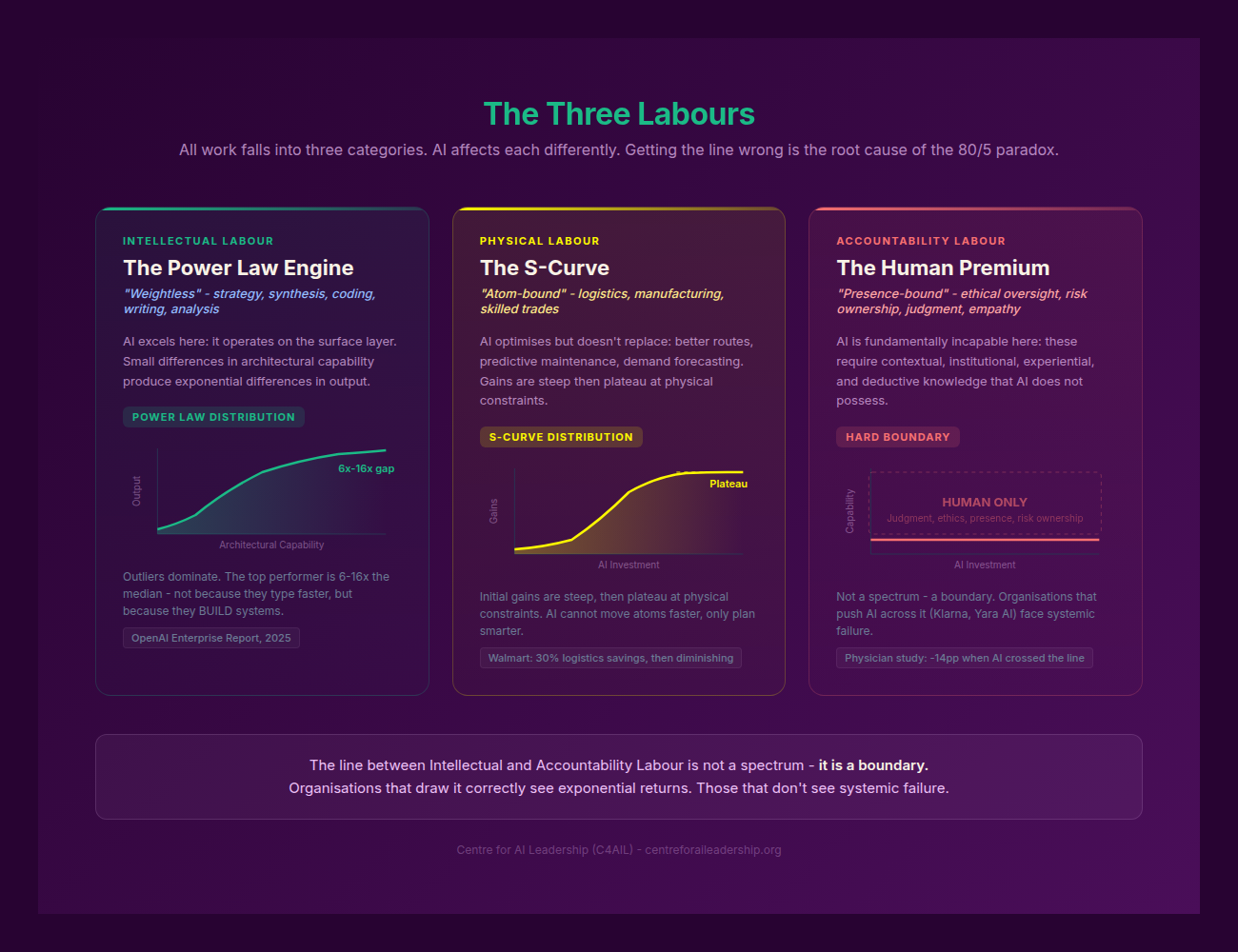
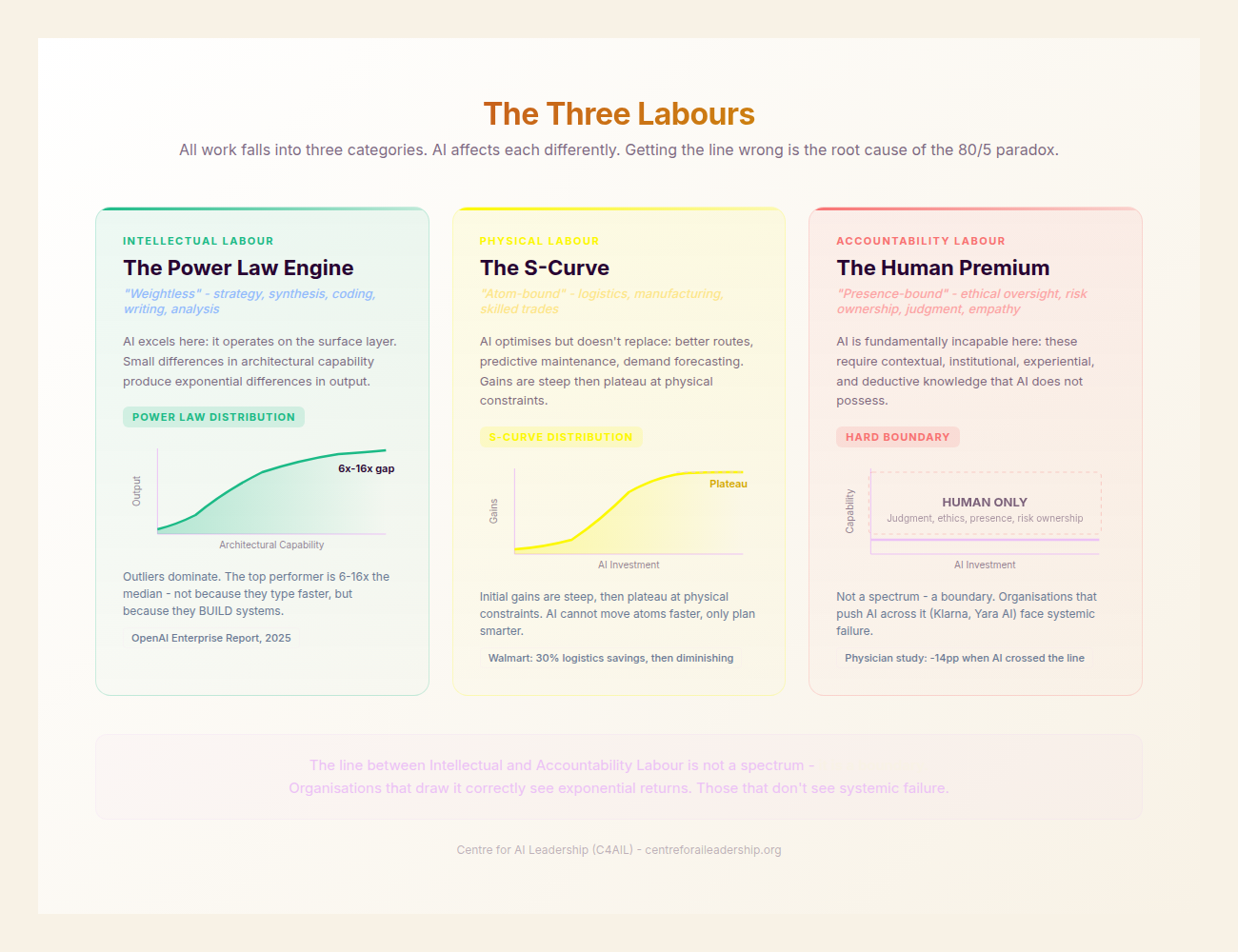
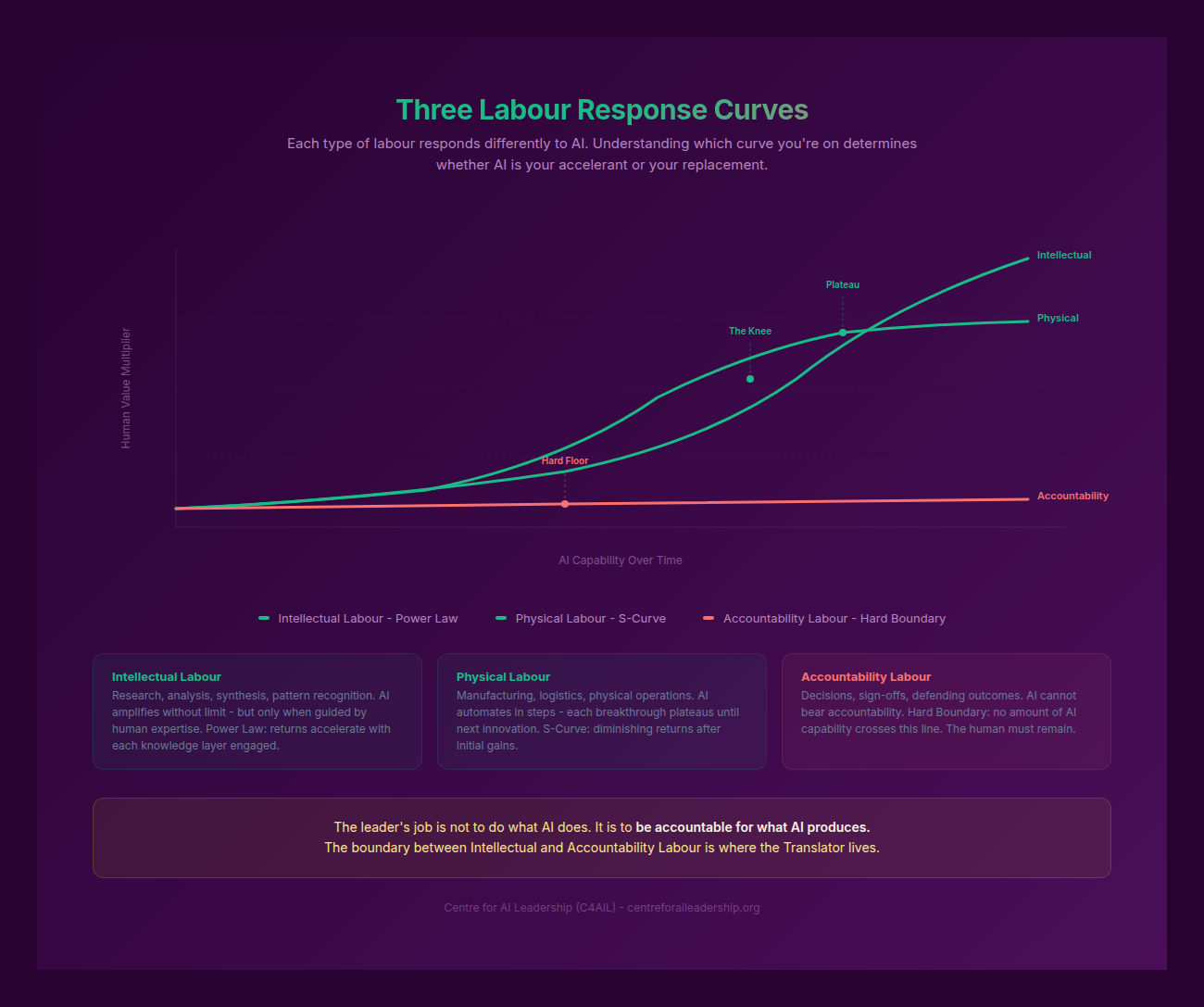
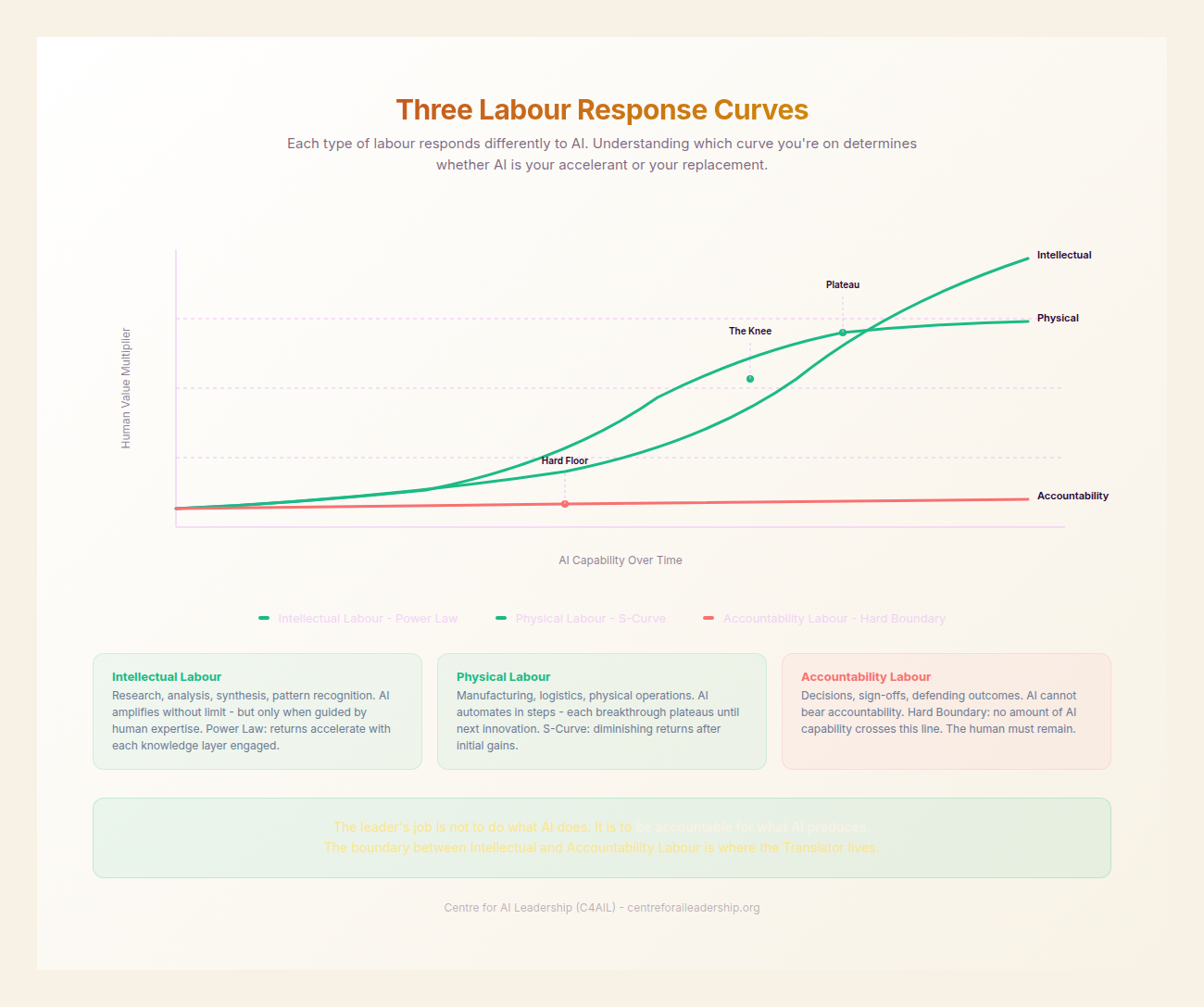
Whitepaper I defined three categories of labour: Intellectual, Physical, and Accountability. This paper extends the model to four — surfacing Architectural Labour as a distinct category and correcting the assumption that Physical Labour plateaus. Read in the terms introduced in §1.6, the Four Labours are substrate categories, not task categories: each names a distinct kind of substrate a professional develops, and the trajectory column describes what AI does to the surface over that substrate.
One clarification carries over from §1.7. The “judgment” listed under Accountability Labour below bundles two acts that AI can now pull apart: the epistemic labour of knowing whether the output is sound (delegable — it answers to reality) and the accountability of owning the consequence (non-delegable — it answers to others). The table keeps Accountability as the owning monopoly; epistemic labour, named in §1.7, is its delegable precondition — and the failure mode (granting Epistemic Credit) is exercising the second while skipping the first.
| Labour Type | Definition | AI Relationship (2025) | Trajectory |
|---|---|---|---|
| Intellectual | Weightless — strategy, synthesis, coding, writing, analysis | LLMs replacing and augmenting now | Commoditised. Humans exit execution, retain architecture and verification. |
| Physical | Atom-bound — logistics, manufacturing, trades, operations | AI optimises; robotics converging | Follows intellectual labour on a 2-3 year lag. The “atom-bound” constraint is temporary. |
| Accountability | Presence-bound — ethical oversight, risk ownership, judgment, empathy, care | Cannot be automated | The only durable human monopoly. Grows as both intellectual and physical output become machine-generated. |
| Architectural | Design-bound — building the systems through which AI and robots operate | New category emerging | The growth category. Where all the new jobs live. |
Intellectual Labour is being commoditised in real time. The evidence is no longer speculative — Part I documented the scale across PwC, Baker McKenzie, Salesforce, and Klarna. But the pattern extends beyond headline cases. Chegg lost 99% of its market capitalisation after ChatGPT replaced its core service — from $14.7 billion (February 2021) to approximately $156 million (October 2025) — and cut 45% of remaining staff in October 2025. Duolingo eliminated contract translators entirely. UiPath saw its business model shift from automating tasks humans could not do efficiently to competing with AI that could do them for free. The pattern across these cases is consistent: they do not eliminate headcount absolutely — they shift the labour type. Every intellectual role automated creates demand for someone to architect the system and someone to be accountable for its output.
Physical Labour does not plateau. Whitepaper I described an S-Curve for physical labour — gains that eventually hit the constraints of physical reality. That was Phase 1. Phase 2 is arriving. Goldman Sachs estimates 15,000-20,000 humanoid robots shipped in 2025. Amazon already has over one million robots operating alongside 1.56 million human workers in its warehouses — approaching parity. Tesla’s Optimus Gen 3 begins slow-ramp production in summer 2026, with a long-term cost target of $20-25K per unit at scale. Boston Dynamics’ Electric Atlas entered production deployment in January 2026 with all 2026 units spoken for. Figure AI completed an 11-month pilot at BMW’s Spartanburg plant. Eighty percent of warehouses still have no automation whatsoever (Interact Analysis) — representing a massive greenfield for robotics deployment.
The cost trajectory matters. Tesla’s $20-25K at-scale cost target for Optimus would break the cost barrier the way GPT-3.5 broke the LLM cost barrier. When the unit economics cross the threshold, adoption follows a Power Law, not an S-Curve. Goldman Sachs revised its humanoid market estimate from $6 billion to $38 billion by 2035 — a 6x increase. McKinsey’s November 2025 analysis found that 57% of US work hours are automatable with current technology: 44% through AI agents and 13% through robotics. For services economies where 80% of work is intellectual labour, the exposure is already existential. If physical labour follows — and the convergence of humanoid robotics, computer vision, and foundation models suggests it will, though the timeline is less certain than for intellectual automation — the entire labour market is exposed.
Accountability Labour is the only durable human monopoly — but this claim requires honest stress-testing. The strongest counterargument: AI systems are already developing consequence-tracking capabilities. Reinforcement learning from human feedback (RLHF) creates models that adjust behaviour based on outcome signals. Autonomous vehicle systems make split-second decisions with life-or-death consequences and learn from failures across millions of miles. Smart contract platforms execute financial commitments with verifiable, immutable consequence chains. If AI develops persistent episodic memory across consequential interactions, embodied presence through humanoid robotics, and verifiable commitment mechanisms, the human monopoly on accountability could narrow significantly. This paper’s framework depends on this boundary holding — Limitation #5 flags it as the most important assumption to track.
Why the monopoly holds today: no jurisdiction on earth accepts “the AI decided” as a defence. Legal liability requires a human signatory. Insurance frameworks require named accountable parties. The EU AI Actthe EU's risk-tiered AI regulation; Art. 14 (human oversight) and Art. 50 (transparency) are the load-bearing duties for high-risk systems.See full entry → Article 14 mandates human oversight for high-risk AI systems. Singapore’s Agentic AI Framework requires human checkpoints at decision boundaries. These are not just regulatory preferences — they reflect a deep structural reality: accountability requires someone who can be held to account, who bears personal consequences for failure, and whose judgment integrates contextual understanding that no current AI architecture possesses. The autonomous vehicle decides in milliseconds but cannot testify in court about why it chose as it did. The smart contract executes deterministically but cannot exercise discretion when circumstances change. RLHF optimises for reward signals, not for the felt weight of signing a document that determines someone’s livelihood.
Accountability scales with output, not headcount — the more work AI produces, the more human oversight is required. CAIOthe Translator made institutional: a Direct-seat Orchestrator built on Build substrate, measured by dispensability, who succeeds by manufacturing Translators, not being the bottleneck.See full entry → appointments are up 70% year-on-year. Board-level AI oversight grew from 16% to 48% in a single year (2024-2025). Seventy-seven percent of organisations are building formal AI governance programmes. The demand for accountability labour is growing precisely because the supply of intellectual and physical labour is being automated. This growth may not last forever — but it will last longer than most current workforce strategies are planned for.
Architectural Labour is where all the new jobs live. This is the labour of building the systems through which AI operates: CAGE templatesversioned repositories of validated reasoning chains (structure + constraints + quality bar + known failure modes).See full entry → (structured frameworks that constrain AI output to domain-valid ranges), verification enginesdeterministic (rule-based, not AI-judging-AI) checks that validate AI output against domain rules before human review.See full entry →, Knowledge Layer specifications, workflow orchestration, Queue A/B/C triage architecture (routing AI outputs by confidence level — auto-approved, human-reviewed, or escalated). These roles did not exist before AI. AI Architect and AI Solutions Architect roles command $145-210K (Robert Half/Glassdoor). AI/ML Ops ranges from $111-263K with a median of $175K. GenAI role postings grew approximately 170% year-on-year (Indeed Hiring Lab, January 2024-2025). Gartner projects over 32 million jobs per year reconfigured starting 2028-2029. Stanford’s Digital Economy Lab found a 13-16% decline in entry-level hiring in AI-exposed fields alongside a surge in mid-senior AI roles. The jobs are not disappearing — they are changing category.
Whitepaper I’s Part IX quietly introduced Architectural Labour in a single sentence — the Knowledge Layer — but never named it as a distinct labour category. This paper makes the naming explicit. Architectural Labour is intellectual in nature (designing systems, building templates) but distinct from Intellectual Labour because it creates the infrastructure through which other labour types operate. An Architect does not write the report — they build the system that writes the report and the verification engine that checks it.
2.2 The Skills Architecture — From Microskill to Labour Type
The Four Labours describe what kind of work is done. But labour does not happen at the category level — it happens at the skill level. Between “this role performs accountability labour” and “here is what the person actually does” sits a hierarchy of capability that determines what workforce redesign must target.
Microskill (atomic, teachable, assessable)
  │  e.g., "parse a balance sheet line item," "hold silence after a challenge,"
  │       "sign off on a recommendation you can defend"
  ↓  clusters integrate through practice into
Skill / Macroskill (demonstrated competency in context)
  │  e.g., "financial analysis," "stakeholder negotiation," "governance oversight"
  ↓  integrated set becomes
Job Role (bundle of skills applied to a domain)
  │  e.g., "CFO," "Data Analyst," "Project Manager," "Surgeon"
  ↓  performed through
Labour Type
     Intellectual | Physical | Accountability | Architectural
A microskill is the smallest teachable unit of performance — a discrete action that can be practised, observed, and assessed in isolation. A skill is a cluster of microskills integrated through practice until they function as a coherent capability. A job role is an integrated set of skills applied within a domain context. The labour type describes the nature of the work.
The cognitive mechanism is chunking and compilation. Miller (1956) established that working memory holds seven plus or minus two chunks. What constitutes a “chunk” depends on expertise — the novice driver holds “check mirror, signal, blind spot, turn, accelerate” as five separate chunks; the experienced driver holds “change lanes” as one. Anderson’s ACT-R theory (1982) provides the mechanism: skill acquisition moves from declarative knowledge (conscious facts) through knowledge compilation (facts compiled into procedures through practice) to procedural knowledge (automatic execution). Sweller’s Cognitive Load Theory (1988) demonstrates that instruction pitched at the wrong level of this hierarchy — isolated microskills without integration scaffolding, or demanding macroskill performance before microskills are compiled — overwhelms working memory and learning fails.
The Dreyfus model (1980) maps the qualitative shift: the novice operates with rules applied to individual microskills; the competent practitioner has compiled enough microskills to manage routine situations; the expert acts from integrated intuition — the entire hierarchy compiled to the point where recognition and response are a single fluid act. Ericsson’s deliberate practice research (1993) adds the development pathway: decompose performance into components, practise with focused attention and feedback, reintegrate at a higher level.
2.3 Three Domains of Microskills
The hierarchy applies across all human capability. But not all microskills are alike. They fall into three domains — and the domains are not parallel categories. They are a developmental stack.
Technical microskills are domain-specific procedural knowledge. Writing a SQL query, reading an X-ray, configuring a firewall. This is what education systems teach and what competency frameworks (WSQ, NVQ, AQF) certify. Any technical microskill describable as a procedure is, in principle, automatable. This is the domain AI is commoditising.
Emotional microskills are the capacity to recognise emotions as they arise, name them accurately, hold space for another’s distress, and read a room. These cluster into macroskills: empathy, self-regulation, relational attunement. They are teachable and assessable — but almost no formal system treats them as skills to be developed. They require the Body → Feel → Accept sequence to be functional. You cannot recognise an emotion you have not first allowed to land.
Accountability microskills are the capacity to sign your name to a recommendation under uncertainty, conduct a post-mortem without blame, hold contradictory expert opinions and choose anyway, and defend a decision after it goes wrong. These require consequence — they only compile when the practitioner experiences the weight of the outcome. This is why residencies, military command, and apprenticeships produce accountability in ways lectures cannot.
The developmental sequence matters:
Accountability microskills (full sequence under consequential stakes)
  ↑ requires
Emotional microskills (Feel + Accept)
  ↑ requires
Technical microskills (Think + Choose)
  ↑ requires
Physical safety + somatic foundation (Body)
This is not arbitrary ordering. It is the Body → Feel → Accept → Think → Choose sequence applied to workforce capability. Stress takes the prefrontal cortex offline (Arnsten, 2009). Without physical and psychological safety, technical learning degrades. Without emotional processing — the capacity to register a feeling as information rather than suppressing it — accountability is impossible because the practitioner cannot distinguish “what feels right” from “what IS right.” The developmental psychologist Robert Kegan estimates that approximately 58% of adults have not reached the developmental stage (Stage 4, Self-Authoring) required for independent accountability. Not because they lack intelligence. Because the meaning-making structure that enables independent judgment has not been built.
Mapping domains to labour types:
| Labour Type | Primary Domain | Secondary | Tertiary |
|---|---|---|---|
| Intellectual | Technical | — | — |
| Physical | Technical (embodied) | — | — |
| Accountability | Accountability | Emotional | Technical |
| Architectural | Technical | Accountability | Emotional |
AI commoditises technical microskills — the domain that constitutes the entirety of intellectual labour and the bulk of physical labour. Emotional and accountability microskills cannot be compiled by AI because they require embodied experience, consequential stakes, and felt ownership. The human premium lives in these domains. And competency frameworks certify only the technical domain — the one being automated.
2.4 The Four-Column Task Decomposition
Workforce redesign must operate at the microskill level, not the job level. A job is a bundle of skills across all three domains. When you decompose a job into tasks and classify each task by labour type, you are classifying the microskill clusters that constitute each task. The four columns extend CompTIA’s Workload and Task Redesign methodology:
| Column | Labour Type | What Happens | Timeline |
|---|---|---|---|
| Automated (Intellectual) | Intellectual | AI replaces now | 2024-2026 |
| Automated (Physical) | Physical | Robotics replaces | 2027-2030 (with probability) |
| Elevated (Accountability) | Accountability | Requires MORE human judgment post-AI | Immediate and growing |
| New (Architectural) | Architectural | Did not exist before AI | 2024 onwards |
Applied to representative roles:
| Role | Automated (Intellectual) | Automated (Physical) | Elevated (Accountability) | New (Architectural) |
|---|---|---|---|---|
| Financial Analyst | 60% — research, modelling, report drafting | — | 15% — sign-offs, risk judgment, client trust | 25% — building analysis pipelines, verification engines |
| Compliance Officer | 40% — regulation scanning, gap analysis | 10% — site inspections (stable for now) | 30% — interpretation, enforcement decisions, regulatory judgment | 20% — compliance automation architecture, audit trail design |
| Warehouse Supervisor | 20% — scheduling, inventory analysis | 40% — routing, picking (robot-augmented by 2028) | 20% — safety decisions, team management, exception handling | 20% — robot workflow design, human-robot handoff protocols |
| Project Manager | 50% — status reporting, schedule optimisation, comms drafting | 10% — physical coordination | 25% — stakeholder judgment, priority decisions, conflict resolution | 15% — workflow automation, AI agent orchestration |
| IT-BPM Agent (Philippines) | 80% — near-total automation risk | — | 5% — escalation judgment, empathy-requiring interactions | 10% — if reskilled into architectural roles |
The IT-BPM agent row is particularly significant for services economies. In the Philippines, the IT-BPM sector employs 1.9 million workers generating $40 billion in revenue (2025). Eighty percent of that work is intellectual labour — the most exposed category. IBPAP survey data shows 67% of member companies have integrated AI, but near-zero are ready for the labour type transition. A services economy where the vast majority of work lives in Column 1 faces existential exposure. The timeline compresses from decades to years.
Part III: The Accountability Gap — Why Education Produces the Wrong Labour Type
3.1 The Factory Was the Point
The education system was designed to produce intellectual labourers. The one labour category now being commoditised fastest. It has no mechanism for producing accountability labour — the one category where demand is growing and supply is structurally constrained.
This is not a failure of execution. It is success at the wrong objective.
Ken Robinson (Out of Our Minds, 2011; Creative Schools, 2015) documented the design intent: schools were modelled on the factory system for the industrial revolution’s 80/20 labour split — 80% manual, 20% administrative and professional. Students are grouped in batches (age cohorts), processed through standardised outputs (testing), and trained to be risk-averse and frightened of being wrong. In a factory, you do not want workers to reimagine the product. You want them to follow the manual. The system produces compliance, not judgment.
Paulo Freire (Pedagogy of the Oppressed, 1970) named the mechanism: the “banking model” of education. Knowledge is treated as “a gift bestowed by those who consider themselves knowledgeable upon those whom they consider to know nothing.” Students are “receiving objects,” not “conscious beings.” The banking model “regards men as adaptable, manageable beings” — it produces individuals who adapt to the world as it is. You cannot be accountable for a reality you have been conditioned to accept as static.
bell hooks (Teaching to Transgress, 1994) extended Freire’s critique: the banking model is worse than Freire describes because it also demands a “mind/body split.” Students leave their identities at the door. For marginalised students, this is “psychic self-mutilation.” Accountability is presence-bound — it requires wholeness, not performance. A system that trains people to split mind from body cannot produce people capable of accountability, because accountability requires the full person to be present.
The shared diagnosis across Robinson, Freire, and hooks: education produces people optimised for intellectual labour (receiving deposited knowledge, applying rules, generating output on command) but structurally incapable of accountability labour (judgment, presence, naming reality, defending decisions under uncertainty). The AI age has made that design catastrophically obsolete.
3.2 Why We Switched — And Why It Made Sense Then
We trace this history in detail because the reforms being proposed today — more courses, more certifications, more AI training — repeat the same structural error the Prussian reformers made two centuries ago. Without understanding why every prior attempt to rebuild accountability through policy alone has failed, the current generation of workforce transformation initiatives will fail for the same invisible reasons.
This was not an accident. The factory model replaced something that worked. But at every stage of the replacement, the reformers lacked awareness of what they were discarding. They could see what the guild system produced — skilled craftsmen — but not how it produced them. The accountability mechanisms were invisible. They still are.
The Guild System Was Not Small
The conventional narrative — “apprenticeship was a quaint, small-scale system that couldn’t meet industrial demand” — is empirically false.
In London circa 1500, guild masters comprised 50-60% of all householders and 12-13% of the total population. The city operated through 72 livery companies and 14 additional occupational associations (Rappaport, Worlds within Worlds, 1989; cited in Ogilvie, Journal of Economic Perspectives, 2014). In Florence around 1300, 21 guilds — seven Arti Maggiori and fourteen Arti Minori — organised the city’s economy. The textile trade alone employed approximately 30,000 workers, roughly one-third of the city’s population (Giovanni Villani, Nuova Cronica, c. 1330). In Cologne, 22 Gaffeln (political guild federations) governed the city after the Verbundbrief of 1396, encompassing approximately 80 distinct trade associations, including female-dominated guilds for yarn-spinning and silk-weaving (Militzer). In 18th-century Central Europe, government censuses in Baden-Durlach (1767), Württemberg (1759), and Bavaria (1811) show that 80-95% of all craftsmen belonged to a guild (International Review of Social History, 2008). The Hanseatic League, at its peak around 1300-1400, connected nearly 200 settlements across eight modern countries (Dollinger, The German Hansa, 1970).
In the Dutch Republic circa 1670, approximately 13,800 new apprentices entered training annually across 1,153 guilds (de la Croix, Doepke & Mokyr, “Clans, Guilds, and Markets,” Quarterly Journal of Economics, 2018). Continental apprenticeships typically lasted 3-5 years — not the 7 years mandated by England’s exceptional Statute of Artificers (1563). The system sustained specialised labour markets for over 500 years.
A medieval guild apprentice progressed from observation to supervised practice to independent work, culminating in a masterpiece — a work that proved the apprentice could be trusted with unsupervised practice. The model embedded every mechanism this paper identifies as essential: graduated autonomy (you earned the right to work alone), consequential decisions (your work bore your mark), reflective accountability (the master reviewed and corrected), a signing moment (the masterpiece examination), and community of practice (the guild itself, with its standards and mutual obligations).
The guilds had real problems. Ogilvie (Journal of Economic Perspectives, 2014) documents rent-seeking: guilds restricted entry to protect incumbents, increasingly reserved apprenticeships for members’ sons, suppressed innovations that threatened existing skills, and extracted monopoly rents. Epstein (Journal of Economic History, 1998) counters that guilds solved the moral hazard of training — third-party enforcement ensured masters actually taught and apprentices did not abscond — and that the Wanderjahre (journeyman years) facilitated rapid cross-city diffusion of techniques. Both are right. The guilds were imperfect institutions that nonetheless produced something no subsequent system has replicated at scale: practitioners who could be trusted with unsupervised judgment.
The question is not whether the guilds were ideal. The question is what was lost when they were dismantled — and whether the reformers who dismantled them understood what they were discarding.
The Prussian Pivot: Three Steps of Narrowing Awareness
The Prussian education model did not emerge from a single decision. It emerged from three sequential reformers, each narrowing the definition of what education was for — and each less aware than the last of what the previous system had produced.
Frederick the Great (1763) issued the Generallandschulreglement, drafted by the Pietist theologian Johann Julius Hecker, mandating eight years of state-funded education for ages 5-14. The Volksschule (people’s school) prioritised literacy and religious obedience. Frederick’s objective was state control, not educational philosophy. He could see that a literate, obedient population was easier to govern than an illiterate one. He could not see — and had no reason to care about — the accountability mechanisms embedded in the guild system that his schools would begin to displace.
Johann Gottlieb Fichte (1807-1808), after Prussia’s catastrophic defeat by Napoleon at Jena in 1806, delivered his Addresses to the German Nation. He argued the state must take “total control of education” to “mould the will” of citizens. Traditional decentralised apprenticeships were insufficient for national survival. Fichte was the ideological catalyst — he provided the nationalist justification for centralising education under the state. His awareness was focused entirely on national cohesion. The guild system’s role in producing capable practitioners was invisible to him; he saw only its localism, its fragmentation, its failure to produce citizens who would die for the nation.
Wilhelm von Humboldt (1809), appointed head of the Section for Culture and Education, formalised the philosophical shift. In his Königsberger und Litauischer Schulplan, he argued that “vocational skills are easily acquired later on” if a general “cultivation of the mind” (Bildung) is first established. This created the Gymnasium — academic education as the superior form, vocational training as something that could be bolted on afterward. Humboldt’s awareness was the narrowest of the three: he actively theorised that what the guilds produced was secondary to what the academy produced. He could see episteme (theoretical knowledge) and techne (craft skill). He was blind to phronesis (practical wisdom) — the very capability Aristotle had distinguished 2,100 years earlier.
The Prussian model did not set out to destroy accountability. It set out to produce literate, obedient, nationally cohesive citizens at scale. It succeeded. The accountability mechanisms of the guild system were not attacked — they were simply not seen. They fell away as an unnoticed casualty of a reform that was solving a different problem.
Who Destroyed Their Guilds — And Who Didn’t
The Prussian model spread. But it spread differently depending on what each country did with its existing guild infrastructure. This is where the story diverges — and where the lack of awareness becomes most consequential.
France (1791): Abolition. The Le Chapelier Law of 14 June 1791 abolished all guilds (corporations), trade unions, and workers’ associations. The d’Allarde Law three months earlier had already dismantled guild monopolies. The revolutionary logic was clear: guilds were remnants of the Ancien Régime, obstacles to individual liberty and free markets. France replaced the guild infrastructure with elite state institutions — the École Polytechnique (1794) trained state bureaucrats and engineers, not practitioners. In 1985, Education Minister Jean-Pierre Chevènement set a target for 80% of an age group to reach the baccalauréat level, further stigmatising the Lycées Professionnels as a track for failure. France is now spending approximately EUR 15 billion annually in subsidies trying to rebuild apprenticeship (DG Trésor, 2025), having reached 1 million apprentices — 230 years after destroying the institutional infrastructure that made apprenticeship self-sustaining.
United Kingdom (1944-1965): Starvation. The Butler Act of 1944 proposed a tripartite system — Grammar Schools (academic), Secondary Modern Schools (general), and Technical Schools (vocational). The Norwood Report of 1943 had already categorised children into three “types of mind,” with the “technical mind” positioned as socially inferior. By 1958, only 4% of secondary students were enrolled in Technical Schools — they were starved of funding because local authorities found it cheaper to convert existing buildings into Grammar Schools than to build equipment-heavy technical facilities (McCulloch, The Secondary Technical School, 1989). Circular 10/65, issued in 1965 by Education Secretary Anthony Crosland, moved toward comprehensive schools, effectively dissolving the technical track entirely. The Technical Schools were not explicitly abolished. They were made invisible through administrative neglect — a pattern that would repeat.
The UK has attempted to rebuild vocational education six times since 1983. Each attempt has failed:
| Initiative | Years | Investment | Outcome |
|---|---|---|---|
| TVEI | 1983-1997 | £900M-£1.1B | Marginalised by the 1988 National Curriculum; phased out |
| Tomlinson Report | 2004 | N/A (rejected) | Proposed replacing A-Levels with a unified diploma; Blair kept A-Levels as “gold standard” |
| 14-19 Diplomas | 2008-2013 | £295.6M | 594 students completed the Advanced Diploma by June 2010 |
| Wolf Report | 2011 | N/A (review) | Found 350,000-400,000 young people in courses offering “little or no labour market value” |
| Sainsbury Review | 2016 | N/A (review) | Found the system burdened by 20,000+ courses from 160 organisations |
| T-Levels | 2020-present | Ongoing | 16,000 students in 2023/24 — 1% of 16-18 learners. Approximately 1 in 4 withdraw within the first year |
(Sources: Edge Foundation 2010, 2023; DfE 2011, 2016; Education Policy Institute 2024)
Why do they keep failing? An Ofqual/YouGov survey (June 2025) found that only 48% of employers value vocational qualifications, compared to 88% of training providers. The “parity of esteem” problem is not a perception issue — it is a market signal that employers themselves reinforce. Without mandatory intermediary bodies (chambers) to enforce quality and standardise credentials, vocational qualifications remain fragmented, inconsistent, and low-trust.
United States (1862-1983): Academicisation. The Morrill Act of 1862, signed by Abraham Lincoln, granted 30,000 acres of federal land per congressional representative to establish colleges for “Agriculture and the Mechanic Arts.” These land-grant institutions — Cornell, MIT, Texas A&M — quickly evolved into elite research universities, moving vocational training from the workshop to the lecture hall. The Smith-Hughes Act of 1917 then separated vocational education into a distinct, lower-status secondary track, cementing the divide between “college-bound” and “vocational” students. A Nation at Risk (1983) defined educational excellence exclusively through academic rigour and college attainment, effectively positioning vocational programmes as the opposite of excellence.
The result: only 680,000 registered apprentices in the United States as of 2024 — approximately 0.4% of the total workforce (US Department of Labor, 2025). Burton Clark’s 1960 analysis of American community colleges identified the “cooling out” function: institutions redirect students from “unrealistic” academic aspirations toward lower-status vocational tracks, managing institutional failure by lowering individual expectations (American Journal of Sociology, 1960). James Rosenbaum (Beyond College for All, Russell Sage Foundation, 2001) found the gap in stark terms: 84% of high school seniors planned to earn a degree (NELS:92 survey), but only 37.7% of those who planned to actually completed one within ten years (High School and Beyond survey). Kevin Fleming’s analysis showed the structural mismatch: for every job requiring a Master’s degree, two require a Bachelor’s and seven require a sub-baccalaureate credential — yet 66% of high school graduates entered higher education immediately (Fleming, 2013). Randall Collins (The Credential Society, 1979) identified the self-reinforcing loop: credential inflation drives pursuit of ever-higher degrees, which further devalues vocational pathways, which drives more credential inflation.
Japan (1868-1899): Modernisation as erasure. The Meiji Restoration systematically dismantled the traditional Shokunin (craftsman) apprentice system. The Education System Order of 1872 (Gakusei) established universal primary education modelled initially on French and American systems, with higher education explicitly modelled on the Prussian system. The Regulations for Apprentice Schools of 1894 replaced “handicraft training based upon the traditional apprentice system” with “technician training using modern scientific technology” (IDE-JETRO, 2024). The Vocational School Order of 1899 completed the absorption. By 1902, overall elementary enrolment reached 90% (boys’ enrolment had reached 90.6% by 1900; girls’ 71.7%). Traditional apprenticeships, seen as “pre-modern” and “feudal,” were absorbed into the state-controlled school system. The Meiji reformers could see the Prussian system’s success at producing literate, nationally cohesive citizens. They could not see — and actively disdained — the accountability mechanisms embedded in the Shokunin tradition they were erasing.
Australia (2012-2016): Market failure. Australia’s TAFE (Technical and Further Education) system was once a functional vocational pathway. Total government expenditure on vocational education fell to AUD 6.02 billion in 2017-18 — a 21.3% decline from the 2012 peak of AUD 7.65 billion (Productivity Commission, 2020). In New South Wales, TAFE completions dropped 67% between 2011 and 2023; teacher numbers fell 45% between 2012 and 2022. The VET FEE-HELP scheme (2012-2016) diverted billions to for-profit providers, many later exposed as fraudulent, leaving students with worthless qualifications and debt — costing taxpayers an estimated AUD 7.5 billion. The pattern: once the institutional infrastructure is weakened, market forces do not fill the gap. They exploit it.
The Countries That Kept Their Guilds
Germany kept its dual system despite Humboldt because the guild structures — Handwerkskammern (chambers of crafts) and Industrie- und Handelskammern (chambers of industry and commerce) — were strong enough to survive alongside the state education system. They were co-opted into the framework rather than abolished. The Berufsbildungsgesetz (Vocational Training Act) of 1969 unified the system under federal law. The 2020 reform introduced equivalence titles — Bachelor Professional and Master Professional — deliberately signalling parity with academic degrees.
The scale is not marginal. Germany currently trains approximately 1.22 million active apprentices across 327 government-recognised occupations (BIBB, 2025; Destatis, 2023). In 2023, 489,200 new apprenticeship contracts were signed — a 3% increase from the previous year. More than 40% of German adults hold a vocational qualification as their highest attainment (OECD Education at a Glance, 2023). Seventy-six percent of apprentices are hired by their training company upon completion — the highest rate since 2000 (IAB Betriebspanel, 2023).
The economics work because the system is structured to make them work. The BIBB Cost-Benefit Survey (2017/18) found average gross costs of EUR 20,855 per apprentice per year, offset by EUR 14,377 in productive returns — a net cost of EUR 6,478. The ROI is realised through saved recruitment costs (EUR 10,000+ per external hire avoided) and the 76% retention rate.
The critical structural feature: mandatory chamber membership. All German companies are legally required to belong to their IHK or HWK. These chambers enforce training quality, standardise national examinations, and prevent free-riding. Kathleen Thelen (How Institutions Evolve, Cambridge University Press, 2004) identifies this as the mechanism that solves the “poaching problem” — the collective action failure that kills apprenticeship in liberal market economies. When almost all firms either train or contribute, no firm can simply poach trained workers without also training. Without mandatory membership, you get the UK pattern: fragmented qualifications, inconsistent quality, employer distrust, repeated policy failure.
Switzerland goes further. Fifty-eight percent of upper-secondary students choose vocational education and training (Swiss Federal Statistical Office, 2024/25). In 2024, 58,515 Federal VET Diplomas were awarded. The system’s defining innovation is permeability — no qualification is a dead end. VET diploma holders can take the Federal Vocational Baccalaureate (approximately 13,500 obtained annually), which grants direct admission to Universities of Applied Sciences. FVB holders can then take the Passerelle examination for admission to research universities, including ETH Zurich and EPFL Lausanne. You can start as a plumber’s apprentice and end with a doctorate in engineering. The pathway exists, is used, and is culturally legitimate.
Swiss employers are net beneficiaries during the training period itself — approximately CHF 3,170 per year (Gehret et al., 2019, updating Strupler & Wolter, 2012). This is the opposite of Germany, where employers bear a net cost. Swiss apprentices receive productive tasks earlier at lower relative wages. The result: Swiss employers do not need mandatory chambers to compel participation — they participate because it is profitable.
Austria trains 106,000+ apprentices across 27,000+ companies. Approximately 40% of 10th-grade students choose apprenticeship (CEDEFOP). Denmark has achieved near-total labour market parity: VET graduate employment is 87.7%, virtually identical to higher education’s 87.8% (EU Education and Training Monitor, 2025) — though a 22% wage gap persists. Finland reformed its VET system in 2018 to provide universal eligibility for higher education from vocational qualifications.
The Evidence: Youth Unemployment
The most direct measure of whether the dual system works is youth unemployment. The Eurostat and OECD data (ages 15-24, annual average, 2023) is unambiguous:
| Country | System | Youth Unemployment 2023 |
|---|---|---|
| Germany | Dual (mandatory chambers) | 5.9% |
| Switzerland | Dual (employer-profitable) | 7.9% |
| United States | Academic-dominant (0.4% in apprenticeship) | 7.9% |
| Austria | Dual (mandatory chambers) | 11.0% |
| EU-27 average | Mixed | 14.5% |
| France | Academic-dominant (rebuilding apprenticeship) | 17.3% |
| Italy | Academic-dominant | 22.7% |
| Spain | Academic-dominant | 28.8% |
(Sources: Eurostat une_rt_a; OECD HUR; Swiss FSO/ILO; BLS)
Germany’s youth unemployment is 5.9%. Spain’s is 28.8%. That is a factor of nearly five. A fair objection: Germany and Spain differ in many ways beyond guild infrastructure — industrial composition, labour market regulation, macroeconomic policy, geographic concentration of industry, and the 2008 financial crisis hit Southern Europe disproportionately. No single variable explains a fivefold gap. But the institutional difference is consistent across the full table: the dual-system countries (Germany, Switzerland, Austria) cluster at one end, the academic-dominant countries (Spain, Italy, France, UK) at the other, and this pattern holds across business cycles and across very different economies. Germany has mandatory chambers (IHK/HWK) that enforce quality, standardise credentials, and prevent free-riding. Spain does not. France does not. Italy does not. The UK does not. The correlation is not proof of causation, but the institutional mechanism is clear: mandatory intermediary bodies create structured employer commitment that survives economic downturns, whereas voluntary or state-directed programmes are the first thing cut in a recession.
The pattern is consistent: every country with intact guild-descended intermediary bodies has structurally lower youth unemployment. Every country that destroyed its guilds and tried to rebuild vocational education through government policy alone has failed. Confounders exist, but they do not explain the consistency of the pattern across very different economies sharing only this institutional feature.
What Was Lost — And Why No One Noticed
The thread running through every case is the same: lack of awareness.
Frederick could not see that the guild system produced more than craftsmen — it produced practitioners capable of unsupervised judgment. Fichte could not see that national cohesion and practitioner accountability were not in conflict — Germany would eventually prove they could coexist. Humboldt could not see phronesis — he theorised it away as secondary to Bildung. The French revolutionaries could not see that destroying guild institutions would not liberate individual capacity but would remove the scaffolding that made individual capacity possible. The British could not see that a Technical School starved of funding would not just decline but would vanish — and that the accountability mechanisms it carried would vanish with it. The Meiji reformers could not see that the Shokunin tradition they dismissed as feudal contained developmental architecture their modern schools could not replicate.
Each reformer solved a real problem. Each was unaware of what they discarded in solving it. The guild system’s accountability mechanisms — graduated autonomy, consequential practice, reflective review, the signing moment, community of mutual obligation — were never named, never theorised, never valued by the reformers who replaced them. You cannot preserve what you cannot see.
The countries that kept their dual systems did not keep them because they understood accountability theory. Germany did not read Kegan. Switzerland did not cite Vygotsky’s Zone of Proximal Development. They kept their guild-descended chambers because those institutions were politically strong enough to survive — and the accountability mechanisms survived as a structural byproduct of institutional persistence, not as a conscious design choice.
This is the deepest layer of the problem. The factory model was not adopted in opposition to the accountability model. It was adopted in ignorance of it. The accountability mechanisms were invisible to the people who built the replacement — and they remain invisible to the people who run it today. Every failed reform in the UK, every “college for all” campaign in the US, every credential inflation cycle everywhere repeats the same error: trying to produce capable practitioners through a system that was designed, from its Prussian origins, to produce compliant citizens. Not because the reformers are foolish, but because they cannot see what is missing. The system’s blindness is self-reinforcing: it produces graduates who were never exposed to accountability, who therefore cannot recognise its absence, who therefore design reforms that reproduce the same gap.
The system is not broken. It is functioning exactly as designed. The design is for a labour market that no longer exists. And the people running the system lack the awareness to see why — because the system that trained them was designed to produce exactly that lack of awareness.
3.3 The Constructivist Foundation — What We Already Knew
We have known since Aristotle that the banking model cannot produce accountability. The theorists who proved it are taught in every education faculty. The system persists anyway.
The 2,400-year thread runs: Aristotle (Nicomachean Ethics, ~340 BC) distinguished episteme (theoretical knowledge), techne (craft skill), and phronesis (practical wisdom — judgment in particular situations). Accountability is phronesis. It cannot be taught through universal rules or technical training because every situation requiring judgment is particular. Flyvbjerg (2001) argues that rationalistic methods actively stifle practical wisdom — more rules produce less judgment. Piaget (1954) established that knowledge is constructed through interaction with the environment, not deposited. Vygotsky (1978) defined the Zone of Proximal Development — all meaningful learning happens in the gap between what a learner can do alone and what they can do with guided practice on real tasks. Dewey (1938) required two conditions for genuine education: continuity (each experience builds on prior experience) and interaction (the learner engages with a real environment). The banking model fails both. Freire (1970) named the banking model as the mechanism that removes agency, making accountability impossible. Robinson (2006) identified the factory model as designed to remove agency. hooks (1994) argued that accountability requires wholeness and presence, not performance.
Every one of these thinkers is taught in education faculties. The system they critique persists because it was never designed to produce judgment. It was designed to produce compliance for the industrial labour market.
3.4 Why Accountability Cannot Be Taught in a Classroom
The research converges from multiple disciplines on a single conclusion: what education does and what accountability requires are structurally incompatible. In the substrate/surface language of §1.6, accountability is substrate — it develops through consequential experience, not through surface instruction — and the mechanisms below all describe ways of building that substrate under real stakes.
Accountability is ontological, not epistemological. It is not something you know — it is something you become. Dreyfus and Dreyfus (1986) locate the emergence of accountability at Stage 3 (Competent) — the moment you must choose your own approach rather than follow a rule. Providing more rules traps learners at Stages 1-2. Kegan (1982, 1994) identifies the shift from Stage 3 (Socialised — “I do what is expected”) to Stage 4 (Self-Authoring — “I decide what is right”) as the accountability threshold. Most adults never reach Stage 4 — Kegan’s composite data shows approximately 58% remain below it (1994, pp. 191-195; N=282). Jarvis-Selinger et al. (2012) found that “competency is not enough” — a practitioner can be technically proficient while still deriving their sense of rightness from external validation.
Education teaches one of four required components. Rest’s Four Component Model (1986) established that moral behaviour requires Sensitivity (recognising the moral dimension), Judgment (knowing right from wrong), Motivation (doing it when it costs you), and Character (persisting under pressure). Education systems focus almost exclusively on Component 2 — Judgment. Components 3 and 4 require real consequences. Patenaude et al. (2003) found that medical students’ moral reasoning scores actually decline during clinical years — the system degrades the capability it claims to develop.
Simulation fails at the critical threshold. The NCSBN study (Hayden, 2014) found that substituting 50% of clinical hours with simulation produces equivalent skill outcomes. But simulation has what we call the Safety Paradox: defined by its lack of real consequence, it cannot develop moral motivation and character (Rest’s Components 3-4). VR ethics scenarios reduce moral ambiguity to branching logic. You cannot simulate the feeling of signing your name to a decision that could end a career or a life.
Schools sequester students from accountability. Lave and Wenger (1991) identified the fundamental problem: schools produce “student” identity (accountable to grades) rather than “practitioner” identity (accountable to outcomes). Wenger (1998) described the “communal regime of mutual accountability” in real communities of practice — the felt sense of responsibility to peers and to the work itself. Classrooms do not generate this. A student who fails an exam loses a grade. A practitioner who fails a patient loses a human being. The felt weight of consequence is the mechanism of accountability development, and classrooms are specifically designed to remove it.
3.5 The Five Mechanisms That Actually Produce Accountability
Across medicine, military, law, engineering, aviation, and audit, five mechanisms produce accountability. They share a common feature that no classroom replicates: real stakes.
Graduated Autonomy (Entrustment). Ten Cate’s Entrustable Professional Activities (2005) formalise what every profession intuits: you earn unsupervised practice through demonstrated trustworthiness, not time served. The five levels — Observe, Direct supervision, Indirect supervision, Unsupervised, Supervise others — describe a transfer of responsibility that cannot be shortcut. Medical data confirms the variance: at 36 months of training, readiness for unsupervised practice ranged from 53% to 98% across residents (JAMA Network Open, 2020). Time does not equal readiness. More troublingly, the ABMS found in 2024 that 45-65% of programme directors admitted graduating at least one resident they would not trust to care for their own family. The mechanism works. The execution is failing.
Consequential Decision-Making (Pattern Libraries). Klein’s Recognition-Primed Decision model (1998) found that 80% of expert decisions are made in under one minute through pattern recognition. The pattern library is built through exposure to consequential situations — decisions where your choice mattered and you lived with the result. Kahneman and Klein (2009) established the boundary condition: intuitive expertise is valid only in high-validity environments with immediate feedback. The wicked environment problem (Hogarth, 2001) — most professional judgment domains have delayed, ambiguous feedback — means deliberate practice does not transfer cleanly. You cannot build a pattern library from case studies. You build it from cases you owned.
Reflective Accountability (After-Action Reviews). Tannenbaum and Cerasoli (2013) found that AARs improve performance by approximately 25% across military and civilian contexts. The mechanism is self-discovery, not top-down critique. Blame-free environments paradoxically increase felt accountability (Edmondson, 1999). Medicine’s Morbidity and Mortality conferences, the military’s AARs, aviation’s Crew Resource Management debriefs — all share a common structure: what happened, what should have happened, why the gap, who owns it.
The Signing Moment (Identity Threshold). Every profession has a formal point where accountability becomes personal and legal. In medicine: the first unsupervised patient care decision. In engineering: the Professional Engineer seal — personal legal liability that pierces corporate protections, created after the 1907 Quebec Bridge collapse that killed 75 workers. In law: bar admission and the first sole-responsibility client. In aviation: the captain upgrade, evaluated on “ability to shoulder the responsibility of making the call.” In audit: the partner signature (Carcello and Li, 2013, found that mandatory disclosure of the engagement partner’s name led to higher audit quality). Meyer and Land describe this as an irreversible ontological shift — a threshold concept. Once you have signed off and lived with the result, you cannot return to “just following orders.”
Community of Practice (Mutual Accountability). Wenger (1998) identified “joint enterprise” as the mechanism that creates mutual accountability among practitioners. The German Meister system, Japanese senpai-kohai, medical residency, legal articling — all create structured generational obligation. Identity develops as trajectory: you develop accountability because you see yourself becoming a member of a community with standards. Billett (2020) found that the workplace provides a “practice curriculum” progressing from low to high accountability — but only if the individual is “pressed into increasingly effortful authentic activities.”
The common pattern across all professions:
- Rule-based foundation (classroom — the only part education provides)
- Supervised practice with increasing consequence (residency, articling, co-op)
- The signing moment (PE seal, bar admission, captain upgrade, partner signature)
- Consequential participation (real outcomes, real liability)
- Reflective accountability (M&M, AARs, peer review)
Education covers Step 1. Steps 2 through 5 require what Aristotle calls phronesis, Vygotsky calls the ZPD, Dewey calls continuity and interaction, Robinson calls creativity, Freire calls praxis, and hooks calls engaged pedagogy.
3.6 Counter-Examples — Education That Develops Accountability
Models exist at the margins. They share three features the factory model lacks: real consequences, self-direction within structure, and community identity.
Montessori. Lillard and Else-Quest (2006, Science) conducted a lottery-based randomised controlled trial and found Montessori children showed better executive function, social cognition, and “greater sense of justice and fairness.” Lillard (2017, Frontiers in Psychology) found Montessori elevated and equalised outcomes across race and income groups. The mechanism: children choose their own work, experience natural consequences, and develop agency before it is trained out of them.
Problem-Based Learning. McMaster Medical School has run PBL since 1969 — over five decades of systematic review showing equivalent or superior clinical judgment in graduates. Albanese and Mitchell (1993) found PBL graduates rated equal or better on clinical competency by faculty supervisors. The mechanism: the case drives the learning, not the lecture. Students must identify what they need to know — restoring the agency the banking model removes.
Cooperative Education. Raelin (Northeastern University) found that co-op’s largest impact is on work self-efficacy — shaped by authentic performance contexts, not classroom exercises. Henderson (2017) found law students “feel the weight and responsibility of representing real-world clients.” Jackson (2016) found co-op develops “pre-professional identity” — awareness of professional self. The mechanism: real work, real stakes, real feedback.
Freire’s Problem-Posing Education. Applied in medical education (Dos Santos, 2009), legal clinics (Stuckey, 2007), and early childhood (Vandenbroeck, 2021). The mechanism: co-investigation of reality, conscientização, praxis. Students become Subjects who name and act on the world rather than Objects who receive deposited knowledge.
hooks’ Engaged Pedagogy. Six mechanisms: confessional narrative (teacher shares struggle), voice recognition protocol (every student speaks), language as resistance, accountability as presence (stay in the room with conflict), flexible agenda (follow the energy, not the slides), wholeness mandate (acknowledge body, emotion, identity). The mechanism: the classroom becomes a community of practice where accountability is modelled through vulnerability, not enforced through punishment.
These models work. They produce graduates with agency, judgment, and felt responsibility. And they share one more feature that the factory model lacks — one so fundamental it is easy to overlook: creation.
Every counter-example restores the verb that the factory model removed. Montessori children choose and make. PBL students investigate and produce. Co-op students do real work with real consequences. Freire’s students name and act on their world — they become Subjects who create meaning rather than Objects who receive it. hooks’ students speak, risk vulnerability, and construct understanding in community. The factory model replaced all of this with reception: sit, listen, absorb, reproduce on command. Freire called it banking — deposits of knowledge into passive containers. The banking model does not just fail to produce accountability. It fails to produce the thing that develops accountability: the experience of making something, putting your name on it, and living with the result.
This is the missing verb in the education debate. The argument between “more STEM” and “more humanities,” between “hard skills” and “soft skills,” between “technical training” and “liberal education” — all of these are arguments about what to deposit. None of them question whether depositing is the right activity. The foundational change is not from one subject to another. It is from reception to creation.
Creation develops taste — the everyday word for what Aristotle called phronesis (practical wisdom, judgment applied to particular situations). Taste cannot be taught. It can only be developed through making: through producing work, receiving feedback, revising, failing, and gradually developing an internal standard for what constitutes good work. A junior lawyer does not develop judgment about contracts by studying contract law (episteme) or by learning to draft clauses (techne). They develop it by drafting contracts that a senior reviews, by defending their choices, by discovering what they missed, and by gradually internalising the difference between a contract that merely satisfies requirements and one that actually protects the client. That difference — the felt sense of quality that precedes articulation — is taste. It is what separates the competent from the accountable.
AI has no taste. This is the Eloquence Trap at its deepest level. A language model has processed millions of examples of good work and can generate output that pattern-matches the surface features of quality. But it has never made anything and lived with the result. It has never put its name on a document and waited for the consequences. It has infinite episteme and unlimited techne but zero phronesis — because phronesis requires the maker’s relationship to consequences, and AI has no relationship to consequences at all.
When creation becomes co-creation — making alongside others who hold you accountable for the result — the accountability dimension emerges. The guild masterpiece was not just creation; it was creation submitted to community judgment. The surgical residency is not just practice; it is practice under the eye of someone who has signed off and lived with the result. Co-creation is where taste meets accountability: you develop judgment not just about “is this good?” but “would I sign this?” — and you develop it in relationship with people who have already answered that question with their own names.
These models exist at the margins because the factory model was not designed to be replaced — it was designed to scale. Montessori enrols approximately 5 million students worldwide. The factory model enrols over one billion. But the factory model’s product — people trained to receive rather than create — is precisely the product AI commoditises fastest. The counter-examples are not pedagogical curiosities. They are the only models producing the capability the AI age actually demands.
3.7 The AI Crisis — The Training Ground Is Disappearing
Even the professions that successfully produce accountability are losing the pipeline.
Part I documented the scale: two-thirds of enterprises cutting entry-level hiring, junior headcount declining 7.7% within six quarters of GenAI adoption, software developer employment ages 22-25 down 20% from peak while ages 35-49 grow 9%. The numbers are not repeated here — the mechanism is what matters for this section.
The 70-20-10 Model and Its Collapse
The mechanism has a name that every Chief Human Resources Officer and Chief Learning Officer already knows: the 70-20-10 model of professional development.
In 1988, Morgan McCall, Michael Lombardo, and Ann Morrison at the Center for Creative Leadership published The Lessons of Experience, based on behavioural event interviews with 191 successful executives from six Fortune 500 companies. The executives were asked to identify the key events that changed how they managed. From 616 key events and 1,547 lessons learned, the researchers found that successful executives attributed their development overwhelmingly to three sources: 70% to challenging on-the-job experiences (stretch assignments, turnarounds, increases in scope), 20% to developmental relationships (mentoring, coaching, feedback from bosses and peers), and 10% to formal training (classroom courses, structured programmes, reading). Robert Eichinger later popularised the specific ratios through The Career Architect Development Planner (Lombardo & Eichinger, 1996).
The ratios themselves are approximate — they were derived from retrospective self-report, not controlled measurement, and the sample was Western, senior, and predominantly male. Clardy (2018) called them “managerial folklore.” Johnson, Blackman & Buick (2018) found the 20% (social learning) sometimes outweighed the 70% in public sector contexts. The specific numbers are not the point. The underlying principle is, and it is one of the most robustly validated findings in adult learning research.
The principle: most professional development happens through doing consequential work under conditions of progressive challenge, not through formal instruction. The classroom is necessary but insufficient.
The evidence converges from multiple independent research traditions:
-
Transfer-of-training research confirms it from the opposite direction. Baldwin & Ford (1988) concluded that no more than 10% of formal training investment actually transferred to the job. Arthur, Bennett, Stanush & McNelly (1998) found that without continued practice, trained performance dropped from the 50th to the 8th percentile within a year. Blume, Ford, Baldwin & Huang (2010), in a meta-analysis of 89 studies, found that environmental factors — supervisor support, transfer climate — had a stronger relationship with transfer than training design. Saks & Belcourt (2006), studying 150 organisations, found transfer dropped from 62% immediately after training to 34% after one year. The 10% is not ineffective — it provides the mental models, vocabulary, and frameworks that make the 70% intelligible. But without the 70% to activate it, formal training has an 85-90% failure rate.
-
Eraut (2004, 2007) found empirically that most workplace learning is non-formal, occurring through “implicit learning,” “reactive learning,” and “deliberative learning” during work. Formal knowledge remains what Eraut calls “inert” — available for recall but not for action — until activated by social and experiential context.
-
Dreyfus and Dreyfus (1980, 2004) map the same principle as a developmental trajectory. Novices rely on context-free rules (the 10%). Experts rely on intuitive, context-dependent know-how (the 70%). You cannot become Expert through the 10% alone — you can only become Competent. The final stages of expertise require the accumulated experience of consequential practice.
-
Lave and Wenger (1991) grounded it in situated learning theory: learning is inseparable from the context in which it occurs. Newcomers move from “legitimate peripheral participation” to full mastery through engagement in community — not through decontextualised instruction.
-
Kolb (1984) structured it as a cycle: the 70% provides Concrete Experience and Active Experimentation; the 10% provides Abstract Conceptualisation; the 20% facilitates Reflective Observation. Without all four stages, the cycle is incomplete.
-
Bandura (1977) established the social learning foundation: professional behaviour is “caught, not taught” — learned through observation, imitation, and modelling in relationship. The 20% transmits tacit knowledge and cultural nuance that no formal curriculum can encode.
The entire L&D profession has operated for forty years on the assumption that the 70% happens organically — as a natural byproduct of employment. No one needed to design it. It was simply there, embedded in the structure of work itself. Junior lawyers drafted contracts. Junior doctors examined patients. Junior engineers reviewed drawings. The work was the training. The training was the work.
AI breaks this assumption.
How AI Destroys the 70%
The pipeline that produced accountability — junior does volume work → develops pattern recognition → earns graduated autonomy → crosses the signing threshold — is being hollowed out. AI automates the intellectual labour that was the training ground for accountability labour.
The 70% is gutted. The junior work — drafting, research, analysis, data processing — is being automated. When a junior lawyer uses AI to draft a contract, they skip the struggle of research and synthesis that builds the pattern library. The micro-failures that develop intuition are lost. The professional never builds the felt sense of what a good contract looks like versus one that merely satisfies requirements. AI compresses the 70% into a review task — but reviewing AI output is not the same developmental experience as producing the work yourself. Reviewing is reception. Production is creation. And creation is where phronesis develops.
The 20% loses its context. Mentoring traditionally happens “in the flow of work” — a senior reviews a junior’s draft and provides feedback on a specific shared task. If a senior can use AI to complete a task in ten minutes rather than delegating to a junior (which takes two hours including coaching), rational self-interest drives choosing AI. Without shared task context, mentoring becomes abstract and formalised — effectively converting the 20% into more of the 10%. Which transfer research shows does not work.
The 10% survives but cannot carry the load. Formal instruction is the easiest component to digitise, scale, and even enhance with AI. Online courses proliferate. AI tutoring systems improve. But the surviving component is precisely the one that is insufficient on its own — the one with an 85-90% transfer failure rate without experiential reinforcement.
Vygotsky’s ZPD requires a real task, a human scaffold, and gradual transfer of responsibility. AI disrupts all three:
- The real tasks are disappearing. There is less and less in the zone for juniors to do.
- The human scaffold is being replaced. AI-junior pairing means the AI does the work and the junior watches. The scaffold must be human because accountability is learned through relationship, not observation.
- The transfer of responsibility never happens. There is nothing to transfer — AI handles the execution. The junior never earns the right to sign off because they never did the work that builds the judgment.
- Dewey’s two conditions both fail. Continuity is broken (no progression from simple to complex tasks) and interaction is eliminated (the junior interacts with AI output, not with the domain reality).
The 70-20-10 model was never a recommendation. It was a description — an observation about how professional capability actually forms. AI does not change what humans need in order to develop judgment. It destroys the mechanism through which they have historically developed it. The principle remains true: most development happens through consequential experience. But the experience is disappearing.
When two-thirds of enterprises are cutting the entry-level pipeline in 2024-2026, the result is a generation gap in leadership capacity by 2031-2036. This is not a labour market adjustment. It is a civilisational pipeline problem. And it is invisible to any analysis that measures only the 10% — because the 10% is the only part the system tracks, the only part it funds, and the only part it knows how to rebuild.
3.8 Implications for Workforce Redesign
Seven implications follow from the accountability gap:
-
“More courses” is the wrong answer. Reskilling programmes that teach AI skills are producing one-dimensional professionals — trained on the Syntax layer — to compete with a machine that has mastered that dimension completely. The gap is not knowledge. It is dimensionality. Accountability requires all five knowledge layers active simultaneously, and courses develop at most one.
-
Co-creation, not review. AI handles volume work; juniors must co-create with AI under senior supervision — not merely review AI output. The question is not “did you catch the errors?” but “would you sign this?” The accelerated junior development model is not optional — it is the only way to keep the accountability pipeline alive. And what it develops is taste: the felt sense of quality that separates the competent from the accountable.
-
Architectural labour CAN be taught. It is intellectual in nature — designing systems, building templates. This is where conventional education and certification add value. CompTIA AI Architect+, C4AIL programmes, the AI Guildhall’s portfolio system.
-
Accountability must be created, not certified. Portfolio-based assessment over multiple-choice exams. The question is not “do you know?” (episteme) or “can you do?” (techne) but “would we trust what you make?” (phronesis). Creation — making something, putting your name on it, submitting it to community judgment — is the only path to phronesis. Exams test reception. Portfolios test creation.
-
The Trainer role becomes the accountability pipeline. Doc Ligot’s fourth role — Trainers who supervise practice, not deliver content. The AI Guildhall Studio is not a classroom. It is a supervised accountability gym.
-
The Translator capability IS Freire’s “naming the world.” A professional who cannot articulate the reality of their work cannot be accountable for it. The Translator does not just bridge domain and AI — they restore the agency the banking model removed.
-
Organisations must now manufacture experience. The 70-20-10 model assumed the 70% was a natural byproduct of employment — no one needed to design it because work itself provided it. AI breaks this assumption. When the experiential component no longer emerges organically from the job, it must be deliberately constructed: simulated consequential environments, co-creation with AI under senior supervision, portfolio-based assessment that requires the practitioner to create and defend, not merely review and approve. The organisations that understand this will build developmental infrastructure. The organisations that do not will double down on the 10% — more courses, more certifications, more of the one component that has an 85-90% transfer failure rate on its own — and wonder why their workforce cannot exercise judgment.
Part IV: From Diagnosis to Response
Parts I-III diagnosed the problem at civilisational scale — why AI disrupts the workforce, what accountability is, and why the systems designed to produce it have been failing for two centuries. Part V examines the identity crisis facing professionals in this transition. Part VI provides a diagnostic case study of a services economy under structural pressure. Part VII addresses the psychological foundation and cross-civilisational evidence for the developmental principles at stake.
The organisational response — how to redesign roles, pipelines, HR systems, and implementation roadmaps around the diagnostic findings of this paper — will be addressed in Whitepaper III: The Organisational Response. That paper will draw on the broad principles established across both key whitepapers (The Sovereign Choice and The Labour Architecture) and apply them through a framework customised to each organisation’s maturity level, sector, institutional context, and workforce composition. The design constraints identified in Part VII of this paper — embodiment over credentialing, community of mutual obligation, mechanisms for detecting degradation, developmental sequencing that cannot be compressed, and human agency at every level — provide the non-negotiable architectural principles. The specific implementation will vary.
What this paper has established is the diagnostic foundation that any organisational response must account for:
- The Four Labours taxonomy — the demand-side framework for understanding what work is becoming
- The Human Capability Stack — the seven-layer model that explains why piecemeal interventions fail
- The Accountability Gap — why education systems produce the wrong labour type, and what the 70-20-10 model’s collapse means for the developmental pipeline
- The cross-civilisational design constraints — the principles for building institutions that produce accountability and resist their own corruption
- The psychological foundation — the developmental reality that constrains everything above it
Without this diagnostic foundation, organisational interventions will repeat the pattern this paper has documented across 250 years of educational reform: solving the wrong problem with confident precision.
Part V: The Identity Crisis — The Human Side
5.1 The Identity Crisis
The deepest challenge in workforce transformation is not technical. It is existential. People who built careers on intellectual labour — writing reports, conducting analysis, producing research — are watching AI do it faster, cheaper, and (in many cases) better.
The common media narrative frames this as a shift from “I produce the work” to “I check the work” — from creator to reviewer, from author to editor, from expert to quality inspector of a machine that seems to know more than they do. This narrative captures something real: structured review does add value. Kahneman, Sibony, and Sunstein (2021, Noise) showed that systematic auditing of professional judgment reduces decision variance by 20-50% across domains — noise audits, second opinions, and structured protocols all improve consistency. The Floor User’s verification role draws on this insight: disciplined checking against defined standards is genuine skilled work, and organisations that skip it pay in errors.
But checking is not the same as owning. The “checker” narrative becomes dangerous when it defines the professional’s entire identity — when “I review AI output” replaces “I decide what the AI must achieve.” This is the paper’s concern: not that checking has no value, but that checking as identity reproduces the one-dimensional, Syntax-layer relationship the factory model trained for. It moves the human from the production side of the conveyor belt to the inspection side — still reception, still the banking model with a faster machine.
The actual shift is from execution to intent. The professional in the AI age does not check what the machine produced. They set what the machine must achieve — and they own the outcome. The surgeon does not “check” the surgical robot’s work. They decide where to cut, why, and what the acceptable boundaries of error are. The senior lawyer does not “review” the AI-drafted contract. They set the strategic intent — what this contract must protect the client from — and co-create with AI to achieve it. The financial architect does not “validate” the AI’s analysis. They define the question the analysis must answer, the risk tolerances it must respect, and the institutional context it must account for.
This is not a demotion. It is a labour type shift — from intellectual labour (producing the output) to accountability labour (owning the outcome). The professional’s domain knowledge is not just “still important.” It is the entire point. Without the twenty years of institutional knowledge, contextual understanding, and experiential pattern recognition, there is no one qualified to set the intent. AI can generate any output you ask for. Knowing what to ask for — and being accountable for having asked for the right thing — is the human premium.
The honest conversation is: your value was never in the production. It was in the judgment that informed the production. The factory model obscured this by bundling production and judgment into a single workflow — the professional who wrote the report also decided what the report should say. AI unbundles them. The production goes to the machine. The judgment — the intent, the standard, the accountability — stays with you. For professionals who already operate with judgment, this is a liberation. For professionals whose identity was built on production volume, it is a reckoning.
5.2 Floor-ification Anxiety
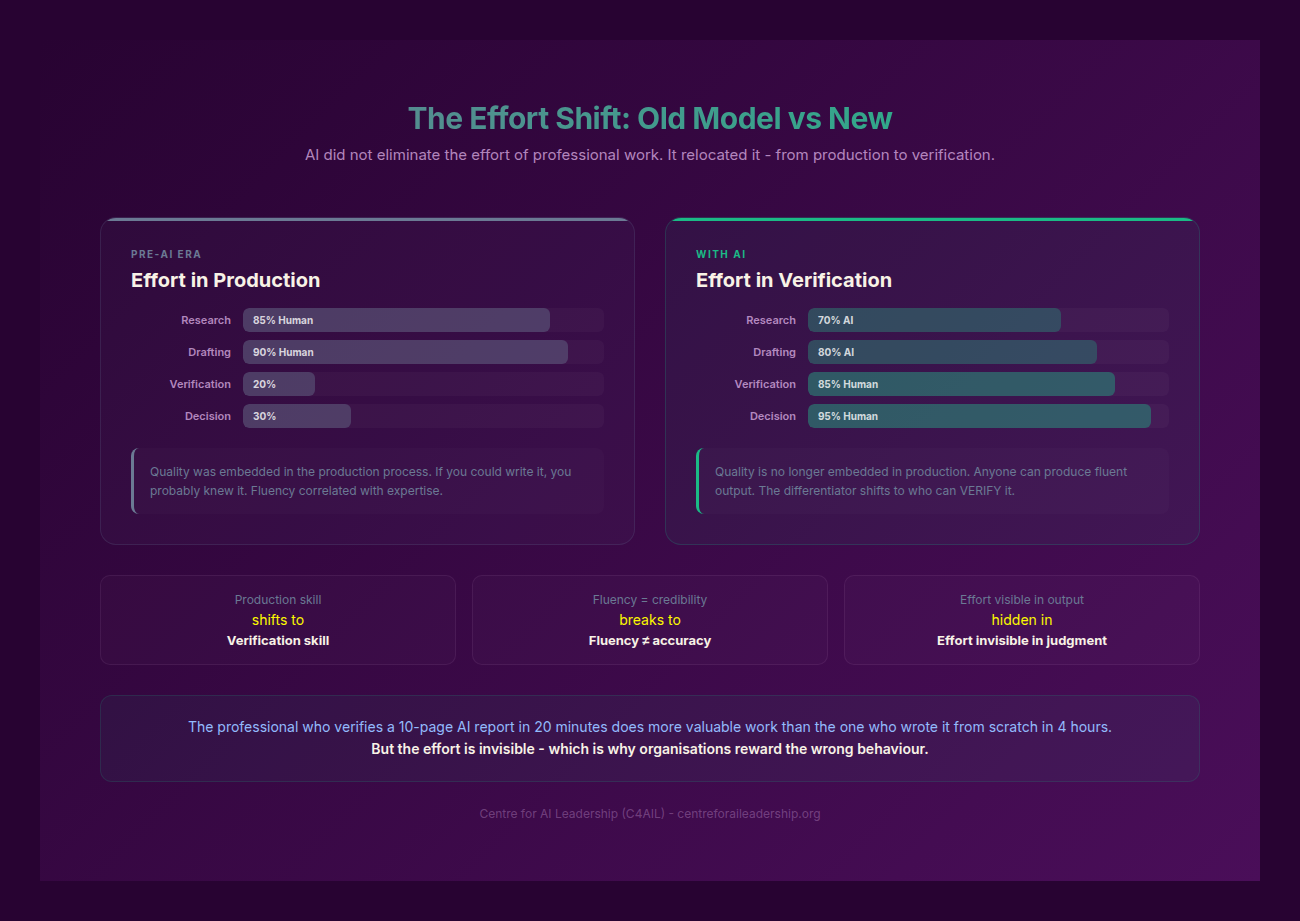
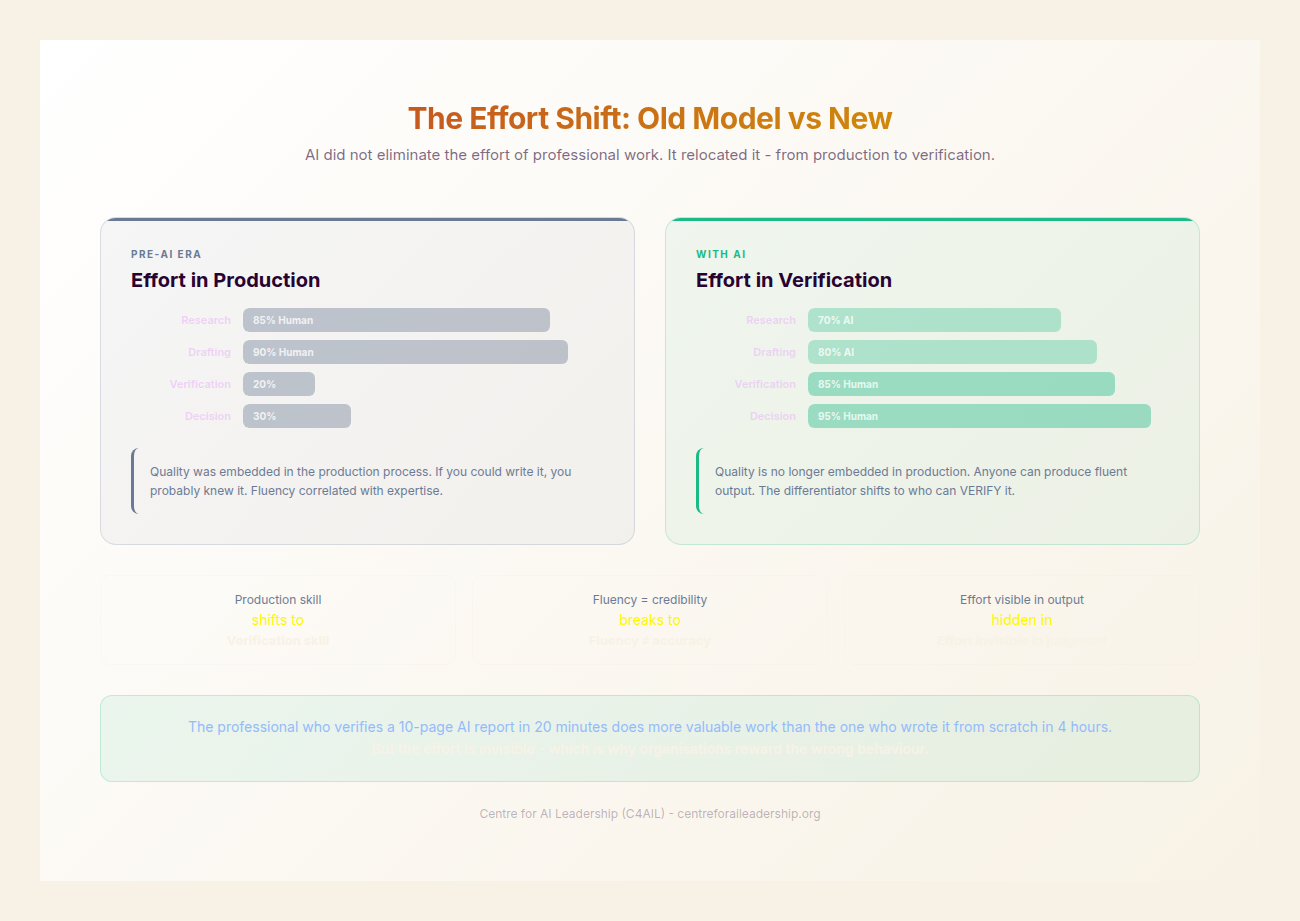
The most common fear: “Am I being demoted to Floor?” The answer must be honest: the Floor is not lesser. It is the backbone. The organisation literally cannot function without Floor Users who have domain expertise and validation discipline. A Floor User with 20 years of industry knowledge is more valuable than an Architect who cannot validate their own output.
But honesty also means acknowledging that the status markers are shifting. In the old model, status came from producing impressive intellectual output — the brilliant report, the elegant analysis, the perfectly drafted brief. In the new model, status comes from setting the right intent and making good judgment calls — the outcome that protected the client, the decision that avoided the crisis, the standard that held when it mattered. Some people will thrive in this shift. Some will not. Having an honest conversation about this — rather than pretending everyone will love their new role — is the difference between change management and change propaganda.
5.3 Communication Strategy
Do not announce “AI transformation.” Announce “workflow improvement.” Show, do not tell. Pilot with one team, demonstrate results (the 25-30% vs 10-15% productivity difference), and let others opt in. The Studio model provides a safe space to explore before committing — people can experience the new way of working without being forced into it.
Do not promise that no jobs will change. They will. Promise instead that the organisation will invest in developing every person who wants to develop. The dual-track model gives everyone a path — Floor or Ceiling, both legitimate. But the path requires the person to walk it.
5.4 The Awareness Gap Is the Change Management Problem
The identity crisis, the Floor-ification anxiety, the resistance to change — these are not irrational responses to a rational transformation. They are symptoms of the same awareness gap that Part III traced through 250 years of educational history.
The Prussian reformers could not see what they were discarding when they replaced apprenticeship with academic education. Today’s professionals cannot see what they are being asked to become — because the media tells them they are becoming “checkers” and “validators,” when the actual shift is from execution to intent, from production to accountability. The mechanism is the same: the system that trained them valued intellectual output above all else, so they value intellectual output above all else. Asking them to redefine their professional identity is asking them to see something the system they grew up in was designed to make invisible.
This is why conventional change management — town halls, rebranding, motivational speeches — fails at this transition. It addresses the symptoms (anxiety, resistance) without addressing the cause (a meaning-making structure built on intellectual labour identity). Kegan’s Stage 3 professional derives their sense of worth from external validation of their intellectual output. Telling them their output is being automated is not a workflow change. It is an identity threat. The shift to accountability labour requires the Stage 3→4 transition — from “my work defines me” to “I define my work.” That is a developmental challenge, not a communications challenge.
The Studio, the portfolio system, and the community of practice are not just training mechanisms. They are developmental environments designed to support exactly this transition — providing the confirmation (you are valued), contradiction (your current approach has limits), and continuity (we will be here while you grow) that Kegan identifies as the conditions for stage transition.
5.5 The Union Question
This paper has discussed workforce transformation without mentioning organised labour. That is a significant omission. In many economies — Germany (where unions co-govern the dual system through Mitbestimmung), the Nordics, parts of Asia-Pacific, and the public sector globally — workforce transformation cannot proceed without union engagement.
The labour architecture has natural points of alignment with collective bargaining: Floor Users need protection against algorithmic management and surveillance; structured career pathways that do not require every worker to pursue Ceiling roles provide a union-negotiable alternative to the current binary of “upskill or become obsolete”; verification standards and quality thresholds are exactly the kind of work conditions that benefit from collective agreement. Germany’s success with the dual system is inseparable from union participation — the Betriebsräte (works councils) negotiate training quality, apprentice ratios, and working conditions at the firm level. The guild infrastructure survived in Germany partly because unions had a structural stake in maintaining it.
The risks of excluding organised labour are equally clear. A Floor deployment that is perceived as deskilling — pushing professionals into AI-supervised workflows without consultation — will generate resistance that no amount of developmental framing will overcome. Unions that see the labour architecture as a management tool for headcount reduction will oppose it. Unions that see it as a framework for protecting worker development and creating legitimate career paths may champion it. The difference is whether they are at the design table or responding to a fait accompli.
This paper does not develop a full industrial relations framework — that is sector-specific and jurisdiction-dependent work. But it names the gap: any implementation of this model in unionised environments must include organised labour as a design partner, not a stakeholder to be managed.
Part VI: The Services Economy Case Study — Philippines
6.1 The Philippine Paradox
The Philippines is the fastest AI adopter in ASEAN — and the least prepared for what adoption means. IBPAP survey data reveals the contradiction: 67% of IT-BPM organisations have integrated AI tools. Near-zero are ready for the labour type transition those tools demand.
The IT-BPM sector employs 1.9 million workers generating $40 billion in revenue (2025). It is the backbone of the Philippine services economy and a critical source of dollar-denominated income for a nation where remittances and BPO revenue together fund a significant share of household consumption.
Eighty percent of IT-BPM work is intellectual labour. Column 1 of the Four-Column Task Decomposition. The most exposed category.
6.2 The Four-Role Mapping
Doc Ligot’s model identifies four roles in the AI-age workforce: Builders, Users, Planners, and Trainers. These map to the C4AIL framework:
| Ligot Role | C4AIL Equivalent | Labour Type | Philippine Reality |
|---|---|---|---|
| Builders | Architects (L3-4) | Architectural | Small and growing — concentrated in Manila tech startups |
| Users | Floor Users (L0-2) | Intellectual (being automated) | 1.9 million workers — existentially exposed |
| Planners | Orchestrators (L5-6) | Accountability | Tiny — mostly expatriate or foreign-trained |
| Trainers | Trainers | Capability building | Nearly absent at scale |
The structural vulnerability is clear: the vast majority of the Philippine IT-BPM workforce sits in the User/Floor category performing intellectual labour. The Builders, Planners, and Trainers required for the transition barely exist at scale. The Philippines is not a sovereign AI builder — it is an AI consumer. Project SPARTA has enrolled over 50,000 in data science and analytics courses, but literacy is a Floor capability. The Ceiling pipeline (Architects, Orchestrators, Trainers) is what the transition demands.
6.3 Lessons for Services Economies
The Philippine case is not unique. India (with its massive IT services sector), Malaysia (with its MDEC-driven digital economy push), and Vietnam (with its rapidly growing BPO sector) face structurally similar exposure. The lessons apply broadly:
-
Services economies cannot reskill their way out of Column 1 exposure with more courses. The courses produce more intellectual labourers. The gap is accountability and architectural capability.
-
The Trainer role is the strategic bottleneck. Without Trainers who can supervise accountability development, the pipeline from User to Builder/Planner does not exist.
-
Policy must fund capability development, not course delivery. SkillsFuture-style subsidy models that fund seat-hours incentivise more of the wrong thing. Policy should fund supervised practice, portfolio development, and the Trainer pipeline.
-
The institutional infrastructure lesson applies here too. No ASEAN services economy has the guild-descended chamber system that makes Germany’s and Switzerland’s dual systems work. Building that infrastructure from scratch is a multi-decade project. In the interim, industry associations like IBPAP can partially fill the role — standardising skill taxonomies, enforcing training quality, and preventing the race-to-the-bottom on capability investment. Whether they have the mandate and the enforcement power to do so is the open question.
The Philippines is not just a case study. It is a preview. Any economy where the majority of the workforce performs intellectual labour — and that describes most services economies in ASEAN, South Asia, and increasingly Eastern Europe — faces the same structural exposure. The difference between a managed transition and a crisis is whether the Trainer pipeline and institutional infrastructure exist before the automation wave arrives. For most of these economies, they do not.
Part VII: The Deeper Problem — Why the Stack Fails from the Bottom
7.1 The Psychological Foundation
This whitepaper has walked the Human Capability Stack from Layer 3 (Labour Types) through Layer 7 (Policy). But the stack has a foundation — Layer 1, the Psychological Foundation — and it is cracked.
The natural developmental order of human capability is: Body → Feel → Accept → Think → Choose. Education delivers it inverted: Think → (maybe Feel) → (maybe Do). Accept and Choose are never addressed.
This is not pedagogical preference. It is neurobiological sequence. Stress hormones impair prefrontal cortex function (Arnsten, 2009 — acute stress causes “rapid and dramatic loss of prefrontal cognitive abilities,” degrading working memory, flexible thinking, and attentional control). The amygdala receives sensory input 12ms before the cortex (LeDoux, 1996). Anticipatory somatic signals precede conscious awareness by 40-70 decision cycles (Bechara et al., 1997). The body and emotional system get the first vote. Cognition arrives second and can override — but only if the prefrontal cortex is online, which requires the body not being in threat state.
Accept — the step between Feel and Think — is the critical gateway. It is the moment a feeling is registered as information rather than identity. “I feel this is right” becomes “I notice I feel this is right — now let me check.” In developmental terms, this is what Kegan calls the subject-object shift: what was subject (invisible, had you) becomes object (visible, something you can examine). Without Accept, the practitioner cannot distinguish emotional response from reality. The Eloquence Trap — accepting AI output because it sounds right — is the AI-specific manifestation of this failure.
This is why multi-dimensional thinking — not intelligence, not knowledge, not skill — is what differentiates humans from AI. Whitepaper I established that AI is a One-Layer Machine: it has mastered the Syntax layer to a degree indistinguishable from human output, but possesses zero capability in the remaining four knowledge layers (Contextual, Institutional, Deductive, Experiential). The Five-Layer Knowledge Model was presented as a diagnostic tool. This paper reveals it as a developmental map. Each knowledge layer requires a corresponding developmental stage to activate:
| Knowledge Layer (Whitepaper I) | Developmental Stage (This Paper) | What Activates It |
|---|---|---|
| Experiential | Body + Feel | Lived consequences — somatic and emotional memory from having done the work and felt the result |
| Deductive | Think (grounded through Accept) | First-principles reasoning — but only trustworthy when anchored in felt reality, not floating free |
| Institutional | Community (developed through co-creation) | How things actually work here — learned through belonging, not briefing documents |
| Contextual | Body (situational presence) | This client, this moment, this constraint — requires the practitioner to be present, not just informed |
| Syntax | Think (surface) | Pattern-matching on language and structure — the one layer AI handles, and the one layer the factory model trains for |
AI processes on one dimension. The factory model trains humans to process on one dimension — the same one. This is not a coincidence. The factory was designed to produce human components for industrial systems, and industrial systems needed exactly what AI now provides: reliable, standardised intellectual output. The factory’s product and AI’s product are the same product. The human premium — the thing that justifies human involvement in any process — is the ability to process across all five dimensions simultaneously. The senior partner who reads a contract and feels something is wrong before they can articulate why is processing Experiential (body memory of past failures) + Contextual (this client’s specific situation) + Institutional (how this firm handles risk) + Deductive (logical analysis) + Syntax (the words on the page) — all at once. No AI does this. No factory-trained professional does this reliably either — because the factory developed only the Syntax dimension and called it education.
Approximately 58% of adults have not reached Kegan’s Stage 4 (Self-Authoring), which requires Accept to be functional (Kegan, 1994, composite of ~282 Subject-Object Interviews with middle-class, college-educated US adults; Kegan & Lahey, 2009, p. 28; corroborated by Torbert, 1987, N=497 managers using the Sentence Completion Test). No population-representative replication exists — the general population figure may be higher, not lower. This means a substantial majority of the workforce structurally cannot perform independent accountability labour without developmental support — not because they lack intelligence, but because they have been developed along one dimension of a five-dimensional capability. Stage transitions take 5-10 years with the right conditions — confirmation, contradiction, and continuity. There is no shortcut. And the right conditions are precisely what the current education system does not provide.
7.2 The Inversion Is Universal
The Body → Feel → Accept → Think → Choose inversion is not a Western construct. It is the universal product of statist education — any system that centralised education for state purposes. But the evidence for the correct developmental sequence is also not Western. It is cross-civilisational. Independent traditions across millennia and continents have arrived at the same conclusion: accountability is developmental, sequential, experiential, and cannot be compressed into information transfer.
The East Asian Inversion
The West did it through the factory model. East Asia did it through 2,000 years of examination culture corruption: from Confucius’ integrated 修身 (self-cultivation) and 六藝 (Six Arts — ritual, music, archery, charioteering, calligraphy, mathematics) through Han Wudi’s imperial co-optation (136 BC), the keju examination system (605 AD), Zhu Xi’s codification of the Four Books as sole exam canon (1313), and the eight-legged essay’s terminal ossification (1368-1905). Japan reached the same destination through a different genealogy — the Meiji Restoration’s import of Prussian industrial education (1868). Korea inherited the gwageo examination system from China and amplified it through yangban hereditary status anxiety.
Wang Yangming (1472-1529), following his enlightenment at Longchang in 1508, articulated the doctrine of 知行合一 (zhixing heyi) — the unity of knowledge and action. His claim is more radical than it sounds. It is not “you should practice what you know.” It is: knowledge and action are one thing that has been artificially separated. If you know something and do not act on it, that is proof you do not know it — not proof of weakness, but proof of ignorance. The knowledge was never there. What was there was information that had not yet become knowledge. Wang called this distinction 真知 (zhen zhi) — genuine knowledge, as opposed to intellectual understanding.
Wang’s definitional test maps precisely onto the accountability gap. The factory model produces professionals who can recite the principles of good practice but cannot exercise judgment under pressure. Wang would say they have never known those principles. They have memorised words. The knowledge was never embodied — and unembodied knowledge, in Wang’s framework, is not knowledge at all.
The irony is that Wang’s opponents won the institutional argument. Zhu Xi’s method — 格物致知 (gewu zhizhi), “investigate external things to extend knowledge” — became state orthodoxy precisely because it produced compliant scholars who looked to external authority. Wang’s method — 致良知 (zhi liangzhi), “extend innate moral knowing” — produced autonomous moral agents who might reject external authority when it conflicted with their felt moral perception. States prefer Zhu Xi for the same reason the factory model persists: compliance is easier to scale than judgment. The Meiji samurai who led the modernisation of Japan were followers of Wang Yangming — and they imported the Prussian education model, which embodies Zhu Xi’s epistemology. The philosopher who could have inoculated against the inversion was honoured in name and ignored in practice.
Cross-Civilisational Convergence
The developmental principle is not an invention of Western psychology. It is a discovery that surfaces independently wherever a tradition has had sufficient time and seriousness to investigate how human capability actually forms.
The Confucian developmental sequence — 修身齐家治国平天下 (xiushen qijia zhiguo ping tianxia: cultivate the self → order the family → govern the state → bring peace to the world) — makes accountability explicitly sequential. You cannot govern until you have cultivated. And cultivation in the Confucian tradition is not individuated self-improvement — it is relational, embedded in family and community. The sequence addresses the collectivist critique of Western developmental psychology directly: accountability in the Confucian framework is developed through relationship, not in spite of it. The Great Learning (大学) places self-cultivation as the root from which all public efficacy grows. Accountability is the flower; cultivation is the soil.
The Japanese martial arts tradition of 守破離 (shu-ha-ri) — follow the form, break the form, transcend the form — maps onto Dreyfus’s novice-to-expert progression with startling precision. Shu (守, “protect/obey”) is the novice stage: learn the kata, follow the rules, do not deviate. Ha (破, “break/detach”) is the competent-to-proficient transition: understand the rules well enough to know when they apply and when they do not. Ri (離, “leave/transcend”) is mastery: the form has been so deeply internalised that the practitioner responds intuitively, without conscious reference to rules. The master looks effortless — not because they skipped the stages, but because they completed them. Shu-ha-ri cannot be compressed. A student who attempts ri without completing shu produces chaos, not mastery. This is the developmental timeline the factory model refuses to respect.
The Hindu ashrama system stages increasing accountability across a lifetime: brahmacharya (student — learning under a teacher), grihastha (householder — accountability for family, community, and livelihood), vanaprastha (forest-dweller — withdrawal from worldly obligations to reflect and mentor), sannyasa (renunciant — teaching from embodied wisdom, free of institutional attachment). Each stage requires completing the previous one. A sannyasi who has not been a grihastha lacks the consequential experience that grounds wisdom. The ashrama system is an explicit institutional design for developmental sequencing — you earn the right to teach only after you have lived with consequences.
The Sufi tradition distinguishes dhawq (tasting — direct experiential knowing) from ‘ilm (knowledge acquired through study). The Sufi murshid’s authority derives from “I know because I have tasted.” The jurist’s authority derives from “I know because I have studied.” These are two different epistemologies — and the institutional power belongs to ‘ilm, because ‘ilm can be examined, credentialed, and controlled. Dhawq cannot. This is the same structural tension as Zhu Xi versus Wang Yangming, and the same tension as the factory model versus the guild system. The epistemology the state can control wins the institutional argument. The epistemology that actually produces wisdom is marginalised. Sufism maps the journey through maqamat (stations) — tawba (repentance/turning), sabr (patience/endurance), tawakkul (trust), rida (contentment) — each requiring sustained practice and embodied transformation, not intellectual comprehension. You cannot read your way to a station. You can only live your way there.
The Buddhist tradition formalised the principle that credentials are the final obstacle to genuine knowing. The Zen koan — “What is the sound of one hand clapping?” — is specifically designed to defeat intellectual processing. You cannot study for a koan. You cannot pass it through memorisation. A koan answer must be embodied — the teacher can tell immediately whether the student has genuinely seen or is merely performing insight. This is the most rigorous anti-credentialing technology in any tradition: a verification mechanism that is intrinsically resistant to being gamed by the factory’s methods. Chan Buddhism’s most famous instruction — “If you meet the Buddha on the road, kill him” — is the ultimate immune response against institutional capture: the concept of mastery is the final obstacle to mastery itself.
The Corruption Cycle — Why Every Institution Fails the Same Way
The convergence extends beyond developmental theory. Cross-tradition analysis reveals a structural pattern: every institution that has attempted to scale the interior — the lived, embodied, experiential dimension of human development — has followed the same six-phase corruption arc.
- Living Teaching — born from direct experience (the interior)
- Necessary Structure — rules and institutions created to protect and transmit it
- Institutional Capture — the structure begins to optimise for what it can control
- Interior Dropped — the unscalable interior is replaced by scalable exterior
- Corruption Complete — the institution uses the teaching’s symbols to exercise the very control the teaching sought to transcend
- Resistant Forms — individuals and movements that recover the interior, often marginalised by the institution
Hinduism: Varna began as psychological (based on guna, internal tendencies) and was corrupted into hereditary caste — the interior assessment replaced by an exterior classification that could be administered at scale. Christianity: Jesus’ metanoia (interior transformation) was replaced by the Nicene Creed (recite the correct words and you are “in”) — the interior requirement of transformation dropped entirely. Islam: the “Gates of Independent Reasoning” (ijtihad) were declared closed in the 10th century — knowledge was no longer discovered but policed, wisdom replaced by blind imitation (taqlid). Buddhism: the Vinaya (monastic code) shifted from “support for practice” to “legalistic hierarchy” — monasteries became merit factories where laypeople bought karmic insurance, recreating the priestly tax system the Buddha had abolished.
The pattern is identical to the education system’s trajectory. The guild system’s living teaching — graduated autonomy, consequential practice, the masterpiece — was captured by an institution (the factory model) that optimised for what it could control (standardised testing, batch processing, time-served credentials). The interior (judgment, phronesis, embodied knowing) was dropped because it could not be measured. The exterior (grades, degrees, certifications) was retained because it could be administered at scale. The factory now uses the symbols of education to produce the very compliance the original developmental architecture sought to transcend.
This is not a metaphor. It is the same structural mechanism operating across religious, educational, and professional institutions. And in every tradition, the resistant forms share common features: they require embodiment rather than credentialing (the Sufi silsila, the Zen koan, the guild masterpiece), they operate through direct relationship rather than institutional mediation (the murshid, the Meister, the mentor), and they resist scaling precisely because the thing they transmit — the interior — cannot be standardised without being destroyed.
The implication for workforce transformation is direct: any institution designed to develop accountability will face the same corruption arc. Guilds corrupted. Universities corrupted. Professional bodies corrupt. Unions can corrupt. The question is not which institutional form to choose. The question is: what are the design principles for institutions that produce accountability labour and resist their own corruption?
This is the contribution that no single tradition makes alone — and that the convergence across all of them reveals. The resistant technologies that best resist capture share three features: they require embodiment (the output must function, not merely be described), they operate through community of mutual obligation (the master and the apprentice are accountable to each other), and they include mechanisms for detecting their own degradation (the koan examination, the challenge to the masterpiece, the dissolution clause). These are not nostalgic prescriptions. They are design constraints derived from 2,500 years of institutional failure across four continents.
The Evidence Is Cross-Regional
Singapore: 1st globally across all three PISA 2022 domains (mathematics, reading, science), but 78% of students said failure makes them doubt their plans for the future — the highest rate among all participating countries and 24 percentage points above the OECD average (PISA 2018). One quarter of youth self-injured at least once (National Youth Mental Health Study, 2025, n=2,600). Japan: 529 student suicides in 2024 — a record since records began in 1980 — while the overall national suicide count declined to its second-lowest since 1978 (MHLW). 346,000 school refusals in the 2023 academic year, the 11th consecutive annual increase and the first time the figure exceeded 300,000 (MEXT). Korea: 7.9 per 100,000 teen suicide rate (record), climbing from 5.5 since 2011 while every other age group declines. Suicide has been the leading cause of death for Koreans aged 10-24 for over a decade. Every high-performing exam-culture system is running the same playbook — add well-being programmes on top of unchanged competitive structure — and getting the same result.
The reforms are hygiene, not development. Removing mid-year exams reduces one stressor. It does not teach a student to feel fear, accept it, and choose a response. The Herzberg distinction applies: hygiene factors prevent harm but do not create growth. Development factors create growth. The education systems of the world have invested heavily in hygiene. They have not invested in Feel as a developmental capability.
7.3 What This Means for Workforce Transformation
The psychological foundation constrains everything above it. An organisation can redesign its roles (Layer 5), reskill its workforce (Layer 6), and align its policy framework (Layer 7) — but if the majority of the workforce — Kegan’s estimate of ~58%, likely conservative — has not developed the Accept capacity required for independent accountability, the Ceiling roles remain unfillable.
This is not a counsel of despair. It is a design constraint. The implementation roadmap must account for developmental timelines, not just training timelines. The Trainer role exists precisely to provide the conditions Kegan identified: confirmation (held, seen, valued where you currently are), contradiction (experiences that expose limits of current meaning-making), and continuity (sustained environment providing both, over time). The Studio, the Guildhall, and the portfolio system are not training programmes. They are developmental environments.
The Institutional Design Problem
The 70-20-10 model assumed the 70% was a natural byproduct of employment. It was never designed. It simply happened — embedded in the structure of work itself. AI breaks this assumption. When the experiential component no longer emerges organically from the job, someone must deliberately construct the spaces where it happens.
But every historical institution that has attempted to construct those spaces has eventually corrupted. Guilds became exclusionary cartels. Universities became credential factories. Professional bodies became gatekeepers. Unions can become rent-seeking monopolies. Schools can become exam mills. The failure mode is not a property of any particular institutional form — it is a property of human institutions as such. The corruption cycle documented in Section 7.2 operates with the same structural inevitability whether the institution is religious, educational, professional, or political.
This means the question is not “guilds or universities?” or “apprenticeship or courses?” or “unions or management?” The question is: what are the design principles for institutions that produce accountability labour and resist their own corruption? Human accountability and agency are not only the output of these institutions — they are the governance mechanism that keeps the institutions honest. The practitioners who have developed phronesis are the ones who can detect when the institution has stopped producing it. The student tests the teacher. The apprentice challenges the master. The community holds the institution to its own stated standards.
The cross-civilisational evidence converges on the design constraints:
-
Embodiment over credentialing. The output must function, not merely be described. The Sufi silsila requires embodiment. The Zen koan requires embodiment. The guild masterpiece requires embodiment. Portfolio over examination. Performance over certificate. “Would we trust what you make?” over “Did you pass the test?”
-
Community of mutual obligation. The master and the apprentice are accountable to each other — not to an institution that mediates between them. The developmental relationship is direct, consequential, and bidirectional. Wenger’s “communal regime of mutual accountability” is the modern expression of what every guild, every ashram, every Sufi lodge, and every medical residency has known: you develop judgment in relationship with people who have already crossed the threshold.
-
Mechanisms for detecting degradation. The Zen tradition says “kill the Buddha” — the concept of mastery is the final obstacle to mastery. The C4AIL antifragile design builds this into institutional architecture: revenue-rigour decoupling (the thing that makes money and the thing that proves mastery are structurally separated), the challenge protocol (any external body may formally challenge the institution’s relevance), published corruption detection metrics, and the dissolution clause (if the interior is lost, the charter mandates dissolution and reconstitution — not reform, but rebirth).
-
Developmental sequencing that cannot be compressed. Every tradition that has produced accountability — medical, military, legal, musical, spiritual — has required time that cannot be shortened. Shu-ha-ri cannot be compressed. The ashrama stages cannot be skipped. Kegan’s stage transitions take 5-10 years. The 70% of the 70-20-10 model was never fast — it was simply invisible, embedded in years of practice that looked like “just doing the job.”
-
Human agency at every level. The practitioner is never merely a recipient. From the first day, the apprentice makes choices, experiences consequences, and develops the felt sense of what good work requires. The factory model’s fundamental error was removing agency from the learner. Every resistant form across every tradition restores it — Montessori children choose their own work, Freire’s students name their own reality, the co-op student does real work with real stakes. Human agency is not a nice-to-have. It is the mechanism through which accountability develops.
These are not prescriptions for a specific institutional form. They are diagnostic findings — design constraints derived from the convergent evidence of 2,500 years of institutional success and failure across four continents. Any institution that satisfies these constraints has a chance of producing accountability labour. Any institution that violates them — regardless of its name, its funding, or its stated mission — will follow the corruption cycle to the same destination: an institution that certifies compliance and calls it competence.
The system must develop its people before it can transform its work. And it must do so while the training ground that historically produced that development is being automated away. This is the deepest challenge of the AI age — not technological, not economic, but developmental. The answer is not more courses — courses add content along the one dimension already saturated. The answer is multi-dimensional development: activating the Experiential, Contextual, Institutional, and Deductive layers that the factory model never touched, so that human professionals operate across all five dimensions while AI operates on one. Better humans, not faster humans. And better humans take time, conditions, and care that no policy subsidy can shortcut.
There is a word for what multi-dimensional capability looks like in practice, and it is simpler than any framework: taste — phronesis, the practical wisdom that can only develop through consequential creation (see Section 3.6). The five knowledge layers, the accountability threshold, the guild mechanisms — all converge on this single capacity: the felt sense of quality that separates the competent from the accountable.
Kenny Werner calls the integrated expression of this capacity “effortless mastery” — the state where creation flows from the whole person, not just from the analytical mind. Werner’s insight, developed through decades as a jazz pianist and teacher, is that the barrier to mastery is not insufficient technique. It is fear, ego, and the compulsive need to prove — all of which live in the Body and Feel layers. When those layers are unresolved, the practitioner creates from tension: performing competence rather than expressing judgment. When Body and Feel and Accept are online — when the practitioner can feel without being hijacked, accept without collapsing, and think without dissociating from what they feel — creation flows from the integrated person. This is the full Body → Feel → Accept → Think → Choose sequence expressed as creative capacity. Taste is what emerges when all five stages are functioning and the person creates from wholeness rather than from anxiety.
The factory model cannot produce this — it truncates the developmental sequence at Think, bypassing Body, Feel, and Accept entirely. The product is a professional who can execute but cannot judge, who can pass the exam but cannot sign the document. And creation requires all five developmental stages to be online — which is why the psychological foundation is not a nice-to-have at the bottom of the stack. It is the prerequisite for the only capability that matters.
Conclusion: The Labour Architecture as Diagnostic
This paper has walked the Human Capability Stack from bottom to top — from the psychological foundation that determines whether a person can be accountable, through the skills architecture that AI is disrupting, to the labour types that define the new demand.
The central argument is that workforce transformation is not a technology problem, not a training problem, and not a policy problem. It is a labour architecture problem — a fundamental mismatch between what work is becoming and how the humans who do it are developed.
The Four Labours model (Intellectual, Physical, Accountability, Architectural) provides the demand-side framework. The Skills Architecture (three microskill domains in developmental sequence) provides the supply-side framework. The Accountability Gap explains why supply does not meet demand. The collapse of the 70-20-10 model — AI destroying the experiential mechanism through which professional judgment has been produced for centuries — explains why the gap is widening, not closing.
Underneath all of it sits a developmental reality that no organisational redesign can bypass: AI is a one-dimensional machine. The factory model produces one-dimensional humans. The capacity for accountability requires all five dimensions — Experiential, Contextual, Institutional, Deductive, and Syntax — active simultaneously, built through a sequence the factory inverts: Body → Feel → Accept → Think → Choose. This is not a Western insight. Independent civilisational traditions across four continents — Confucian, Japanese, Hindu, Sufi, Buddhist, and Western — have arrived at the same conclusion: accountability is developmental, sequential, experiential, and cannot be compressed into information transfer. And every institution that has attempted to scale the interior — the lived, embodied dimension of human development — has followed the same corruption arc, whether that institution is a guild, a university, a professional body, a union, or a school.
The foundational change required is not from one subject to another, not from “hard skills” to “soft skills,” but from reception to creation — because creation is the only activity that activates all five dimensions at once. The factory model produces receivers. The AI age demands creators — people who make things, put their names on them, and develop taste through the accumulated experience of consequential creation. Taste — phronesis, practical wisdom, judgment applied to making — is the human premium that AI cannot replicate, because AI has no relationship to consequences.
This paper has traced a thread that runs deeper than any single framework: the thread of awareness. The Prussian reformers could not see the accountability mechanisms embedded in the guild system they were replacing. The countries that destroyed their guilds could not see what they were losing. The professionals facing AI-driven role transformation cannot see what they are being asked to become — because the system that trained them was designed to make it invisible.
The question this paper answers is what is happening and why. The question it does not answer — and that a companion paper must address — is what to do about it. The design constraints are clear: embodiment over credentialing, community of mutual obligation, mechanisms for detecting institutional degradation, developmental sequencing that cannot be compressed, and human agency at every level. These are the non-negotiable architectural principles. The specific organisational response — customised to each organisation’s maturity level, sector, institutional context, and workforce composition — is the work of Whitepaper III: The Organisational Response.
The labour architecture is not a diagram. It is a diagnostic: what is the work becoming, what does the work require, and why are the systems designed to produce it failing? Until that diagnostic is understood — until the invisible thing is made visible — every intervention will repeat the pattern this paper has documented across 250 years: solving the wrong problem with confident precision.
Limitations and Research Agenda
This paper is a diagnostic framework supported by existing research, not an empirical study. The following limitations are acknowledged, and each points to a research question the authors intend to pursue.
What This Paper Has Not Proven
1. The creation-to-accountability link has no controlled study. The argument that creation develops taste/phronesis more effectively than reception is philosophically grounded (Aristotle, Piaget, Dewey, Freire, Werner) and consistent with existing evidence from apprenticeship, medical residency, and cooperative education. But no randomised controlled trial has directly compared creation-based versus reception-based professional development on accountability outcomes.
Research needed: Quasi-experimental study comparing junior professionals trained through co-creation (AI + senior supervision, portfolio assessment) versus conventional training (courses, certifications, AI review tasks). Measure: judgment accuracy, accountability readiness (ten Cate EPA levels), time to signing moment, supervisor trust ratings.
2. The multi-dimensional mapping is a novel claim. The mapping of Whitepaper I’s Five Knowledge Layers to this paper’s Body→Feel→Accept→Think→Choose developmental sequence is an original contribution. It is logically coherent and consistent with the neuroscience cited (Arnsten, LeDoux, Bechara). But it has not been independently validated. The claim that “creation activates all five dimensions simultaneously” is a theoretical assertion, not an empirical finding.
Research needed: Psychometric instrument development — operationalise the five dimensions as measurable constructs, validate against existing instruments (Kegan’s Subject-Object Interview for Accept/Stage 4, clinical empathy scales for Feel, domain expertise measures for Experiential/Contextual/Institutional). Test whether multi-dimensional scores predict accountability performance better than single-dimension measures (IQ, technical certification, years of experience).
3. Counter-example evidence has selection bias. Montessori, problem-based learning, and cooperative education all tend to attract self-selecting populations — motivated families, high-agency students, institutions with reform-oriented cultures. The Lillard and Else-Quest (2006) lottery-based RCT partially addresses this for Montessori. No equivalent exists for the other models at the scale needed to draw causal conclusions.
Research needed: Natural experiment analysis — identify contexts where creation-based and reception-based education were assigned by circumstance rather than choice (e.g., policy-mandated PBL programmes, co-op requirements in specific institutions). Compare long-term accountability outcomes (career progression, judgment roles, professional licensing, disciplinary actions) across cohorts.
4. No workforce voice. The paper theorises about identity crisis, Floor-ification anxiety, and the shift from execution to intent. It cites no interviews, surveys, or qualitative data from people actually experiencing the transition. The identity crisis analysis in Part V is derived from developmental theory (Kegan) and organisational psychology (Edmondson), not from the lived experience of professionals undergoing AI-driven role transformation.
Research needed: Qualitative study — structured interviews with 50-100 professionals across 3-5 industries who have experienced AI-driven role changes in the past 12-24 months. Map their reported experience against the paper’s predictions (identity threat, execution-to-intent shift, developmental versus communications challenge). Validate or revise the diagnostic based on what people actually report.
5. The “durable human monopoly” assumption may not hold. The paper asserts that accountability labour cannot be automated because it requires embodied experience, consequential stakes, and felt ownership. The Accountability Labour section (Part II) steelmans the counterargument (RLHF consequence-tracking, autonomous vehicles, smart contracts) and explains why the monopoly holds today. But this is a contingent assessment, not a permanent truth. If AI develops multi-modal reasoning with embodied presence (humanoid robotics + foundation models), persistent episodic memory across consequential interactions, or verifiable commitment mechanisms, the boundary could shift. This is the framework’s most important assumption.
Research needed: Scenario analysis — define the specific technical capabilities that would weaken the accountability monopoly (persistent episodic memory, embodied consequence-tracking, verifiable commitment mechanisms). Monitor progress against these capabilities on a 12-month cycle. If any capability crosses the threshold, the model’s labour type boundaries need revision.
6. Gender, diversity, and structural equity. AI-driven automation disproportionately exposes female-dominated occupations. The ILO found female-dominated occupations nearly twice as likely to face high GenAI exposure — 16% versus 3% at the highest risk level (Berg & Butt, ILO Research Brief, March 2026). McKinsey (2023) projects women are 1.5x more likely to need occupational transitions by 2030. Stanford HAI (2024) reports only 22% of CS PhD graduates are women, with AI-specific PhD programmes at 21% (Stanford HAI, 2023). Any organisational response to the diagnostic this paper provides must actively address whether its implementation reproduces or disrupts existing inequalities.
Research needed: Demographic analysis of labour type distribution in organisations undergoing AI-driven transformation — how does the shift from intellectual to accountability labour affect different demographic groups? Partner with ILO, WEF, and national workforce agencies to track gender, ethnicity, and age distribution across the emerging labour categories.
7. The cross-civilisational convergence is interpretive, not empirical. The paper argues that independent traditions (Confucian, Japanese, Hindu, Sufi, Buddhist, Western) converge on the same developmental principle. This is a synthesis claim — logically argued and textually grounded — but it is interpretive scholarship, not empirical research. Scholars within each tradition may dispute the specific mappings.
Research needed: Cross-cultural validation — partner with scholars in Confucian philosophy, Buddhist studies, Sufi epistemology, and Hindu developmental frameworks to test whether the convergence claims survive expert scrutiny from within each tradition. The claim is strongest when validated by insiders, not imposed by outsiders.
8. The 70-20-10 collapse is a logical inference, not a measured finding. The paper argues that AI selectively destroys the experiential (70%) and social (20%) components of the 70-20-10 model. This is consistent with the pipeline collapse data (Part I) and the transfer-of-training literature. But no study has directly measured the shift in developmental source proportions before and after AI adoption within the same organisation.
Research needed: Longitudinal study within 3-5 organisations — measure how AI adoption changes the proportion of professional development attributed to experiential, social, and formal sources. Compare against the pre-AI baseline. Test whether the predicted collapse of the 70% correlates with measurable declines in judgment quality, accountability readiness, or pipeline health.
The Research Partnership
These eight research questions define the empirical programme required to move this paper from diagnostic framework to validated model. The AI Guildhall, in partnership with CompTIA (workforce methodology and cross-industry access), CirroLytix (services economy data and Philippine workforce research), and ClassDo (programme development and credentialing innovation), proposes to conduct this research over a 24-month period beginning Q3 2026.
The first priority is Research Question 4 (workforce voice) and Research Question 8 (70-20-10 collapse measurement) — because the first tests whether the diagnosis matches lived experience and the second tests whether the mechanism operates as predicted. Everything else follows from those two. The organisational response — Whitepaper III — will be developed in parallel, drawing on the diagnostic foundations established here and the broad principles from both key whitepapers, customised to each organisation’s specific context.
Sources
C4AIL Framework
- C4AIL Whitepaper I: Sovereign Command: AI-Ready Leadership (2026).
- C4AIL Whitepaper III: The Organisational Response: Job Redesign for the AI Age (2026).
- C4AIL Whitepaper VI: The Full Stack: Education, Community, Meaning, and Economics for the AI Age (2026).
- C4AIL WP7: The AI Guildhall: Building What the Factory Cannot (2026).
AI, Automation, Verification, and the Economics of Codification (§1.7–1.9)
- Autor, D.H., Levy, F. & Murnane, R.J. (2003). The skill content of recent technological change. Quarterly Journal of Economics, 118(4), 1279–1333.
- Bainbridge, L. (1983). Ironies of automation. Automatica, 19(6), 775–779.
- Brynjolfsson, E., Li, D. & Raymond, L.R. (2025). Generative AI at work. Quarterly Journal of Economics (NBER Working Paper 31161, 2023).
- Choudhry, N.K., Fletcher, R.H. & Soumerai, S.B. (2005). Systematic review: The relationship between clinical experience and quality of health care. Annals of Internal Medicine, 142(4), 260–273.
- Cowan, R., David, P.A. & Foray, D. (2000). The explicit economics of knowledge codification and tacitness. Industrial and Corporate Change, 9(2), 211–253.
- Dell’Acqua, F., et al. (2023). Navigating the Jagged Technological Frontier. Harvard Business School Working Paper 24-013.
- Goos, M. & Manning, A. (2007). Lousy and lovely jobs: The rising polarization of work in Britain. Review of Economics and Statistics, 89(1), 118–133.
- Lu, Y. (2025). Working paper on LLM codification of half-explicit (vs embodied tacit) knowledge — cited for the limit that AI moves, but does not dissolve, the tacit/codified boundary (Polanyi).
- METR (2025). Measuring the Impact of Early-2025 AI on Experienced Open-Source Developer Productivity. METR Research Report.
- Parasuraman, R. & Manzey, D.H. (2010). Complacency and bias in human use of automation. Human Factors, 52(3), 381–410.
- Peng, S., Kalliamvakou, E., Cihon, P. & Demirer, M. (2023). The impact of AI on developer productivity: Evidence from GitHub Copilot. arXiv:2302.06590.
- Vaccaro, M., Almaatouq, A. & Malone, T. (2024). When combinations of humans and AI are useful. Nature Human Behaviour.
- Practitioner discourse cited in §1.7 (developer essays/talks, 2023–2025): Simon Willison, Salvatore Sanfilippo, Thomas Ptacek, Birgitta Böckeler (Thoughtworks), Steve Yegge.
Learning Science, Transfer, and Skill Acquisition
- Anderson, J.R. (1982). Acquisition of cognitive skill. Psychological Review, 89(4), 369–406.
- Arthur, W., Bennett, W., Stanush, P.L. & McNelly, T.L. (1998). Factors that influence skill decay and retention. Human Performance, 11(1), 57–101.
- Baldwin, T.T. & Ford, J.K. (1988). Transfer of training: A review and directions for future research. Personnel Psychology, 41(1), 63–105.
- Bandura, A. (1977). Social Learning Theory. Prentice-Hall.
- Blume, B.D., Ford, J.K., Baldwin, T.T. & Huang, J.L. (2010). Transfer of training: A meta-analytic review. Journal of Management, 36(4), 1065–1105.
- Chase, W.G. & Simon, H.A. (1973). Perception in chess. Cognitive Psychology, 4(1), 55–81.
- Chi, M.T.H., Feltovich, P.J. & Glaser, R. (1981). Categorization and representation of physics problems by experts and novices. Cognitive Science, 5(2), 121–152.
- Chi, M.T.H., Glaser, R. & Rees, E. (1988). The nature of expertise. In The Nature of Expertise (pp. xv–xxviii). Lawrence Erlbaum.
- Clardy, A. (2018). 70-20-10 and the dominance of informal learning: A fact in search of evidence. Human Resource Development Review, 17(2), 153–178.
- Cohen, W.M. & Levinthal, D.A. (1990). Absorptive capacity: A new perspective on learning and innovation. Administrative Science Quarterly, 35(1), 128–152.
- Dreyfus, S.E. & Dreyfus, H.L. (1980). A Five-Stage Model of the Mental Activities Involved in Directed Skill Acquisition. Operations Research Center, University of California, Berkeley.
- Dreyfus, H.L. & Dreyfus, S.E. (1986). Mind Over Machine: The Power of Human Intuition and Expertise in the Era of the Computer. Free Press.
- Dreyfus, H.L. & Dreyfus, S.E. (2004). The ethical implications of the five-stage skill-acquisition model. Bulletin of Science, Technology & Society, 24(3), 251–264.
- Eraut, M. (2000). Non-formal learning and tacit knowledge in professional work. British Journal of Educational Psychology, 70(1), 113–136.
- Eraut, M. (2004). Informal learning in the workplace. Studies in Continuing Education, 26(2), 247–273.
- Eraut, M. (2007). Learning from other people in the workplace. Oxford Review of Education, 33(4), 403–422.
- Ericsson, K.A., Krampe, R.T. & Tesch-Römer, C. (1993). The role of deliberate practice in the acquisition of expert performance. Psychological Review, 100(3), 363–406.
- Ericsson, K.A. (2006). The influence of experience and deliberate practice on the development of superior expert performance. In K.A. Ericsson, N. Charness, P.J. Feltovich & R.R. Hoffman (Eds.), The Cambridge Handbook of Expertise and Expert Performance (pp. 683–703). Cambridge University Press.
- Johnson, S.J., Blackman, D.A. & Buick, F. (2018). The 70:20:10 framework and the transfer of learning. Human Resource Development Quarterly, 29(4), 383–402.
- Kolb, D.A. (1984). Experiential Learning: Experience as the Source of Learning and Development. Prentice-Hall.
- Lave, J. & Wenger, E. (1991). Situated Learning: Legitimate Peripheral Participation. Cambridge University Press.
- Miller, G.A. (1956). The magical number seven, plus or minus two. Psychological Review, 63(2), 81–97.
- Saks, A.M. & Belcourt, M. (2006). An investigation of training activities and transfer of training in organizations. Human Resource Management, 45(4), 629–648.
- Sweller, J. (1988). Cognitive load during problem solving: Effects on learning. Cognitive Science, 12(2), 257–285.
- Teece, D.J., Pisano, G. & Shuen, A. (1997). Dynamic capabilities and strategic management. Strategic Management Journal, 18(7), 509–533.
- Wenger, E. (1998). Communities of Practice: Learning, Meaning, and Identity. Cambridge University Press.
Developmental Psychology and Identity
- Bechara, A., Damasio, H., Tranel, D. & Damasio, A.R. (1997). Deciding advantageously before knowing the advantageous strategy. Science, 275(5304), 1293–1295.
- Ibarra, H. (2003). Working Identity: Unconventional Strategies for Reinventing Your Career. Harvard Business School Press.
- Jarvis-Selinger, S., Pratt, D.D. & Regehr, G. (2012). Competency is not enough: Integrating identity formation into the medical education discourse. Academic Medicine, 87(9), 1185–1190.
- Kegan, R. (1982). The Evolving Self: Problem and Process in Human Development. Harvard University Press.
- Kegan, R. (1994). In Over Our Heads: The Mental Demands of Modern Life. Harvard University Press.
- Kegan, R. & Lahey, L.L. (2009). Immunity to Change: How to Overcome It and Unlock the Potential in Yourself and Your Organization. Harvard Business Press.
- LeDoux, J.E. (1996). The Emotional Brain: The Mysterious Underpinnings of Emotional Life. Simon & Schuster.
- Meyer, J.H.F. & Land, R. (2003). Threshold concepts and troublesome knowledge: Linkages to ways of thinking and practising within the disciplines. In Improving Student Learning: Theory and Practice Ten Years On (pp. 412–424). OCSLD.
- Torbert, W.R. (1987). Managing the Corporate Dream: Restructuring for Long-Term Success. Dow Jones-Irwin.
Neuroscience
- Arnsten, A.F.T. (2009). Stress signalling pathways that impair prefrontal cortex structure and function. Nature Reviews Neuroscience, 10(6), 410–422.
Decision-Making and Expert Judgment
- Hogarth, R.M. (2001). Educating Intuition. University of Chicago Press.
- Kahneman, D. & Klein, G. (2009). Conditions for intuitive expertise: A failure to disagree. American Psychologist, 64(6), 515–526.
- Kahneman, D., Sibony, O. & Sunstein, C.R. (2021). Noise: A Flaw in Human Judgment. Little, Brown Spark.
- Klein, G. (1998). Sources of Power: How People Make Decisions. MIT Press.
Moral and Professional Development
- Billett, S. (2020). Learning in the Workplace: Strategies for Effective Practice. Allen & Unwin.
- Carcello, J.V. & Li, C. (2013). Costs and benefits of requiring an engagement partner signature. The Accounting Review, 88(5), 1545–1575.
- Edmondson, A.C. (1999). Psychological safety and learning behavior in work teams. Administrative Science Quarterly, 44(2), 350–383.
- Hayden, J.K. et al. (2014). Use and effectiveness of clinical simulation in nursing education (NCSBN Simulation Study). Journal of Nursing Regulation, 5(2), S1–S64.
- Henderson, W. (2017). Real clients and professional identity development in law students. Legal Education Review, 27(1), Article 3.
- Jackson, D. (2016). Re-conceptualising graduate employability: The importance of pre-professional identity. Higher Education Research & Development, 35(5), 925–939.
- Patenaude, J., Niyonsenga, T. & Fafard, D. (2003). Changes in students’ moral development during medical school. Medical Education, 37(9), 822–829.
- Raelin, J.A. (2008). Work-Based Learning: Bridging Knowledge and Action in the Workplace. Jossey-Bass.
- Rest, J.R. (1986). Moral Development: Advances in Research and Theory. Praeger.
- Tannenbaum, S.I. & Cerasoli, C.P. (2013). Do team and individual debriefs enhance performance? A meta-analysis. Human Factors, 55(1), 231–245.
- ten Cate, O. (2005). Entrustability of professional activities and competency-based training. Medical Education, 39(12), 1176–1177.
- Werner, K. (1996). Effortless Mastery: Liberating the Master Musician Within. Jamey Aebersold Jazz.
Tacit Knowledge
- Nonaka, I. & Takeuchi, H. (1995). The Knowledge-Creating Company: How Japanese Companies Create the Dynamics of Innovation. Oxford University Press.
- Polanyi, M. (1966). The Tacit Dimension. University of Chicago Press.
Education Philosophy and Critique
- Albanese, M.A. & Mitchell, S. (1993). Problem-based learning: A review of literature on its outcomes and implementation issues. Academic Medicine, 68(1), 52–81.
- Clark, B.R. (1960). The “cooling-out” function in higher education. American Journal of Sociology, 65(6), 569–576.
- Collins, R. (1979). The Credential Society: An Historical Sociology of Education and Stratification. Academic Press.
- Dewey, J. (1938). Experience and Education. Kappa Delta Pi.
- Dos Santos, M.F. (2009). Freirean pedagogy in health education: A systematic review. International Nursing Review, 56(4), 412–417.
- Fleming, K. (2013). Success in the New Economy: A Career and Technical Education Guide. Presentation and white paper.
- Flyvbjerg, B. (2001). Making Social Science Matter: Why Social Inquiry Fails and How It Can Succeed Again. Cambridge University Press.
- Freire, P. (1970). Pedagogy of the Oppressed. Continuum.
- hooks, b. (1994). Teaching to Transgress: Education as the Practice of Freedom. Routledge.
- Lillard, A.S. & Else-Quest, N. (2006). Evaluating Montessori education. Science, 313(5795), 1893–1894.
- Lillard, A.S. (2017). Montessori preschool elevates and equalizes child outcomes. Frontiers in Psychology, 8, 1783.
- Piaget, J. (1954). The Construction of Reality in the Child. Basic Books.
- Robinson, K. (2006). Do Schools Kill Creativity? TED Talk.
- Robinson, K. (2011). Out of Our Minds: Learning to Be Creative (2nd ed.). Capstone.
- Robinson, K. (2015). Creative Schools: The Grassroots Revolution That’s Transforming Education. Viking.
- Rosenbaum, J.E. (2001). Beyond College for All: Career Paths for the Forgotten Half. Russell Sage Foundation.
- Stuckey, R. (2007). Best Practices for Legal Education. Clinical Legal Education Association.
- Vandenbroeck, M. (2021). Meeting young children’s rights in early childhood services. In The Routledge International Handbook of Young Children’s Rights. Routledge.
- Vygotsky, L.S. (1978). Mind in Society: The Development of Higher Psychological Processes. Harvard University Press.
Philosophy and Cross-Civilisational Sources
- Aristotle. (~340 BC). Nicomachean Ethics. (Multiple translations.)
- Wang Yangming. (1508–1529). Instructions for Practical Living (傳習錄). (Multiple translations; see Chan, W.-T. (Trans.), 1963, Columbia University Press.)
Workforce and Professional Development
- Lombardo, M.M. & Eichinger, R.W. (1996). The Career Architect Development Planner. Lominger.
- McCall, M.W., Lombardo, M.M. & Morrison, A.M. (1988). The Lessons of Experience: How Successful Executives Develop on the Job. Lexington Books.
Guild, Institutional, and Economic History
- Clark, G. (2008). A Farewell to Alms: A Brief Economic History of the World. Princeton University Press.
- de la Croix, D., Doepke, M. & Mokyr, J. (2018). Clans, guilds, and markets: Apprenticeship institutions and growth in the preindustrial economy. Quarterly Journal of Economics, 133(1), 1–70.
- Dollinger, P. (1970). The German Hansa. Macmillan.
- Epstein, S.R. (1998). Craft guilds, apprenticeship, and technological change in preindustrial Europe. Journal of Economic History, 58(3), 684–713.
- McCulloch, G. (1989). The Secondary Technical School: A Usable Past? Falmer Press.
- Militzer, K. (Various). Studies on Cologne guild federations (Gaffeln). (Multiple publications.)
- Ogilvie, S. (2014). The economics of guilds. Journal of Economic Perspectives, 28(4), 169–192.
- Rappaport, S. (1989). Worlds within Worlds: Structures of Life in Sixteenth-Century London. Cambridge University Press.
- Thelen, K. (2004). How Institutions Evolve: The Political Economy of Skills in Germany, Britain, the United States, and Japan. Cambridge University Press.
- Villani, G. (~1330). Nuova Cronica.
Workforce Measurement and Credentialing
- Hodges, B. et al. (1999). OSCE checklists do not capture increasing levels of expertise. Academic Medicine, 74(10), 1129–1134.
Medical Education Data
- ABMS (2024). Programme director survey on graduate readiness for unsupervised practice.
- JAMA Network Open (2020). Entrustable professional activity readiness variance at 36 months of residency training.
Labour Market Data and Industry Reports
- Accenture (2024). AI maturity and talent strategy survey data.
- Bain & Company (2025). AI transformation value analysis: 10/20/70 split and US AI talent gap projections.
- BCG (2026, February). AI adoption and financial gains survey.
- BIBB (2017/18; 2022/23; 2025). Kosten und Nutzen der betrieblichen Berufsausbildung and apprenticeship statistics. Federal Institute for Vocational Education and Training.
- Bloomberg Intelligence (2025). Global banking AI displacement projections.
- Challenger, Gray & Christmas (2025). AI-linked US layoff tracking data.
- Deloitte (2025; 2026, January). AI training and workforce AI access surveys.
- DG Trésor (2025). French apprenticeship subsidy expenditure data.
- Edge Foundation (2010; 2023). UK vocational education reviews.
- Education Policy Institute (2024). T-Levels withdrawal and enrolment data.
- Eurostat (2023). Youth unemployment data (
une_rt_a). - EU Education and Training Monitor (2025). Denmark VET graduate employment data.
- Goldman Sachs (2025). Humanoid robotics market estimates and youth employment analysis.
- Harvard — Hosseini, H.R. & Lichtinger, L. Generative AI as seniority-biased technological change. Working paper.
- IDC/Deel (2025, November). Entry-level hiring reduction survey.
- ILO (2026). GenAI exposure analysis. See also: Berg, J. & Butt, A. (2026, March). Gender dimensions of AI-driven automation. ILO Research Brief.
- Institute of Student Employers (2025). UK graduate hiring data.
- McKinsey (2023; 2025, November). Work hour automation analysis and gender occupational transition projections.
- MIT NANDA Lab (2025). AI pilot failure rate data.
- MIT Sloan Management Review / BCG (2025-2026). AI investment and financial gains survey.
- OECD (2023). Education at a Glance — German vocational qualification attainment.
- Ofqual/YouGov (2025, June). Employer valuation of vocational qualifications survey.
- Pearson/Faethm (2025, January). US reskilling gap economic cost estimate.
- PwC (2025). AI fluency demand growth and skills change rate data.
- Revelio Labs (2025). Entry-level job posting decline analysis.
- Section AI (2025-2026). AI Proficiency Benchmark — recurring survey of US knowledge workers; 2025, Jan 2026 and June 2026 editions.
- Stanford Digital Economy Lab (2025). Early-career employment decline in AI-exposed fields.
- Stanford HAI (2023; 2024). AI PhD demographics and CS gender data.
- US Department of Labor (2025). Registered apprenticeship data.
- WEF (2025, January). Future of Jobs Report 2025 — displacement, creation, and reskilling projections.
Education System Statistics and Policy
- A Nation at Risk (1983). National Commission on Excellence in Education. US Department of Education.
- Australian Productivity Commission (2020). Vocational education expenditure data.
- CEDEFOP. Austrian apprenticeship statistics.
- Destatis (2023). German apprenticeship contract data.
- IAB Betriebspanel (2023). German apprentice retention rates.
- IDE-JETRO (2024). Japanese vocational education history — Meiji-era reforms.
- MEXT (Japan). School refusal statistics, 2023 academic year.
- MHLW (Japan). Student suicide statistics, 2024.
- OECD/Eurostat (2024). Youth unemployment comparative data.
- PISA 2018; 2022. Student well-being and academic performance data (Singapore, Japan, Korea).
- Swiss Federal Statistical Office (2024/25). VET enrolment, diploma, and Federal Vocational Baccalaureate data.
Vocational Education Economics
- Gehret, A. et al. (2019). Cost-benefit analysis of Swiss apprenticeship training. Swiss Federal Office for Professional Education and Technology (updating Strupler & Wolter, 2012).
Psychology of Safety and Organisations
- Edmondson, A.C. (2019). The Fearless Organization: Creating Psychological Safety in the Workplace for Learning, Innovation, and Growth. Wiley.
Canon-consolidated June 2026; locked 2026-06-29 as C4AIL Whitepaper II. Prescriptive material was extracted to Whitepaper III (The Organisational Response). Working notes: whitepaper-ii-prognosis-planning.md.