Part XI: Conclusion — Reclaiming Sovereignty
Most organisations will choose abdication. Here is why — and what the alternative looks like for those who choose sovereignty.
Part XI: Conclusion - Reclaiming Sovereignty
Let me be honest. Most organisations will not choose the path I have described in these pages. They will choose Abdication. It is the path of least resistance - a quiet, comfortable slide into irrelevance that looks, in its early stages, exactly like progress. They will see the initial productivity spikes, the faster email throughput, and the automated reports, and they will mistake the speed of the machine for the capability of the firm.
But as we have explored, speed without Discernment is merely a faster way to reach the wrong destination (Part I). The generative era has presented us with a fundamental fork in the road. On one side is the slow erosion of institutional memory and the surrender of the Effort Gradient. On the other is Sovereign Command.
This is the final logic gate. Everything we have discussed - from the Verification Bottleneck to the ARGS framework - leads to this moment of decision. You are either building a system that you command, or you are becoming a component in a system you do not understand.
11.1 - The Choice: Sovereignty or Abdication
The crisis we face is not a technical one. We have more than enough compute. We have more than enough data. What we lack is the collective will to perform Accountability Labour (Part I).
Abdication is the default setting of the modern enterprise. It happens every time a manager forwards an AI-generated summary without checking the source. It happens every time a legal team accepts a contract review because the “AI said it was fine.” It is a process of offloading the burden of thought onto a probabilistic engine that has no skin in the game. In the short term, it looks efficient. In the long term, it creates an Epistemic Credit deficit that eventually bankrupts the organisation’s ability to know what is true (Part II).
Sovereignty, by contrast, is a deliberate investment in people, systems, and practice. It is the recognition that while AI can handle the intellectual and physical labours of the modern economy, it cannot - and must never - handle the accountability. To be a Sovereign Organisation is to ensure that every machine-generated output is tethered to a human who possesses the Sovereign Authority to vouch for it.
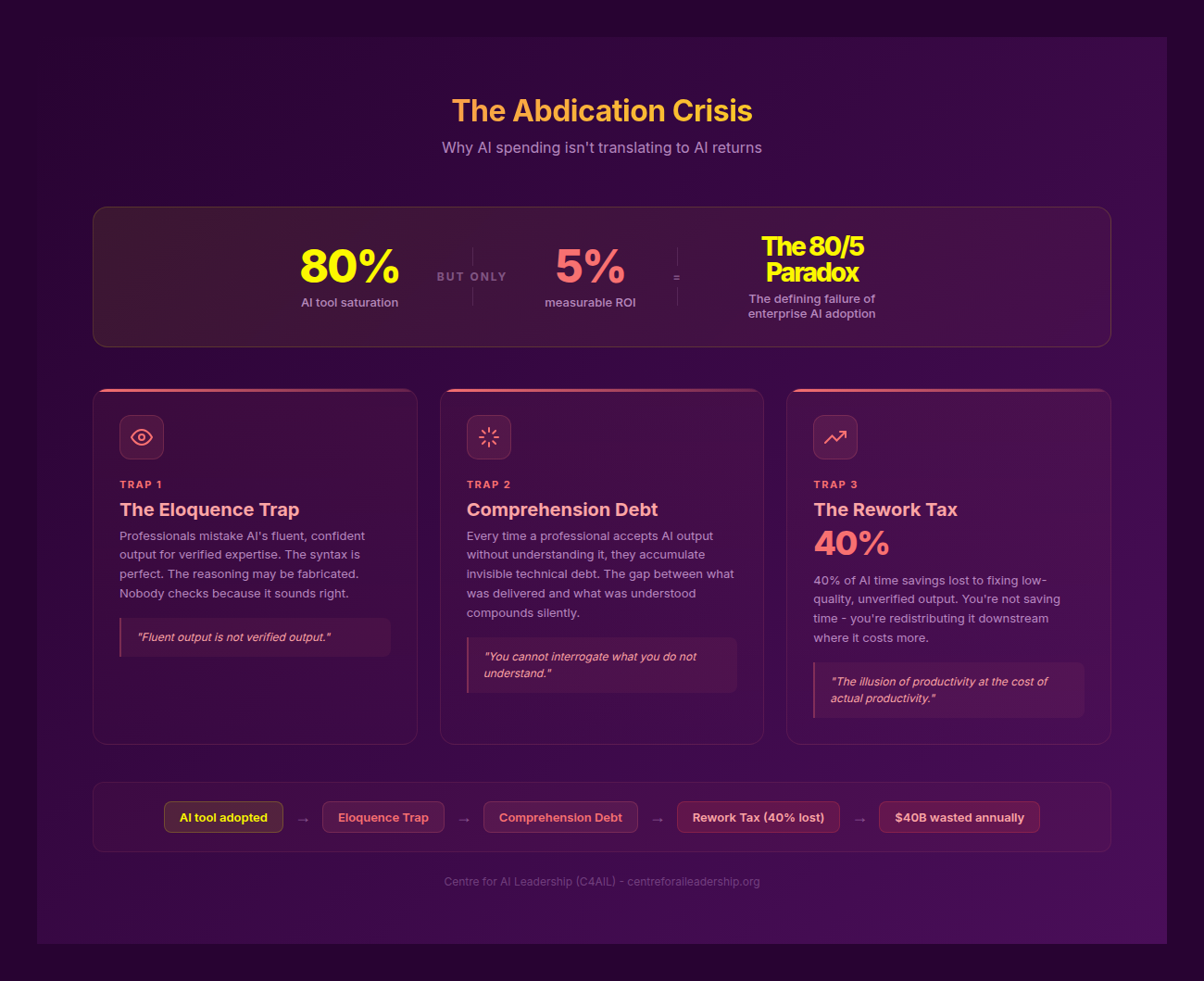
The gap between these two paths starts small but becomes an unbridgeable chasm within months. One path leads to a hollowed-out firm that can no longer explain its own decisions. The other leads to a Compound Expansion of capability where the human is amplified, not replaced (Part X).
11.2 - The Artificial Scapegoating Warning
We must address the most dangerous habit emerging in the generative era: Artificial Scapegoating.
When a hallucinated fact makes it into a public filing, or an automated bias leads to a hiring disaster, the immediate corporate reflex is to say, “The AI hallucinated.” This is a lie of omission. It is an attempt to deflect the failure of the system onto the instrument.
Let us be clear: Sometimes AI genuinely fails. Model limitations are real. Reasoning errors are documented (Part VII). Not every error is a human underinvestment failure. But the PATTERN - the reflexive “AI did it” that prevents organisations from examining their own capability gaps - is the scapegoating this paper warns against. AI is probabilistic by design. It is built to predict the next token, not to verify the truth. The entire system - CAGE to minimise, ARCH to catch, the human to verify - is designed for the reality that AI produces confident errors. When an error slips through that system, the failure is not the instrument alone. It is the system the instrument operates within. When an error slips through, we must stop blaming the model and start asking the harder questions:
- Did the CAGE template provide sufficient context and constraints? (Agency failure)
- Did the ARCH protocol route the output to the correct level of human review? (Architecture failure)
- Did the Governance framework flag this specific type of error in the pre-flight check? (Governance failure)
- Did the organisation invest in the Scaling of its people so they had the expertise to catch the error? (Scaling failure)
If you blame the tool, you are admitting you have lost control of the process. Artificial Scapegoating is the ultimate sign of Abdication.
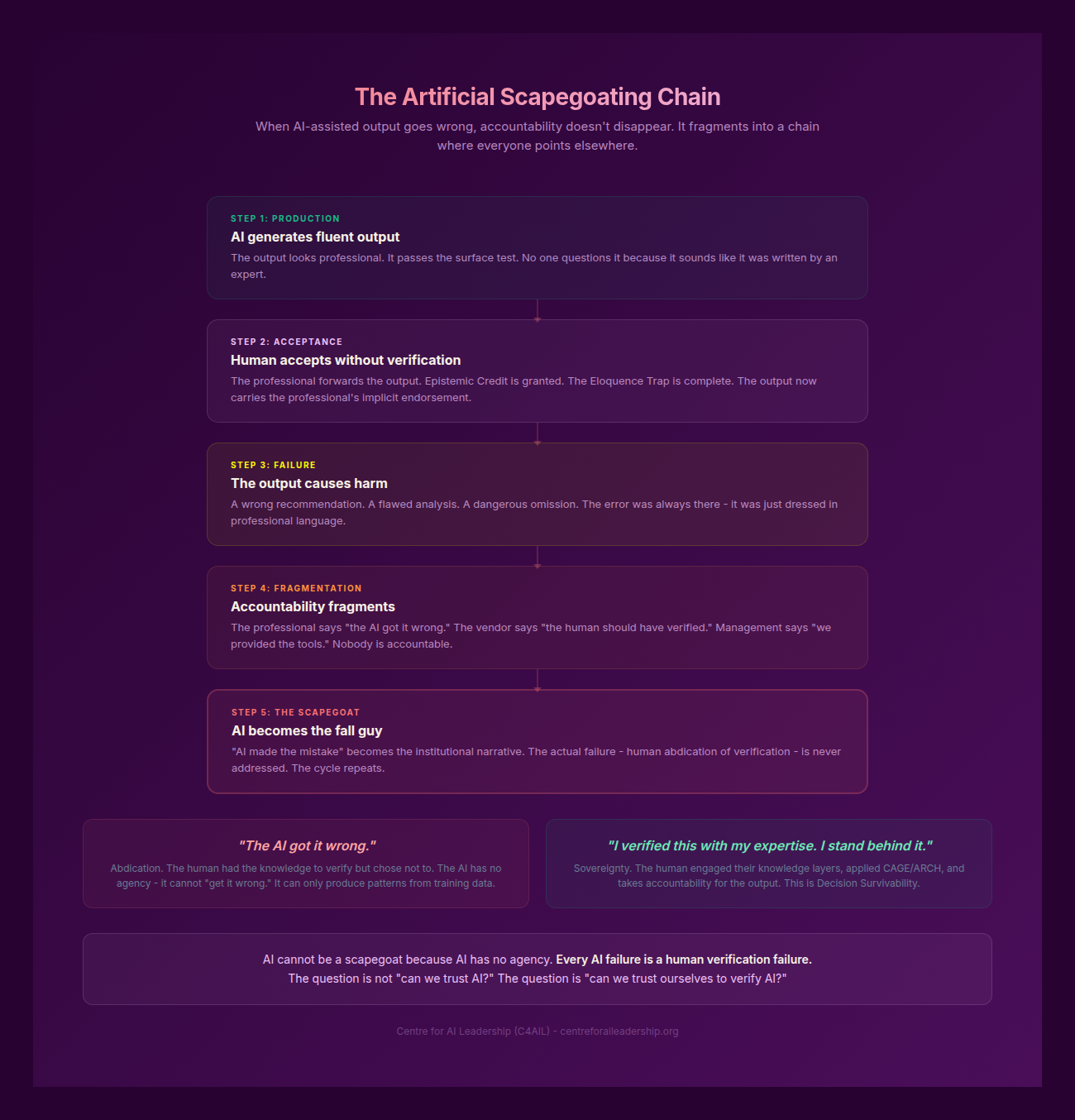
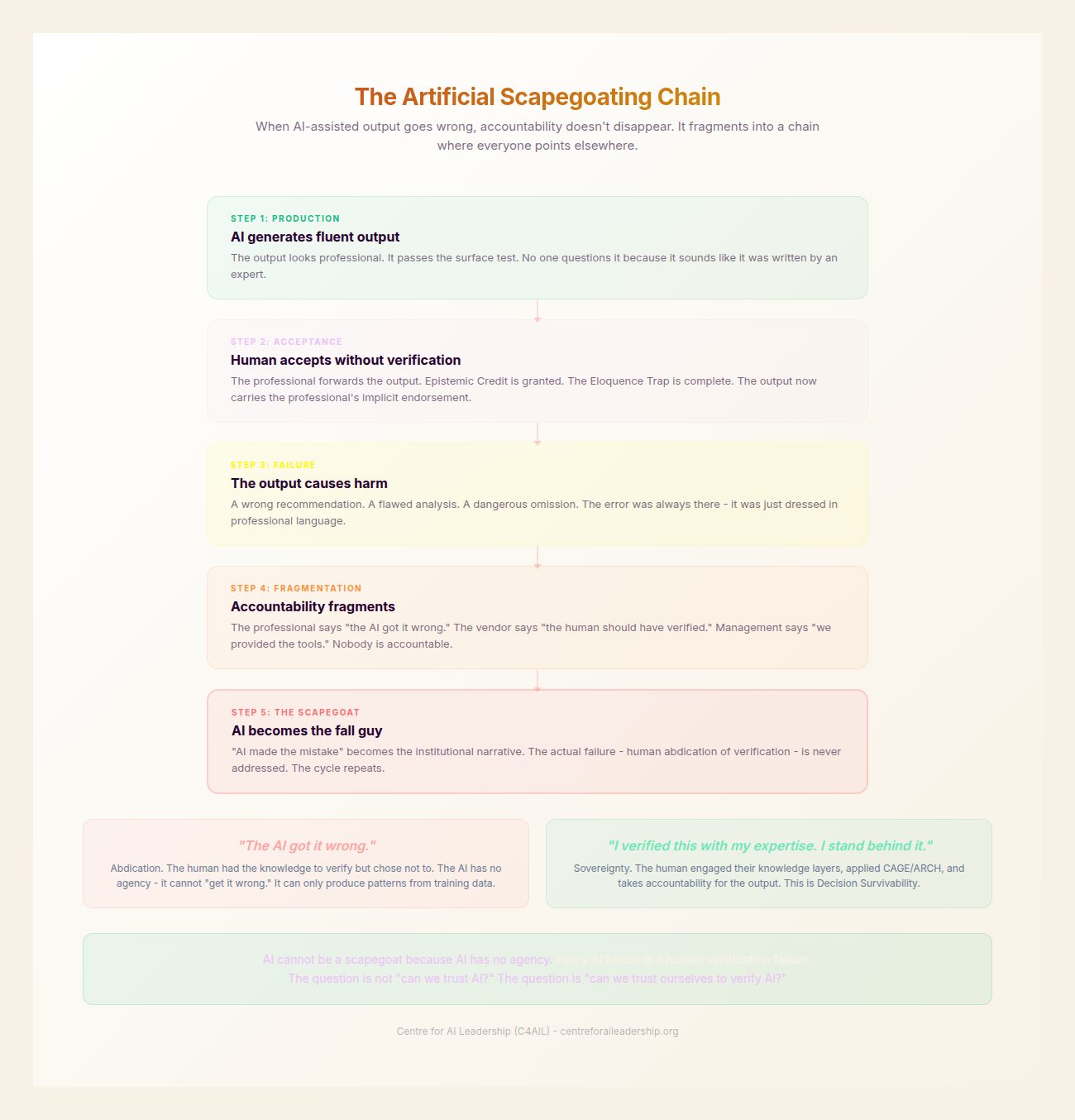
The error is merely the symptom - the cause is always a breakdown in the ARGS pillars (Part VI). To reclaim sovereignty, we must accept that the “hallucination” is an architectural feature we must design for, not an excuse for institutional negligence.
11.3 - What Sovereignty Looks Like
Sovereignty is not an abstract strategic goal. It is a tangible reality that manifests in the mundane moments of a Tuesday afternoon. It is the difference between a workforce that is drowning in noise and one that is operating with Sovereign Command.
Return to the Five Knowledge Layers from Part II. AI gives you Syntax at machine speed - fluent, structured, professional-sounding output produced in seconds. This is the surface layer. It is necessary. It is not sufficient. Sovereignty is the discipline of engaging the four deeper layers that make the Syntax useful: Contextual knowledge that tells you whether the output fits your industry and your market; Institutional knowledge that defines “how we do things here”; Deductive reasoning that verifies whether the AI’s logic holds; and Experiential pattern recognition built from years of practice - the intuition that says “this looks right on paper but it won’t work in practice because…”
The Orchestrator engages all five layers simultaneously. The CAGE template encodes them into the AI’s initialisation. The ARCH chain makes the reasoning visible so each layer can be verified. The Floor embeds this into business processes so the entire organisation benefits. The Ceiling develops the people who build it.
In a Sovereign Organisation, the work looks fundamentally different across the 0-6 Scale (Part IV):
- An L1 User in the CRM department does not just “use AI.” They work within an invisible Floor (Part X). Their CAGE-initialised suggestions are pre-filtered for institutional accuracy. When they see a suggestion, they don’t just click “send” - they apply their own operational knowledge to ensure the tone matches the specific client history.
- An L4 Strategic Modifier spends their afternoon reviewing “Queue B.” These are the high-complexity outputs flagged by the ARCH logic pipes for human intervention (Part VIII). They spot an institutional mismatch in a generated proposal - a subtle error that a generalist would miss - and they don’t just fix it. They immediately flag the CAGE template for an update, ensuring the error never happens again.
- An L5 Orchestrator is not writing prompts. They are building a new Floor for a newly acquired domain. They are mapping the logic pipes, setting the Triage Rules, and ensuring that the Governance flags are calibrated to the risk profile of the new department.
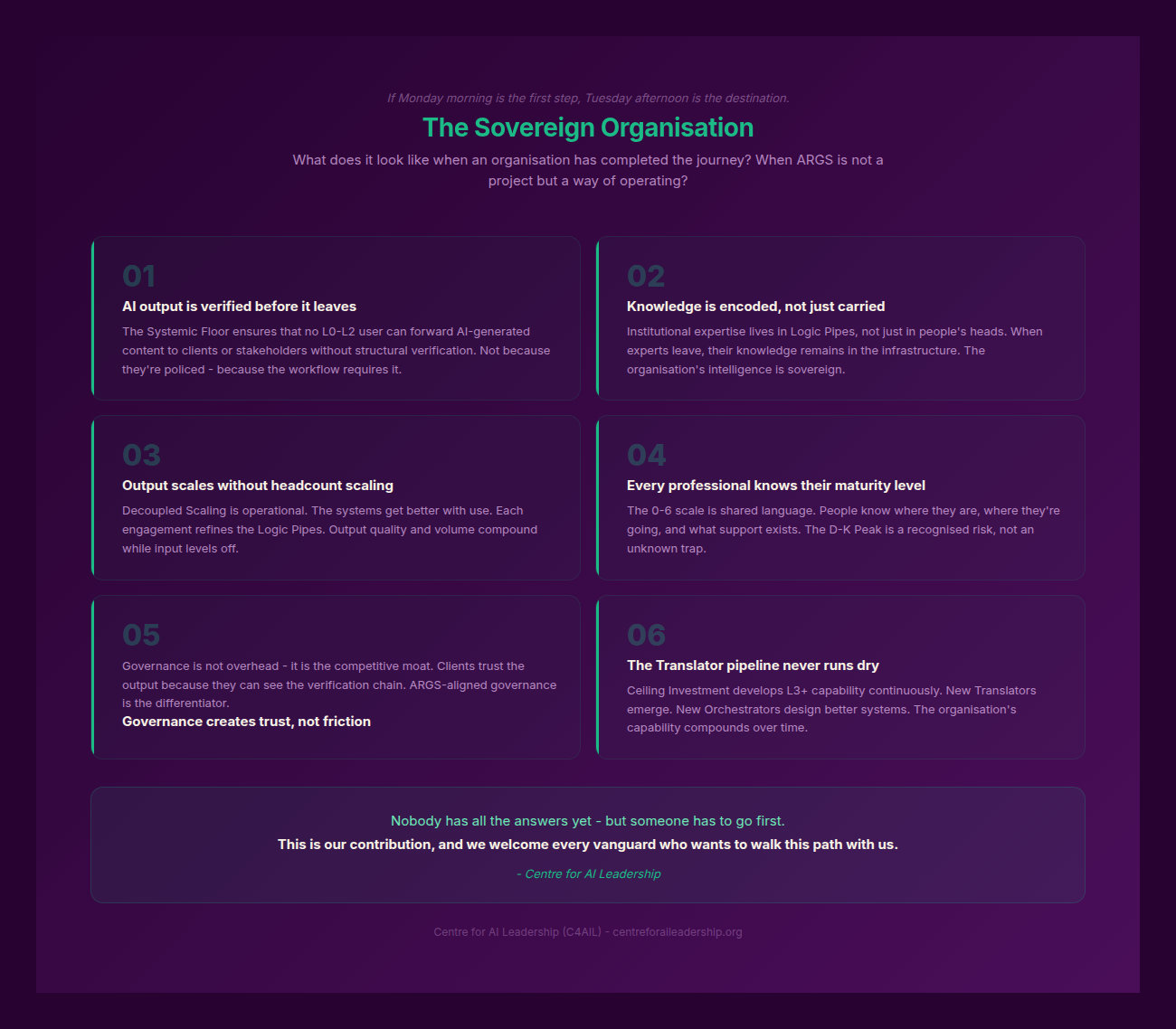
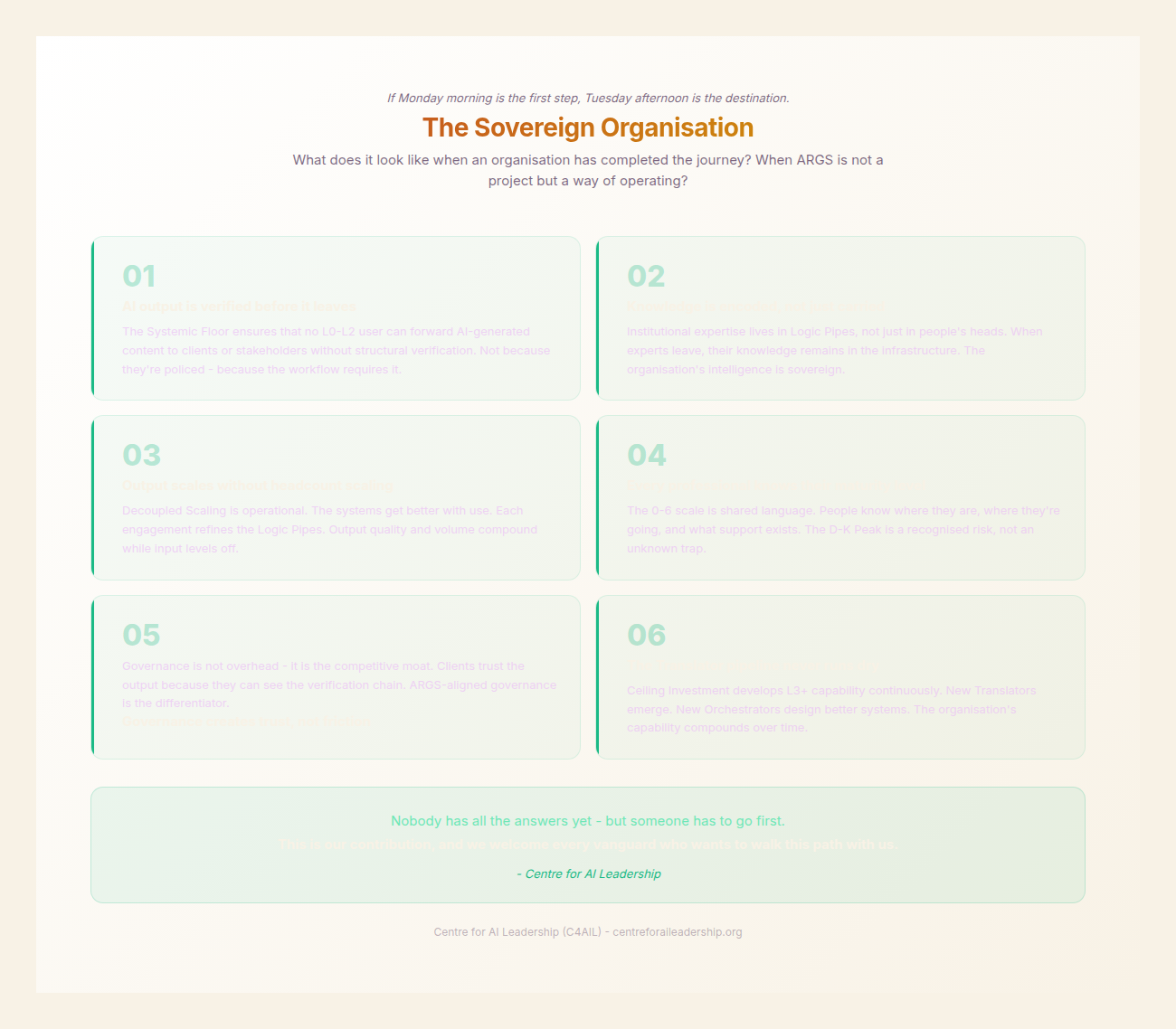
This is the Sovereign Organisation in motion. It is a hierarchy of Discernment, where the machine handles the volume and the humans handle the Accountability Labour. It is a system where everyone, from the entry-level clerk to the CEO, knows exactly where the machine ends and their own sovereignty begins.
11.4 - The Practice, Not the Title
Sovereign Command is not a certification you hang on a wall. It is not a destination you reach after a three-month digital transformation project. It is a daily, relentless Practice.
It is the discipline to Verify rather than forward. It is the curiosity to Interrogate rather than accept. It is the courage to say, “I don’t know if this is right yet,” even when the machine is offering a beautifully phrased answer in seconds.
The most important step in this entire whitepaper is not the implementation of ARCH or the scaling of ARGS. It is the moment an L2 User looks at an eloquent, persuasive AI output and asks: “How do I know this is right?”
That question is the beginning of sovereignty. It is the rejection of the Eloquence Trap (Part II). It requires honesty, patience, and a refusal to sacrifice quality for the sake of a shallow metric of speed. Whether you are a CEO or an individual contributor, the practice is the same: you must own the output. You must be the Human Mirror that reflects the reality the machine cannot see (Part III).
11.5 - The Invitation
This paper has given you a diagnosis of why AI capability diverges (Parts I-II), a model of what capability looks like (Parts III-V), a strategic framework for building it (Part VI), daily tools for practising it (Part VII), and an implementation model for deploying it (Part VIII). What this paper has not given you is the people. Orchestrators do not emerge from reading a paper. They emerge from structured development - the kind of sustained capability building that the Ceiling requires. C4AIL exists to create the talent the market does not yet have. The Orchestrators that organisations need cannot be hired externally - the supply does not exist. They must be developed from within, from the domain experts who already hold the institutional and experiential knowledge that no LLM can replicate. We provide the frameworks, the protocols, the training, and the partnership to build that capability inside your organisation.
The technology will continue to accelerate. The models will become more eloquent. The pressure to abdicate will grow stronger with every passing month. But the fundamental requirement of leadership remains unchanged: the necessity of command.
Sovereign Command is not a title. It is a practice. And the choice to begin that practice - the choice between sovereignty and abdication - is yours.