
Part X: The Implementation — Floor vs Ceiling
The Floor vs Ceiling implementation model — minimum viable sovereignty versus the full sovereign organisation.
Part X: The Implementation - Floor vs Ceiling
The central crisis of the generative era is not a failure of technology, but a failure of discernment. As we move deeper into 2025, the initial euphoria of the “chat box” has curdled into a quantifiable malaise. Gartner now places Generative AI (GenAI) firmly in the Trough of Disillusionment, predicting a two-to-five-year climb before reaching a productive plateau (Gartner 2025). This disillusionment is not accidental. It is the direct result of an implementation strategy that treated AI as a tool to be “adopted” rather than a structural shift to be engineered.
The data is damning. A July 2025 study by METR revealed that experienced developers, when using AI, took 19 per cent longer to complete tasks while simultaneously believing they were 20 per cent faster (METR 2025). This is the Dunning-Kruger Peak at corporate scale: a state where perceived productivity masks actual operational drag. Furthermore, Workday reports that 40 per cent of AI-driven time savings are currently lost to Rework, as humans spend their “saved” time correcting the subtle hallucinations and structural errors of unguided models (Workday 2026).
To escape this trap, organisations must abandon the “universal training” myth. The idea that every employee needs to become a “prompt engineer” is the single most expensive mistake of the last three years. It produces Comprehension Debt - a state where the organisation uses tools it does not understand to produce outputs it cannot verify.
The C4AIL solution is the Dual-Track Model. We do not train everyone to the same level because not everyone needs to be an Orchestrator. Instead, we build a Systemic Floor to protect the many and a Strategic Ceiling to develop the few.
10.1 - The Dual-Track Model: Not Everyone Needs to Be an Orchestrator
The traditional approach to corporate training is egalitarian and, in the context of AI, catastrophic. By attempting to move an entire workforce from Level 0 to Level 3 on the C4AIL Maturity Scale, organisations ensure that no one actually reaches Level 5. They create a “messy middle” where everyone knows how to generate text, but no one knows how to architect a Verification Engine.
The Dual-Track Model (see diagram: dual-track-population.png) acknowledges a fundamental truth: The Choice to Have a Life. Not every subject matter expert (SME) wants to become a workflow architect. A senior legal counsel, a brilliant mechanical engineer, or a high-performing sales lead should be allowed to remain focused on their primary domain. Forcing these individuals to master the intricacies of CAGE (Context, Align, Goals, Examples) templates is a waste of cognitive capital.
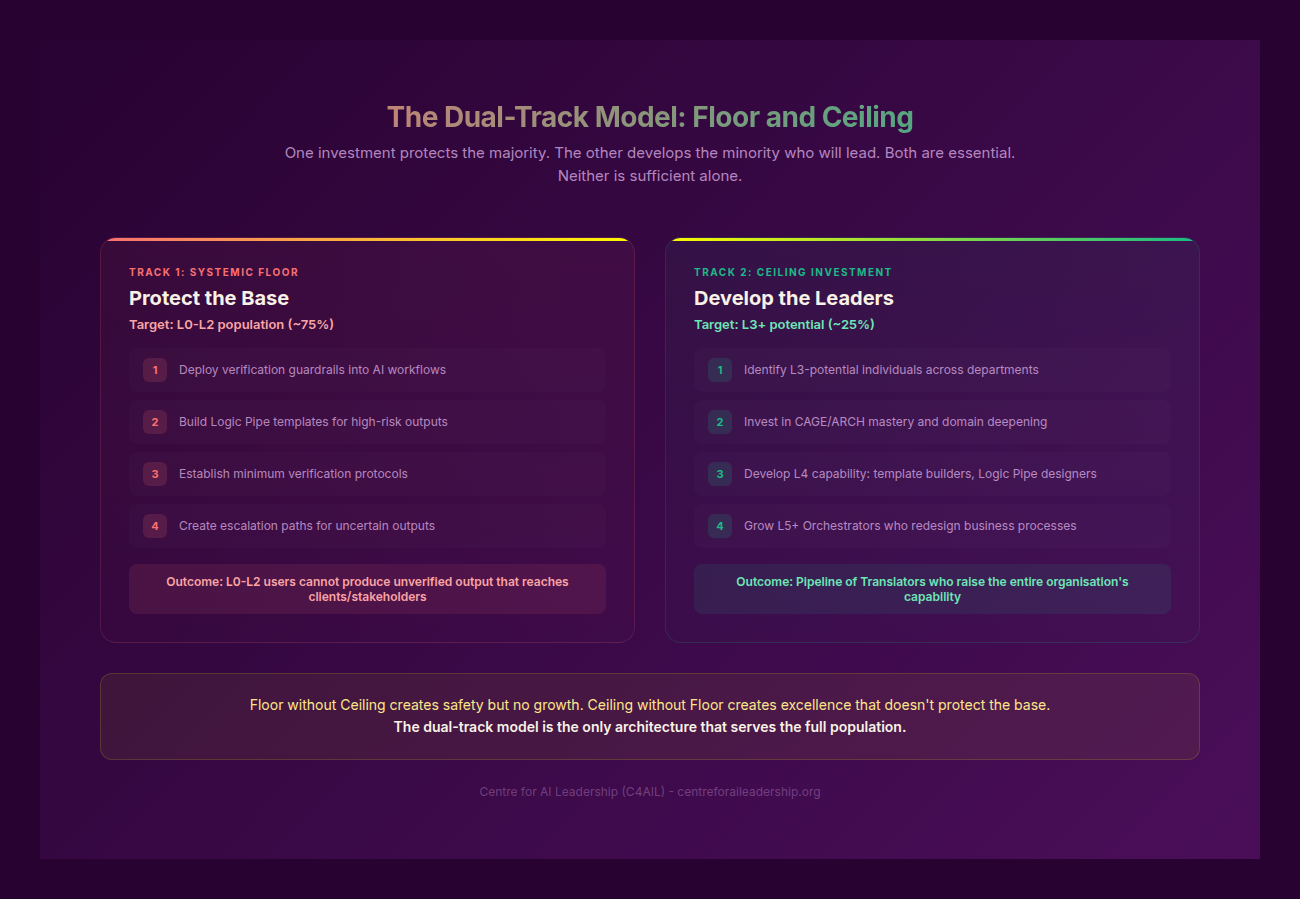
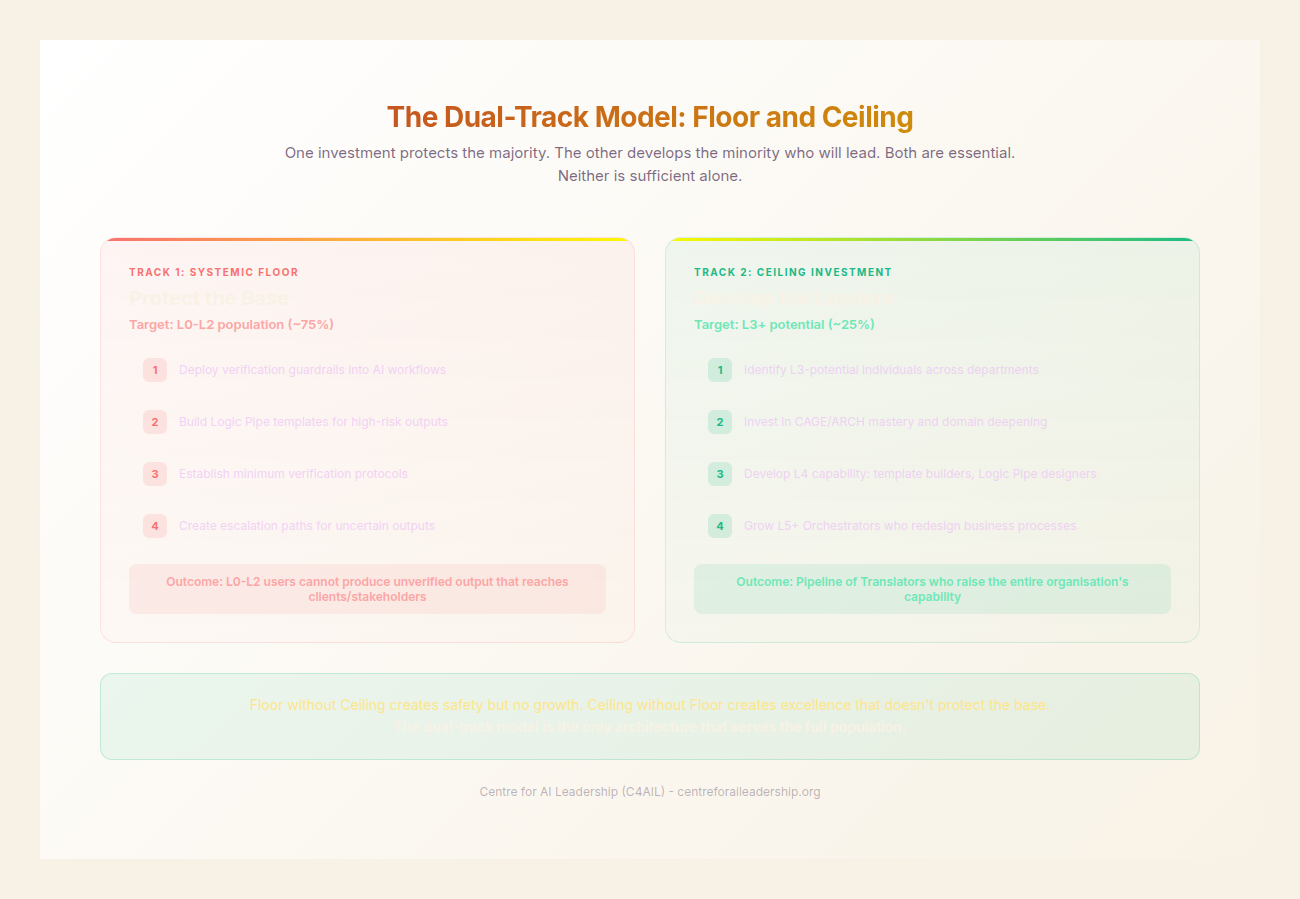
Instead, the organisation must be bifurcated into two distinct developmental paths:
- The Systemic Floor (L0-L2): This covers 90-95 per cent of the workforce. These users do not “manage” AI. They use business tools where AI is an invisible, structural component. Their training is focused on Interrogation and Validation, not creation.
- The Strategic Ceiling (L3-L6): This is the domain of the Orchestrator. These are the individuals - roughly 5 per cent of the workforce - who design the templates, build the ARCH (Action, Reasoning, Contextual Check, Horizon) chains, and manage the Verification Bottleneck.
By separating these tracks, we solve the “95 per cent failure rate” in revenue acceleration reported by MIT NANDA (MIT NANDA 2025). Failure occurs when L1 users are asked to perform L4 architectural tasks. The Dual-Track Model ensures that the complexity is handled by the Ceiling, while the Floor provides a safe, high-velocity environment for daily operations.
10.2 - The Systemic Floor: Invisible AI
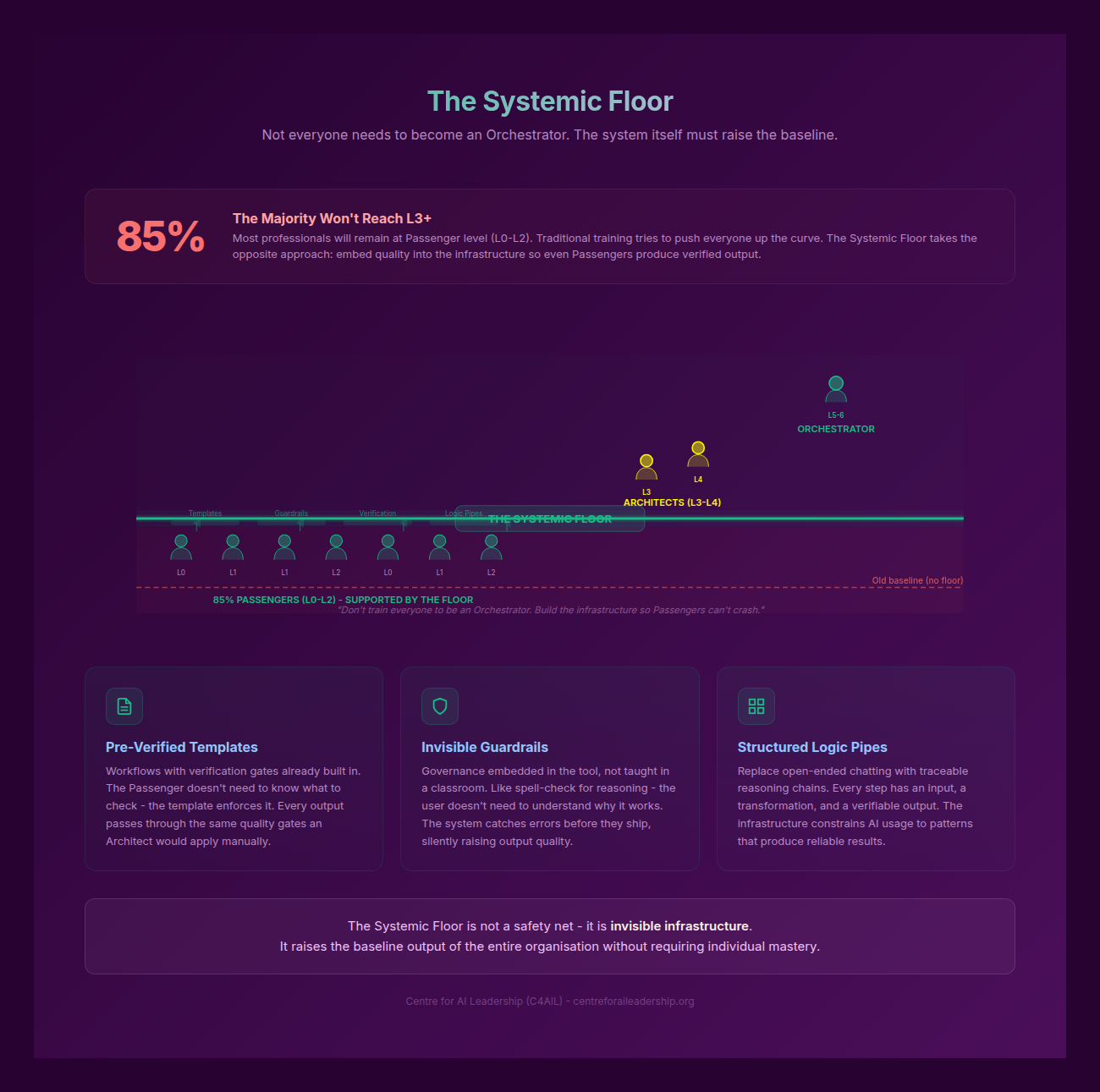
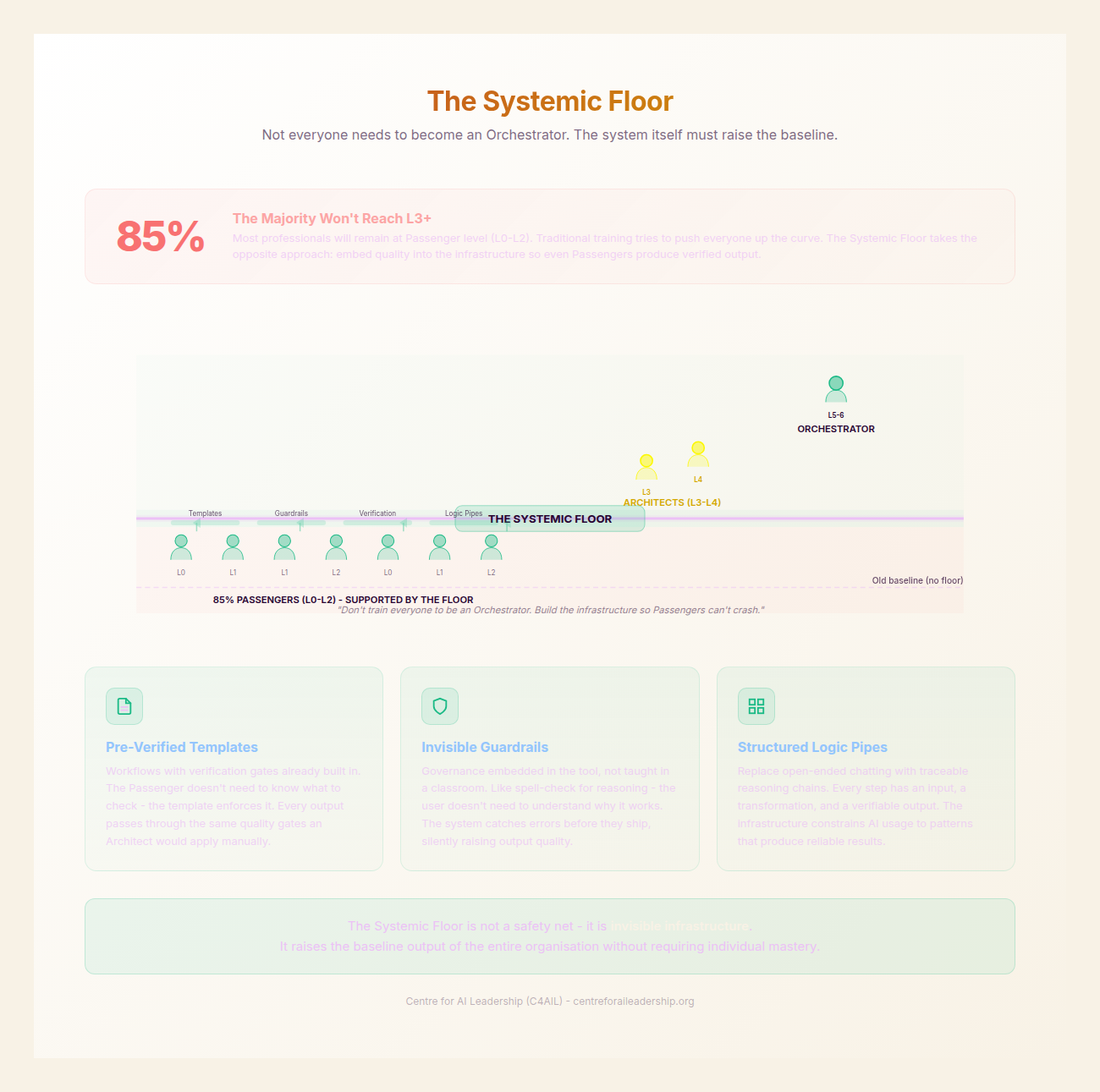
The goal of the Systemic Floor is to eliminate the “blank chat box.” When an L1 or L2 user interacts with AI, they should do so through a Structured Interface. This is Invisible AI - the complexity is hidden, but the existence of the AI is transparent, satisfying the requirements of the EU AI Act Article 50 (EU AI Act 2024).
In a Floor-based environment, a user does not “prompt” a CRM to “help me with this lead.” Instead, they open a standard business tool that has been “floored” by an Orchestrator. Underneath the interface, a CAGE Template is running. It automatically provides the professional context (the “C”), aligns the output with institutional standards (the “A”), applies the strategic goals and scope boundaries (the “G”), and calibrates quality against reference examples (the “E”).
The Floor provides three critical functions:
Structural Verification. Unlike personal verification, where a human “vibes” the output, the Floor uses ARCH Verification Chains. Every output produced by the Floor is automatically checked by a secondary, “critic” model before the user even sees it. This reduces the $9 million annual loss per 10,000 employees attributed to “AI workslop” (HBR/BetterUp/Stanford 2025).
Expert Routing. The Floor manages the Queue System. If an AI output fails a structural check, it is not shown to the L1 user. It is routed to Queue B (for Orchestrator review) or Queue C (for Senior SME sign-off). The L1 user only sees “Verified” or “Draft” outputs that have already passed a baseline of institutional rigour.
Developmental Scaffolding. The Floor is not just a safety net; it is a teacher. By showing users what “good” looks like - and by providing the Reasoning Trace of why an output was generated - it surfaces the next generation of Ceiling candidates. When an L2 user begins to consistently interrogate the Floor’s logic and suggest improvements to the underlying CAGE templates, they have identified themselves as an L3 candidate.
What the Floor requires to build:
The Floor does not build itself. It requires:
- Orchestrators who understand both the domain and the architecture (Part V’s double-threat profile)
- CAGE templates designed for specific workflows, specific roles, specific institutional contexts (Part VIII)
- Verification Engines with appropriate triage (Queue A/B/C from Part V, governance infrastructure from Part VI)
- Living governance - the templates and verification logic must evolve as the domain shifts (Part VI’s governance-as-value)
- Data infrastructure - data foundations, model selection, RAG architecture designed around CAGE requirements (Part VIII Section 8.5)
All of this comes from the Ceiling. Without the Ceiling, there is no Floor. This is why a tool rollout is not an implementation - you cannot deploy the Floor without the people who build it.
Crucially, Accountability on the Floor travels upward to the human who signed off on the process, not the AI or the template designer. By standardising the “how,” the Floor allows the “who” to take sovereign command of the “what.”
10.3 - The Strategic Ceiling: Training Orchestrators
If the Floor is the safety net, the Strategic Ceiling is the engine room. This is where the organisation’s Sovereign Command is actually exercised. Training for the Ceiling is not a technology course; it is a discipline in Architectural Thinking.
We have found that the most successful Orchestrators are not necessarily “tech-savvy” juniors, but “process-obsessed” mid-to-senior experts. They possess the deep domain expertise required to know when a model is “hallucinating excellence” - producing something that sounds perfect but is structurally hollow.
The Ceiling curriculum focuses on four pillars:
1. Thinking in Workflows. Orchestrators do not see tasks; they see Information Flows. They are trained to decompose a complex business process (e.g., “Quarterly Financial Reporting”) into a series of discrete ARCH nodes. They learn to identify where the Verification Bottleneck will occur and design the system to solve for it before a single prompt is written.
2. CAGE/ARCH Design. This is the “coding” of the generative era. Orchestrators learn to build robust, reusable templates that embed institutional memory. They learn the art of Negative Guardrailing - telling the model what it is not allowed to assume - and how to use Chain of Verification (CoVe) to force the model to fact-check its own reasoning.
3. Verification Engine Design. The Orchestrator’s primary output is not “content,” but a Verification Engine. They design the automated checks that run on the Floor. This includes setting the thresholds for Queue Routing and defining the “Gold Standard” datasets used to evaluate model performance.
4. Translation at Org Scale. The Orchestrator acts as the bridge between the “What” (Business Strategy) and the “How” (AI Execution). They must be able to translate a CEO’s strategic intent into a technical architecture that 5,000 employees can use safely on Monday morning.
Let me be clear about what Ceiling training is NOT:
- It is not a prompt engineering course. Prompt engineering teaches how to get better individual responses. Ceiling training teaches how to design systems that produce verified output at scale.
- It is not a technology course. The Orchestrator does not need to understand transformer architectures or fine-tuning parameters. They need to understand how to translate domain expertise into structured AI interaction - a design capability, not a technical one.
- It is not a one-day workshop. Moving from L3 to L5 is measured in months, not days. It requires practice, mentoring, feedback on real designs, and iteration on real systems. Part V’s four development triggers apply: frustration with repetition, team responsibility, scale pressure, and structured training.
- It is not for everyone - and that is its strength. An organisation with three L5 Orchestrators, twenty L3-4 practitioners, and hundreds of L1-2 users operating on a well-designed Floor is more capable than one that tried to make everyone an L4.
By concentrating investment in the Ceiling, the organisation builds a high-leverage cadre of leaders who can scale quality across the entire enterprise.
10.4 - The Training Imperative: The Ask
Ethan’s Voice:
Let’s be blunt. You cannot hire Orchestrators. The talent market for this specific blend of domain expertise and architectural rigour does not exist yet. If you try to recruit your way out of this, you will end up with “AI Consultants” who can talk about the technology but cannot build a Sovereign System that survives a Tuesday morning crisis.
You must build them. And you must build them from within.
And let me be honest about conventional L&D: most corporate training fails to produce measurable returns - and the reason is that most L&D departments optimise for the wrong things. Course catalogues that look impressive. Completion rates that satisfy compliance. Certifications that stroke egos. They measure inputs (hours delivered, seats filled) rather than outputs (capability demonstrated, systems built). Ceiling development is a different species entirely: it produces tangible artefacts - CAGE templates, Verification Engines, Floors that serve hundreds. The ROI is not measured in training hours completed. It is measured in Floors built, in verified output quality, in error catch rates, in the operational infrastructure that each Orchestrator creates. Measure the output of the Orchestrators, not the hours of instruction.
“The Ask” I make of every Board I advise is this: Stop buying tools and start building Capability. Your 2025-2026 budget should not be a list of SaaS subscriptions; it should be a blueprint for a Compound Expansion Cycle (see diagram: ceiling-investment-trajectory.png).
The economics of this are clear. A tool-only approach yields a Year 1 productivity bump, followed by a Year 2 plateau and a Year 3 “AI didn’t deliver” post-mortem. However, a Ceiling-plus-Floor approach follows a Power Law. In Year 1, you see the same bump. In Year 2, your quality improves as the Floor catches the “workslop.” By Year 3, the cycle compounds. Your Orchestrators (Ceiling) build better Floors, which free up more SMEs to become Orchestrators. By Year 4, you achieve Decoupled Scaling - your output and quality increase exponentially while your headcount and risk profile remain linear.
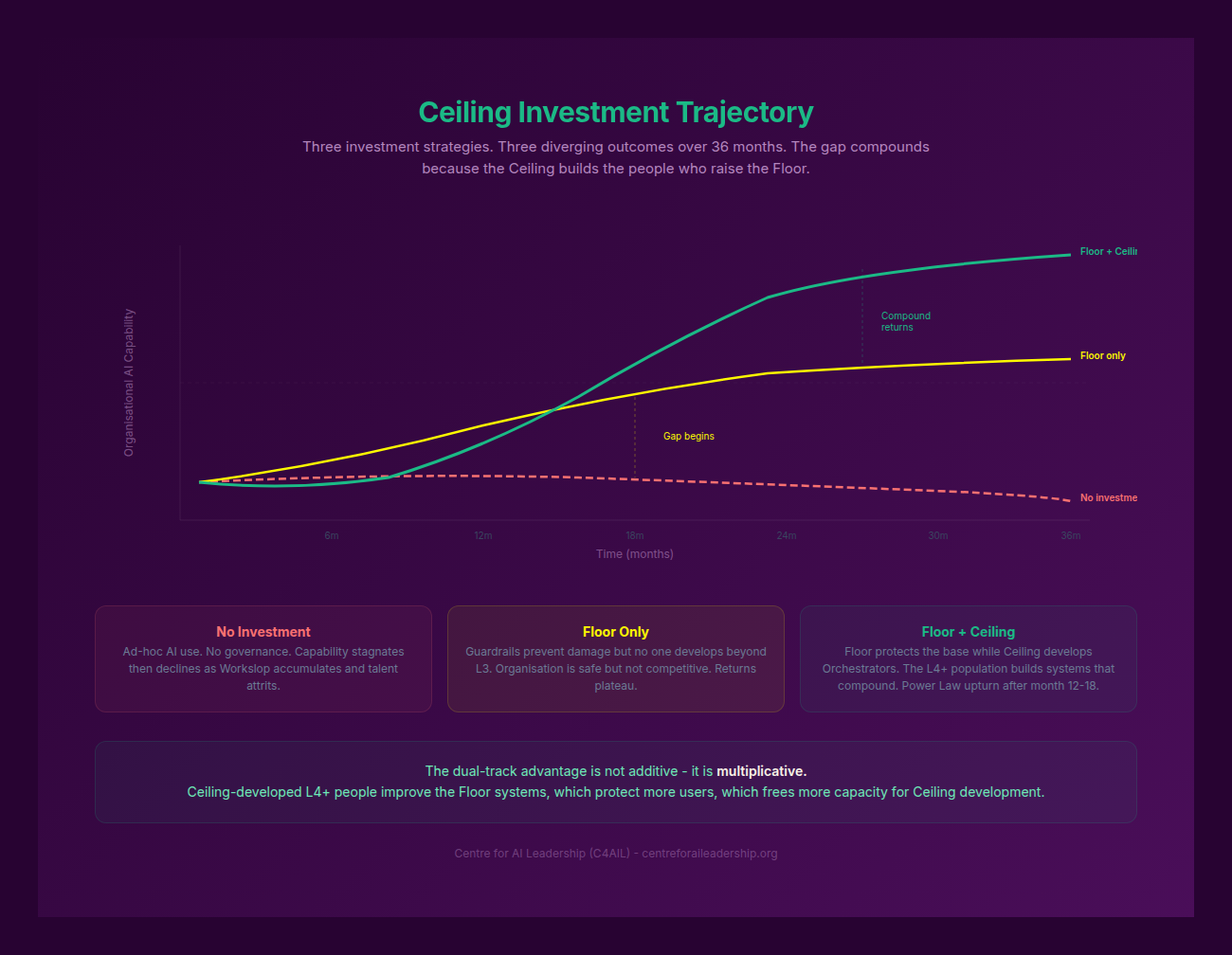
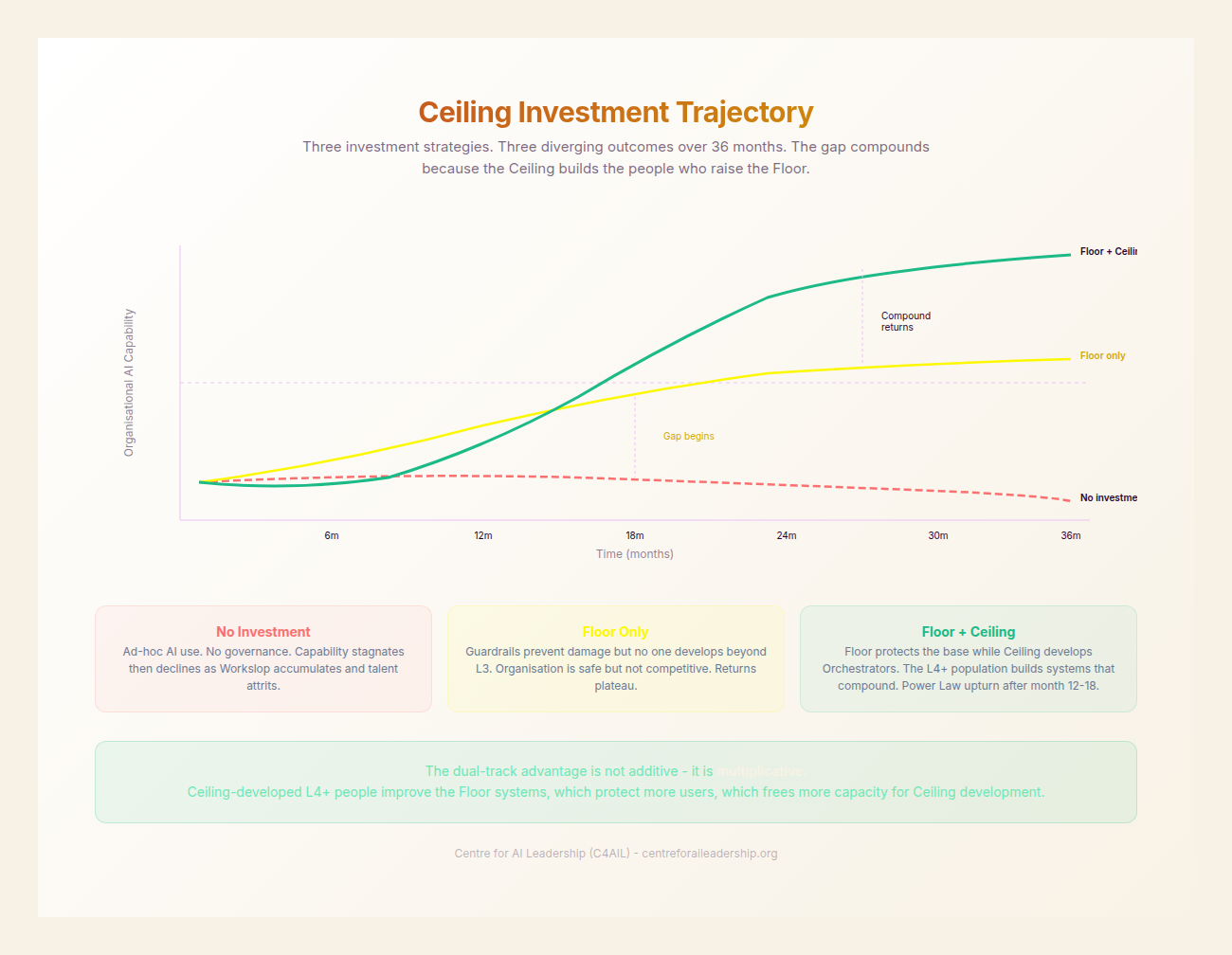
Bain’s 2025 Technology Report confirms this: organisations that focus on Workflow Redesign (the Ceiling) see 25-30 per cent efficiency gains, compared to just 10-15 per cent for those who only deploy tools (Bain 2025).
This is the Missing Middle. You have the models (the basement) and you have the vision (the roof). But you are missing the Floor that protects your people and the Ceiling that directs your power. My ask is that you commit to the pipeline. Today’s L0 must become tomorrow’s L2. Today’s L3 must be given the space and the mandate to become the L5 Orchestrators who will run your company in 2027.
If you don’t build this pipeline, you are not “implementing AI.” You are just renting a more expensive way to make mistakes.
10.5 - Monday Morning: Where to Start
Implementation does not begin with a “Global AI Day.” It begins with a surgical strike on your most critical, high-friction workflow. Here is the five-step plan for Monday morning.
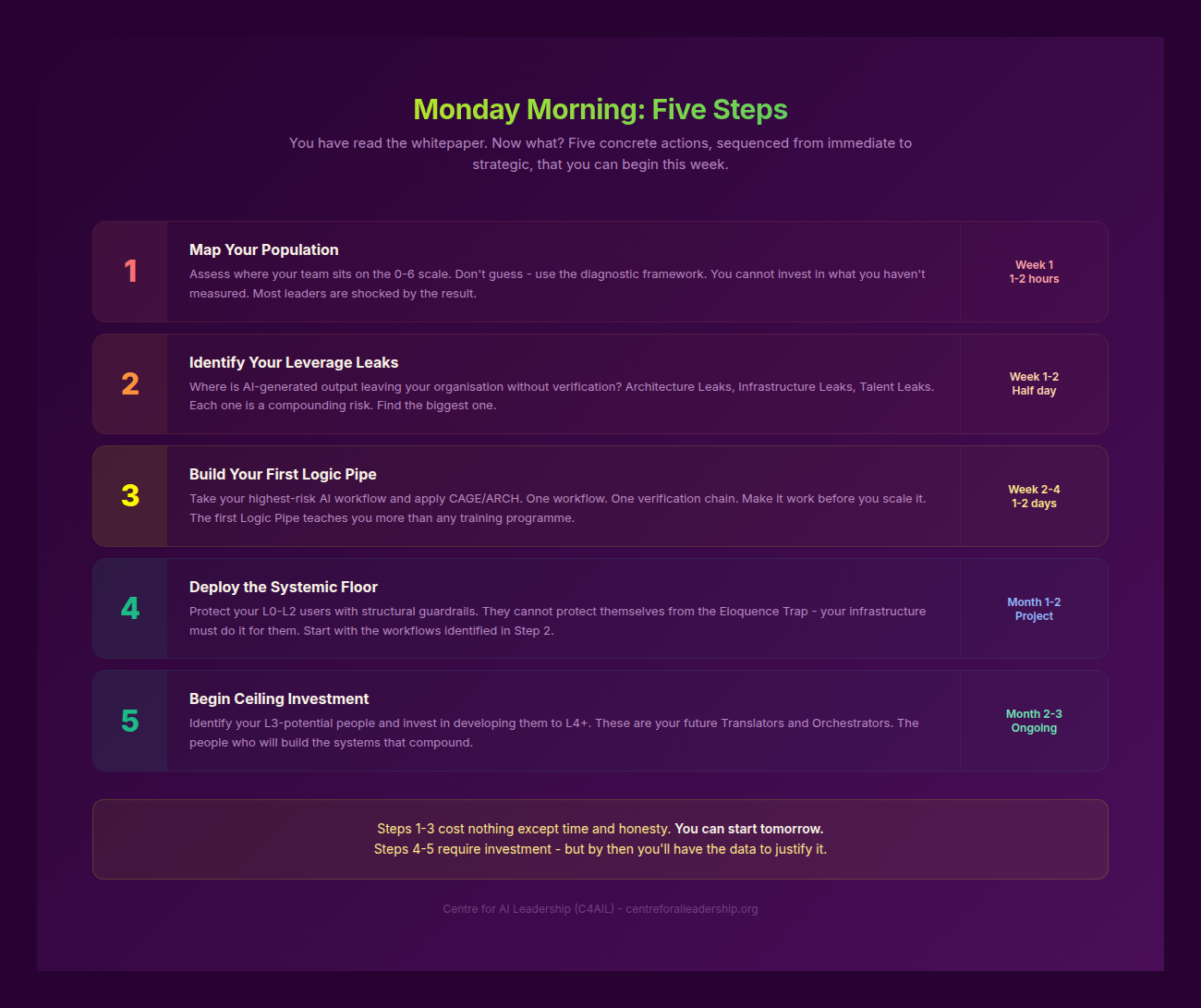
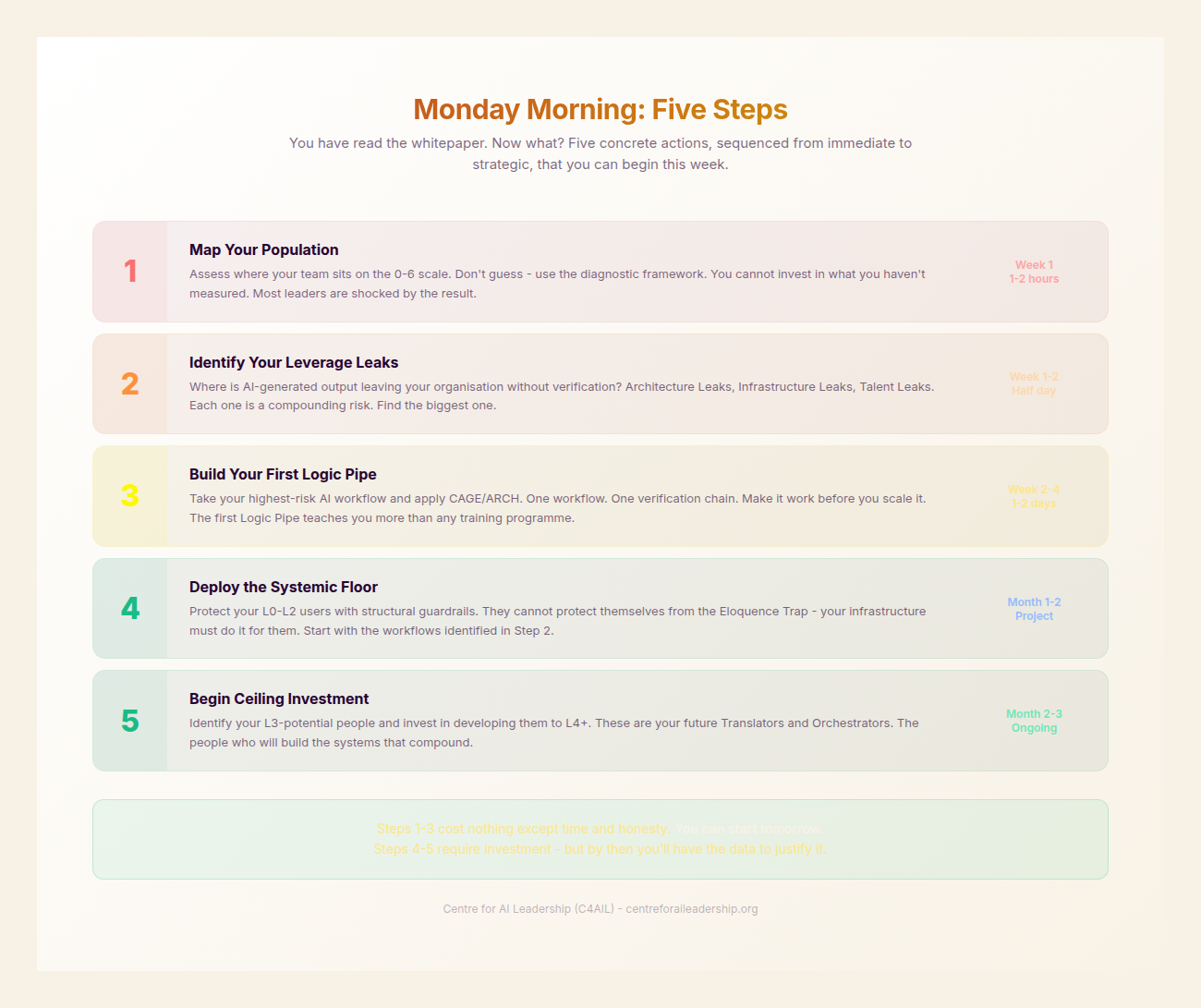
Step 1: The Diagnostic. Use the C4AIL Maturity Diagnostic (from Part IV) to assess your current state. Do not guess. Measure your Error Catch Rate and your Comprehension Debt. Identify which departments are currently living on the “Dunning-Kruger Peak” - believing they are fast while actually creating rework.
Implementation is maturity-gated, not calendar-gated. Where you start depends on where you are:
- If most of your workforce is L0-1 and you have no L3+ practitioners: start with Agency (Part VI). Before you build anything, your people need to understand what AI output is and is not. Begin with awareness, not tools.
- If you have L1-2 users and a few L3+ domain experts: start building the Floor and the Ceiling simultaneously. Your L3+ experts begin Ceiling development while your existing tools serve L1-2 users through whatever structured workflows you can build immediately - even imperfect ones.
- If you already have L4+ practitioners who think architecturally: accelerate the Ceiling. These people are ready to build. Give them the ARGS framework, the CAGE/ARCH protocols, and the authority to design the Floor for their domain.
Step 2: Build the First Floor. Select one high-value workflow (e.g., “Customer Onboarding” or “Technical Documentation”). Do not give the team ChatGPT. Instead, task a small group of SMEs to define the CAGE requirements for that workflow. What is the “Gold Standard” for this task? What are the non-negotiable guardrails? Build a structured interface that embeds these requirements. This is your first Systemic Floor.
Step 3: Develop the First Orchestrators. Identify 3-5 individuals who showed the most aptitude during Step 2. These are your initial Ceiling Candidates. Remove 20 per cent of their “daily grind” and enrol them in a formal Orchestrator Development Programme. Their job is no longer to “do the work,” but to “design the system that does the work.”
Step 4: Expand Systematically. Use the output of your first Orchestrators to build the next three Floors. As these Floors go live, monitor the Verified Output per Domain. This is your North Star metric. Adoption rates are a vanity metric; verified, high-quality output is the only metric that matters for Sovereign Command.
Step 5: Govern as a Living System. AI implementation is not a “project” with a completion date. It is a Living System. Your Orchestrators must meet weekly to review the Error Catch Rate at each verification level. When the Floor fails - and it will - the Orchestrators must perform a “Root Cause Analysis” on the CAGE template and update the system.
The transition from “using AI” to “commanding AI” is the defining challenge of leadership in this decade. The tools are ready. The models are capable. The only question is whether you have the architectural courage to build the Floor that supports your people and the Ceiling that elevates your organisation.
The era of “prompting” is over. The era of the Orchestrator has begun.
References:
- Bain & Company (2025). Bain Technology Report 2025: The Workflow Imperative.
- EU AI Act (2024). Article 50: Transparency obligations for providers and users of certain AI systems.
- Gartner (2025). Hype Cycle for Emerging Technologies: The Trough of Disillusionment.
- HBR / BetterUp / Stanford (Sept 2025). The Workslop Audit: Quantifying the Cost of Unverified AI Output.
- METR (July 2025). The Productivity Paradox: Perceived vs. Actual Speed in AI-Assisted Development.
- MIT NANDA (Aug 2025). Why 95% of GenAI Pilots Fail to Accelerate Revenue.
- Workday (2026). The Rework Report: The Hidden Cost of AI Efficiency.