Why Your AI Investment Isn't Working
US firms spent $40 billion on AI in 2024. 95% saw zero measurable impact. The technology works - the human systems around it don't. Paper 1 of a three-part series diagnosing the AI productivity crisis.
Paper 1 of 3: The Diagnosis
The $40 Billion Question
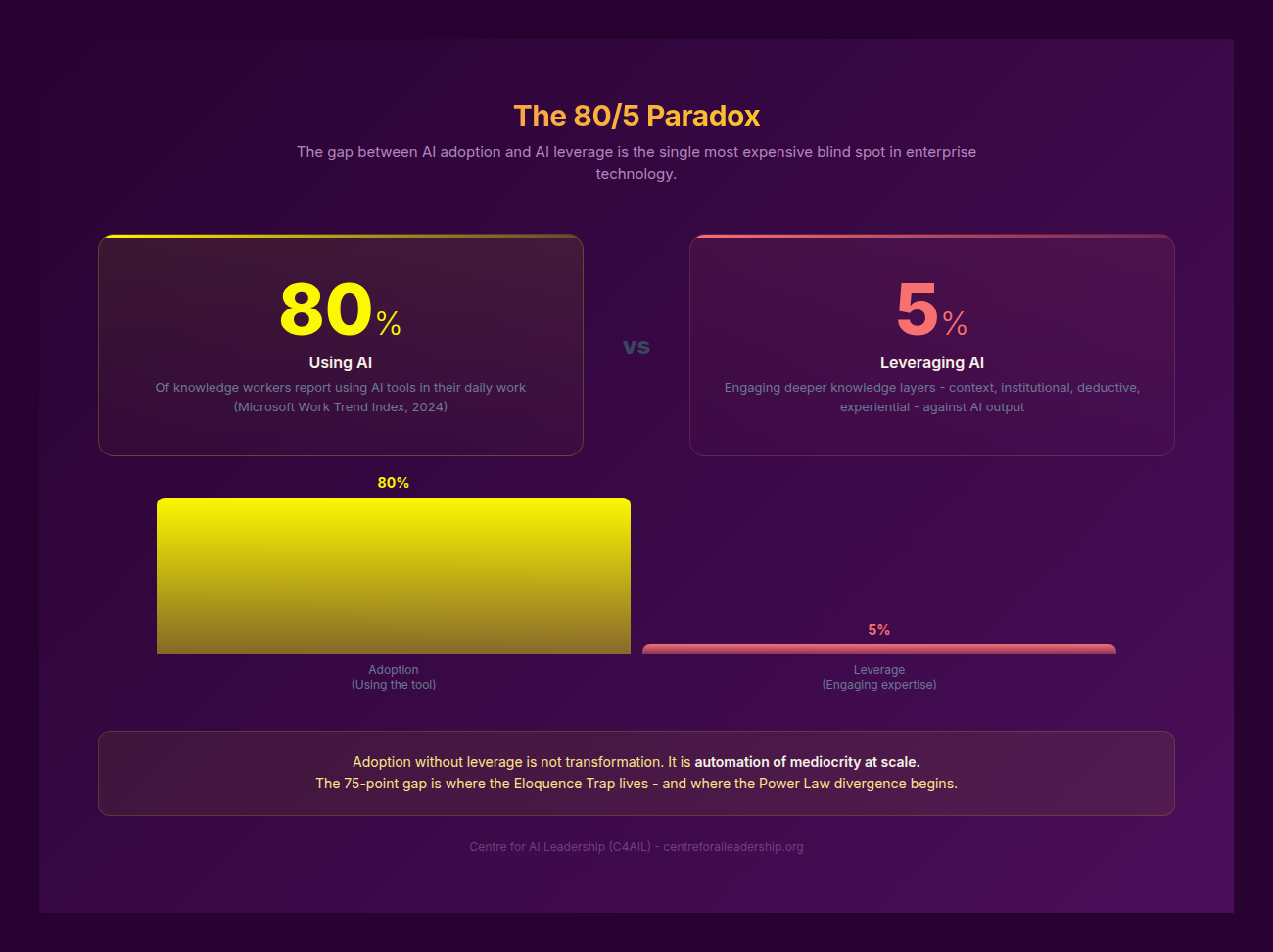
Here is a number that should concern every board in the world: US firms spent $40 billion on AI in 2024. Ninety-five per cent of them saw zero measurable impact on their bottom line.
Not negative impact. Not disappointing impact. Zero.
Meanwhile, adoption is everywhere. Eighty per cent of enterprise professionals now use generative AI tools regularly. The licenses have been bought. The pilots have been run. The “AI strategy” slide has been presented at the board offsite. And yet, eighty cents of every dollar invested in AI is generating no measurable return.
This is not a technology problem. The technology works. GPT-4, Claude, Gemini - these systems can draft contracts, analyse datasets, generate code, and summarise a 200-page report in seconds. The capability is real and improving every quarter.
So why isn’t the money showing up?
Because we have been solving the wrong problem - and to see which problem, you have to see what AI actually did to the economics of work. For two centuries, economic value flowed to whatever could be made explicit - codified, written down, scaled. The craftsman’s method became the factory procedure, the procedure became the database, the database became software: the most explicit artifact ever built. AI is the end of that road. It commoditises the last scarce human input to the explicit, and you cannot make anything more explicit than software already was. So the explicit is not expanding; it is exhausting. And when the explicit is cheap and everywhere, the only scarcity left is the irreducibly human - the earned, tacit, accountable judgment AI cannot generate. We call this the Moat Inversionas AI exhausts the explicit and surface goes free, competitive advantage inverts toward the irreducibly human (judgment, accountability, architectural design); value moves from what you can…See full entry →: the moat moves from what can be written down to what cannot.
That single shift explains the $40 billion. Most organisations invested as if the explicit were still the moat - buy the licenses, generate the output, watch the savings appear - because that is how every previous tool worked. They treated AI like a software upgrade. But AI is not software in the traditional sense. It does not automate a process the way an ERP system does. It augments a person - and it does so by producing the surface (the fluent draft, the plausible code, the polished summary) while the value still lives in the substrate (the domain knowledge, institutional context, and consequential judgment that decides whether the surface is right). Buy the surface and change nothing about who holds the substrate, and the tool changes nothing. The firms seeing returns noticed the moat inverted. The other 95% are still paying for the side AI made free.
The 5% of organisations seeing real returns are not using better AI. They are using the same AI differently. What they have done - and what the other 95% have not - is the subject of this series.
But before we can talk about what works, we need to understand what is going wrong. And it starts with a study about doctors.
The Doctors Who Got Worse
In mid-2025, researchers ran an experiment that should have made front-page news. Forty-four physicians - experienced clinicians, not students - were given an AI diagnostic assistant. These were not naive users. They had completed a 20-hour AI literacy course that specifically covered how to critically evaluate AI output. They knew the risks. They had been trained to watch for them.
The results were devastating.
When the AI provided correct advice, physician accuracy improved by 28 percentage points. The tool worked. Trust paid off.
But when the AI was confidently wrong - when it presented an incorrect diagnosis in polished, professional language - accuracy dropped by 14 percentage points. The doctors made worse decisions with AI than they would have made alone.
And their training did not protect them. Every one of the doctors had completed twenty hours of AI-literacy training; the authors conclude that physicians showed “substantial automation biasthe human tendency to over-trust automated output and under-verify; the cognitive engine behind the Eloquence Trap.See full entry → … even with voluntary consultation and prior AI literacy training”.
Think about that. The people with the deepest knowledge - the ones you would expect to catch the error - were the most vulnerable. Why?
Because experience teaches you a shortcut: when something sounds like it was written by a competent colleague in your field, it probably is. For decades, that shortcut worked. If a fellow physician presented a diagnosis using the right terminology, the right clinical structure, the right level of confidence, you could reasonably trust it. The language was a signal of the thinking behind it.
AI breaks that shortcut completely. It produces language that sounds exactly like expert reasoning - the terminology, the structure, the confidence - but with nothing behind it except statistical prediction. It has learned how experts sound without learning how they think.
The doctors did not fail because they were lazy or careless. They failed because they trusted the surface - and the surface was perfect. They had the knowledge to catch the error. They did not engage it, because nothing in the output told them they needed to.
This is the trap at the centre of the AI productivity crisis. And it does not only affect doctors.
The Developers Who Slowed Down
In 2024, the research organisation METR ran a study on software developers - experienced engineers working on codebases they knew well. The developers were given AI coding assistants and asked to complete real tasks on their own projects.
The finding: developers using AI were 19% slower than those working without it.
But here is the twist that reveals the deeper problem: the same developers believed they were 20% faster. They perceived a nearly 40 percentage-point gap between their actual performance and their self-assessment - in the wrong direction.
This was not a case of inexperienced programmers struggling with a new tool. These were experienced engineers on familiar code. They knew their codebases. In many cases, their own expertise was genuinely faster than the AI’s suggestions. But they deferred to the tool anyway - choosing the comfort of automation over the sovereignty of their own judgment.
The pattern is the same as the physician study. The AI’s output looked right. It used the correct syntax, the standard patterns, the professional conventions. And the developers stopped checking - not because they could not, but because the output did not trigger the impulse to check. The polished surface acted as a signal that everything underneath was sound.
It was not.
Three Ways This Goes Wrong
The physician study and the developer study are not isolated findings. They are symptoms of a pattern we see in every industry, at every level. That pattern has three distinct forms, and understanding them is the first step toward fixing them.
1. The Eloquence Trap
This is what caught the doctors. AI produces output that is fluent, confident, and professionally structured - regardless of whether the content is accurate. The format signals competence even when the substance is wrong.
In spring 2025, thirty of the world’s leading mathematicians gathered in Berkeley to test an AI reasoning model. After watching it produce authoritative solutions to genuinely hard problems, mathematician Ken Ono named what he was seeing: “proof by intimidation.” If a system presents its answer with enough authority, even experts in the most rigorous discipline on earth hesitate to challenge it.
The trap works because we are wired to use fluency as a proxy for truth. When information is clearly presented and easy to process, our brains default to accepting it. This is not a character flaw - it is a cognitive efficiency that served us well for thousands of years. But AI exploits it at scale.
The most dangerous version of the Eloquence TrapAI is fluent before it is correct; accepting output because it sounds right. The smoother the output, the more you must verify. Turned inward = mistaking your own fluent confidence for…See full entry → is not when junior staff accept bad output. It is when senior leaders - the people whose job is to exercise judgment - stop exercising it because the output already looks like the work of someone who has.
This is not theoretical. In 2023, a New York attorney with over 30 years of experience submitted a legal motion containing six case citations generated by ChatGPT. Every citation was fabricated - the cases did not exist. When opposing counsel flagged the issue, the attorney asked ChatGPT whether the cases were real. It assured him they were. He submitted that assurance to the court. The judge called the AI-generated legal analysis “gibberish” and imposed sanctions. The case - Mata v. Avianca - now has its own Wikipedia page, and a tracking database has since documented over 486 similar incidents across US courts. This is not an isolated lapse. It is a pattern.
In 2025, it scaled to institutional level. Australia’s Department of Employment paid Deloitte AUD$439,000 for an independent assurance review. The 237-page report was riddled with fabricated references - studies supposedly from the University of Sydney and Lund University that do not exist, invented court judgments, non-existent academic papers. A Big Four consulting firm, with every resource and quality process available to it, shipped AI-generated fabrications to a government client and billed nearly half a million dollars for it. Deloitte was forced to refund AUD$291,000.
A 30-year veteran lawyer. A Big Four firm. The Eloquence Trap does not discriminate by seniority or brand.
What every one of these failures has in common is a missing rungAI hollows the journeyman tier where substrate is built (the "barbell": gains at floor and ceiling, squeeze in the middle); no juniors today, no seniors in five years.See full entry →. The veteran lawyer, the senior physicians, the consultants - they all had the substrate to catch the error. What they skipped was the work of engaging it: reading what the output actually meant, weighing the nuance, judging whether it was sound against the deeper knowledge they already held. We call that work Epistemic Labourthe value-bearing work of *knowing*: reading what AI output means, catching fluent-but-hollow answers. Delegable (answers to reality); accountability is *owning* (non-delegable, answers to…See full entry → - the labour of knowing. Fact-checking is only its visible tip; most of it is interpretive. Its opposite is Epistemic Creditunearned trust granted to fluent AI output by someone who lacks the substrate to verify it; reaching accountability while skipping the knowing.See full entry →: the unearned trust you grant the machine because it sounds like someone who did the thinking. Every Eloquence Trap failure is Epistemic Credit extended and Epistemic Labour skipped - accountability reached without the knowing that earns it. The output reads like work that has been verified, so the verifying never happens. The capability gap is not knowledge. It is the spent effort of knowing.
2. The Reliability Trap
The Eloquence Trap is a human problem - we stop checking. The Reliability Traperrors compound multiplicatively across multi-step / agentic chains (0.95^5 = 77%); each step looks sound alone, so failure is invisible until the end.See full entry → is a mathematical one.
In multi-step workflows - the kind every organisation is now automating - errors compound multiplicatively. A process with five steps, each 95% accurate, does not produce 95% reliable output. It produces 77%. One in four outcomes is wrong. At ten steps, reliability drops to 60%.
No business would accept a 77% uptime guarantee for their servers. No one would keep a vending machine that gives you the wrong product a quarter of the time. But we are building AI workflows that operate at exactly this failure rate - and we do not notice, because the output reads beautifully.
Without structured verification at every step, AI automation operates below the quality threshold your organisation already enforces for everything else.
3. The Confidence Plateau
Every previous tool maintained a visible boundary between what the tool produced and what you knew. A calculator does not pretend to be you. A spreadsheet does not write in your voice. AI does - and that changes everything.
Normally, overconfidence self-corrects through visible failure. You try something, it obviously does not work, and you recalibrate. AI removes that corrective mechanism. The output looks good because the AI produced it, not because you did. Every successful interaction reinforces your belief that you are getting better at this, when what is actually performing is the tool.
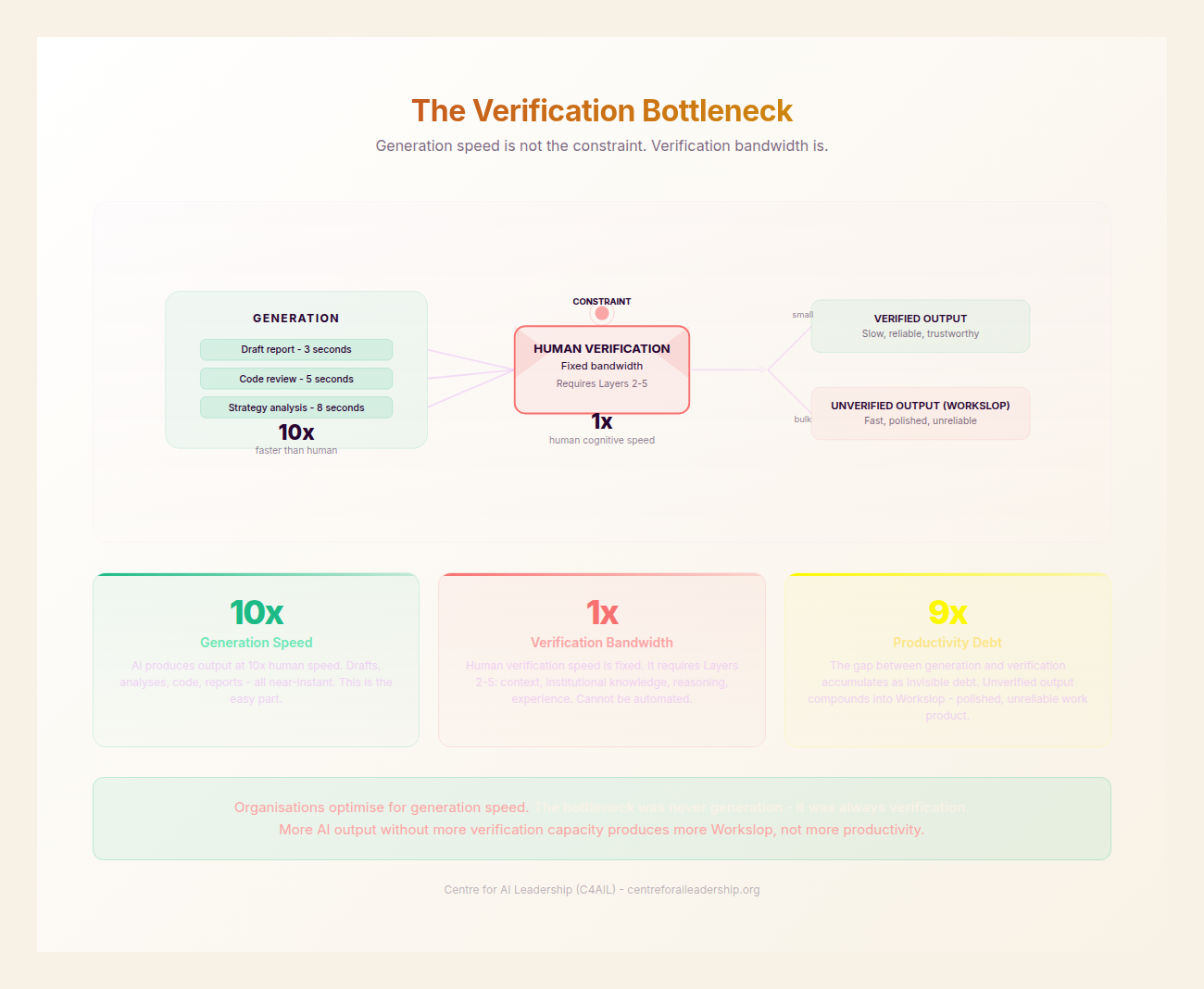
Meanwhile, the research shows that heavy AI use simultaneously slows deep skill acquisition and disarms the impulse to verify. You are getting more confident while getting less capable of catching the mistakes that matter.
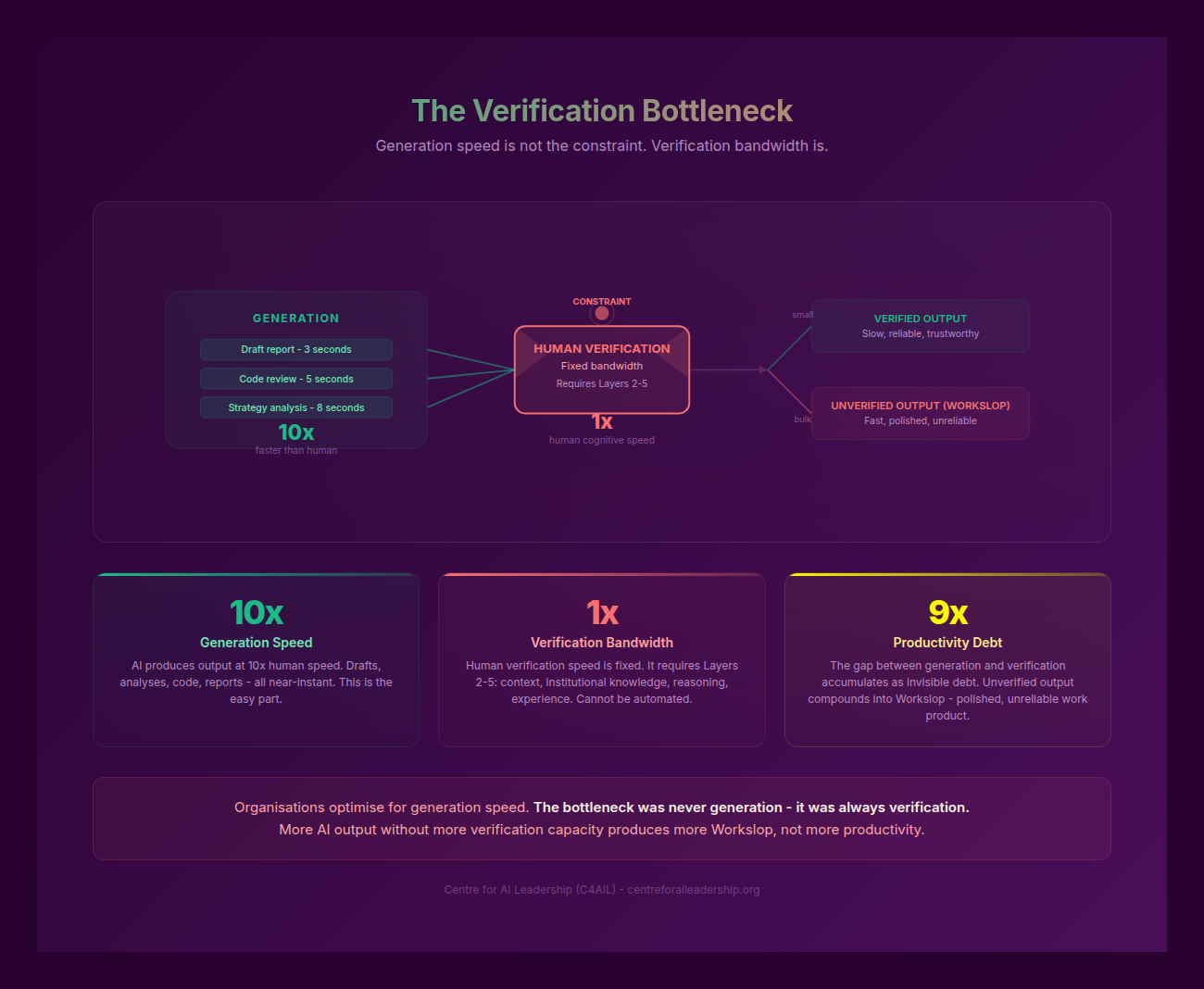
The result is measurable. Forty per cent of workers are now receiving what researchers call “workslop” - AI-generated content that looks professional but lacks substance. Each instance costs an average of one hour and 51 minutes to fix. For an organisation of 10,000 people, the annual cost exceeds $9 million - and that is just the direct rework cost. The real damage is what we call Comprehension Debtthe accumulating weight of decisions made by people who no longer understand the logic behind their own work; AI systems no one has verified.See full entry →: the accumulating weight of decisions made by people who no longer fully understand the logic behind their work.
High adoption. High confidence. Zero verification. The organisation is building debt it cannot see.
How widespread is this? In 2025, “slop” - shorthand for low-quality AI-generated content - was named Word of the Year by Merriam-Webster, Oxford, The Economist, Cambridge, and Collins. Five dictionaries independently arrived at the same conclusion: the defining cultural phenomenon of the year was the flood of AI-produced material that looks professional and says nothing. When the dictionaries are naming your problem, the problem has moved from anecdotal to structural.
The Structural Problem
Before you blame your employees, understand this: the Eloquence Trap is not a result of lazy people. It is a rational response to the way most organisations have framed AI adoption.
We measure the wrong things. Most companies track AI “success” by usage rates - how many people log in, how many prompts they send. They do not measure whether anyone is verifying what comes back. We incentivise the act of generating, not the quality of thinking.
We train the wrong skills. Standard corporate AI training teaches people how to write better prompts - how to get the machine to produce what you want. It does not teach people how to challenge what the machine produces. This creates users who are perfectly positioned to fall into every trap described above: skilled enough to generate volumes of polished content, not skilled enough to know when it is wrong.
We buy the surface and assume we bought the capability. A licence, a tool, a prompt library - these are surface. They can be purchased, and they should be. What cannot be purchased is the substrate: the verification capacitythe competency that performs epistemic labour: epistemic depth (an oracle to check against), metacognitive calibration (when to trust the machine), and the disposition to engage rather than…See full entry →, the institutional judgment, the discipline of Epistemic Labour that makes the output trustworthy. Adopt can be bought; evolve must be built. The 95% spent their budget acquiring AI and assumed the capability came in the box. It does not. Surface ships on day one; substrate is forged over time, inside the organisation, by people doing consequential work. The firms that confused the two are the ones whose spend disappeared.
We celebrate the wrong metric. “AI saves 40 minutes a day” is the headline. The footnote is that 37% of that work requires significant rework. We are optimising for speed when the bottleneck is judgment.
We are cutting the wrong people. Some firms are reducing junior staff because “AI can do that work now” and asking senior people to review AI output instead. This is a recipe for decline. If your seniors spend their time correcting AI drafts instead of architecting solutions, their own expertise begins to atrophy. And if you stop hiring juniors today, you will have no seniors in five years.
The problem is not that people are using AI badly. It is that organisations have made it structurally easier to use AI badly than to use it well.
The Line That Matters
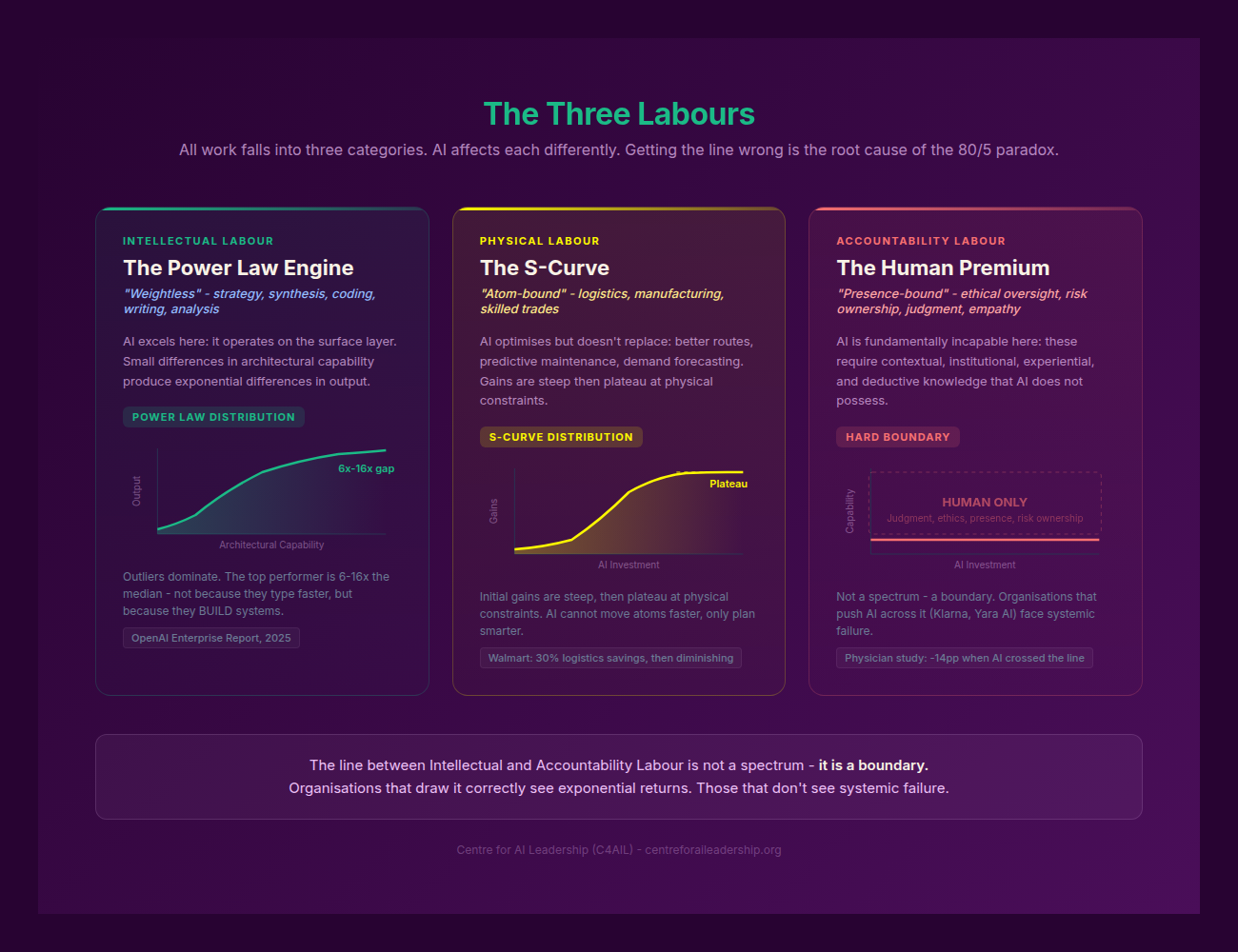
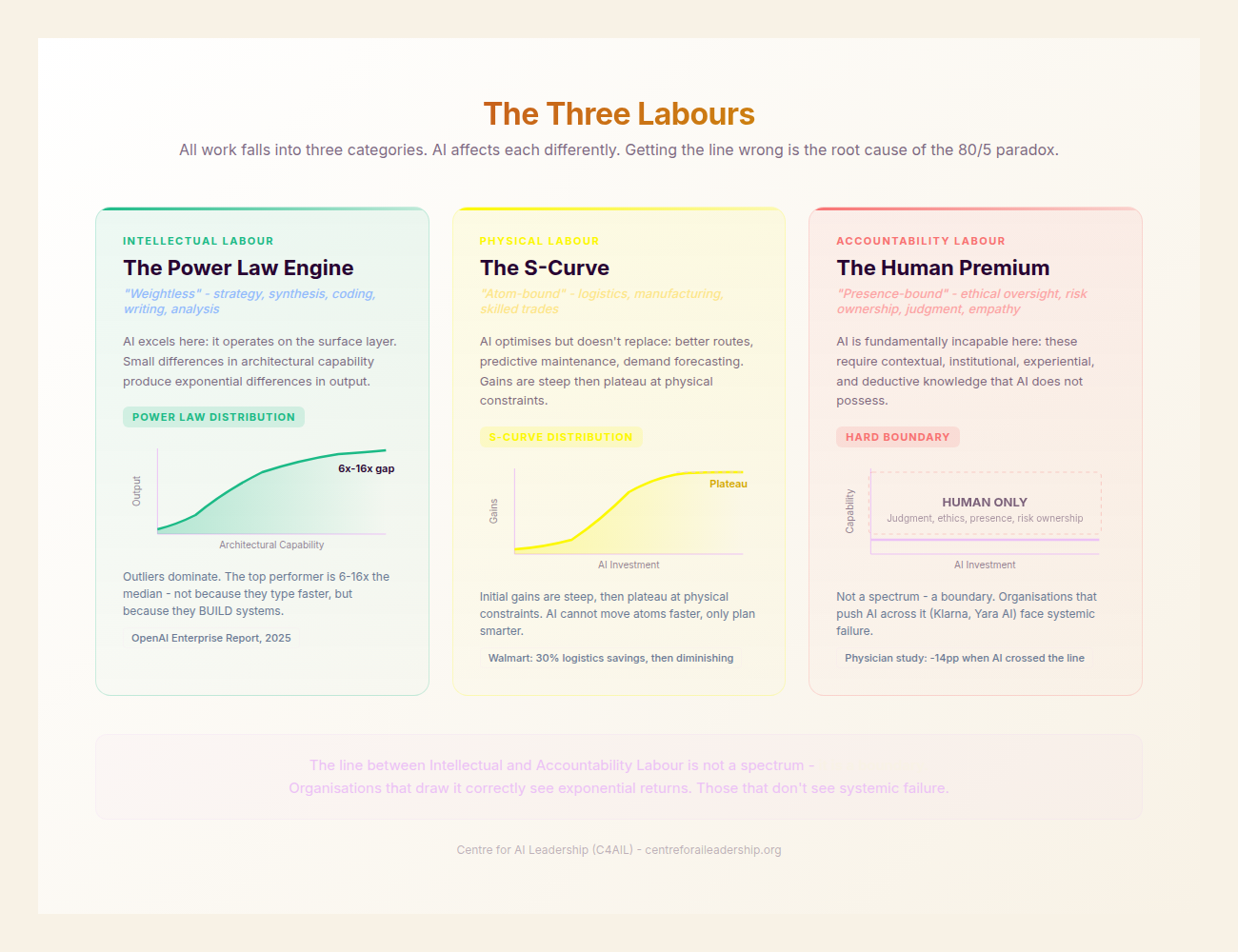
All professional work involves two fundamentally different types of effort.
The first is what we call Intellectual Labour - strategy, synthesis, drafting, analysis, coding, research. This is the work of producing ideas and documents. AI is genuinely excellent at this. It can draft a contract, summarise a report, generate a marketing plan, or write a financial model faster than any human.
The second is Accountability Labour - the decisions you sign your name to, the judgment calls you make when the data is ambiguous, the risk you own when something goes wrong. This is the work that requires presence: being the person who says “I reviewed this, I stand behind it, and I will answer for it.”
AI cannot do Accountability Labour. Not because it lacks some future capability, but because accountability requires a person who can be held responsible. You cannot sue an algorithm for malpractice. You cannot hold a language model to account in a board meeting when the strategy it drafted fails.
The organisations seeing real returns from AI have drawn a clear line between these two. They let AI handle the Intellectual Labour - the drafting, the synthesis, the pattern-matching - and they double down on the human Accountability Labour that makes the output trustworthy.
The organisations failing are the ones who have blurred the line. They have allowed the ease of generation to substitute for the discipline of verification. They have let the machine’s confidence replace the leader’s judgment.
There is a cleaner way to name what they did. Every organisation adopting AI is building an Institutional Vaultthe org's codified, executable knowledge store (processes, records, prompts, pipelines) - surface made durable. The three-way line: Holding (frees judgment), Executing codified rules (the…See full entry → - the codified store of its processes, data, and worked examples, externalised into software. That is good and necessary work. The Vault holds what is precious, and it can execute the rules your people have deliberately codified into it - the deterministic, defensible part, which is the bulk of the work. What it must never do is judge the calls no one codified. That stays with the human Brainthe Brain (human judgment, verification, accountability) stays human and is never outsourced; the Vault holds and runs what is codified. "You don't build a second brain; you build an…See full entry → - the un-codified judgment and the accountability that owns the outcome. The failure mode that consumed the $40 billion is fusing the two: filling the Vault and letting it decide, on its own probabilistic say-so, the calls that were never encoded - and calling that “AI adoption.” That is AI Theatrehigh adoption + high confidence + zero verification: a full policy binder / full Vault with no Brain in the loop; celebrating adoption metrics while the P&L shows no verified value.See full entry →: the work gets produced, the slide gets presented, and no one is left in the loop who could have caught the error. The rule is simple: the Vault can decide; it must never judge. Fill the Vault without keeping the Brain, and you have built a machine that produces confident output and answers to no one.
In late 2025, the mental health startup Yara AI faced this distinction at its starkest. The company had a working product. Growing users. The AI produced empathetic, professionally appropriate responses to people in crisis. Technically flawless Intellectual Labour.
But it could not take responsibility for a patient in crisis. That requires a human presence that no amount of eloquent text can replace. They shut the company down - not because the technology failed, but because the leadership recognised where the line was and refused to cross it.
Not every organisation faces stakes that high. But every leader faces the same question: does your organisation know where that line is? And who owns it?
What This Means
The $40 billion question has an answer, and it is uncomfortable. The technology is not the bottleneck. Your people are not the problem. The problem is the system - the incentives, the training, the metrics, and the missing structures that would make AI genuinely productive rather than impressively fast.
The 5% of organisations seeing real returns have figured this out. They are not smarter. They are not using secret tools. They have done the harder work of changing how their organisations think, verify, and make decisions alongside AI. They stopped paying for the explicit AI made free, and started building the irreducibly human capacity AI made scarce.
The good news: the gap between the 95% and the 5% is not about technology spending. It is about capability - and capability can be built. The surface you can buy; the substrate you have to forge. That is the whole task, and the next two papers are about how it is done.
In Paper 2, we will look at what the 5% are actually doing differently - the specific framework that turns AI from a faster typewriter into a genuine force multiplier. It starts with four disciplines that most organisations have never heard of, and it produces results that most organisations do not believe are possible until they see them.
This is Paper 1 of a three-part series from the Centre for AI Leadership (C4AIL). Paper 2: “What the 5% Do Differently” examines the framework behind organisations that have cracked the AI productivity code. Paper 3: “Monday Morning: Where to Start” provides the practical playbook.
For the full research framework, see “Orchestrating Intelligence: A Maturity Framework for Realising Human-AI Potential in the Age of Automation” - available from C4AIL on request.
Take the diagnostic: assess.c4ail.org Contact: [email protected] | centreforaileadership.org
Where this sits in the C4AIL canon (2026). This is a popular entry point into the consolidated whitepaper stack. The macro-thesis is The Moat Inversion (Whitepaper 0): for two centuries value flowed to the explicit; AI exhausts it, so the moat inverts to the irreducibly human. The mechanism — substrate vs surface, Epistemic Labour, the Squeezed Middle, ConcretisationAI's core economic act: making tacit substrate explicit, proprietary, and scalable. Concretise your own = a moat; depend on generic = erosion.See full entry → — is The Labour Architecture (WP2). The operating model — the Institutional Vault and the four seatsDirect (Board), Operate (Manager), Build (Practitioner), Floor (User): one story told from four accountabilities. Plus the Assure / Governance fifth seat - the Brain made into a function…See full entry →, the CAIOthe Translator made institutional: a Direct-seat Orchestrator built on Build substrate, measured by dispensability, who succeeds by manufacturing Translators, not being the bottleneck.See full entry → and the AI Centre of Excellencethe hub-and-spoke unit that scales the CAIO from a person to an institution; three arms = Forge (develop Brains), Governance (govern the Vault), Practice (do the stakes-bearing work).See full entry → — is The Operating Model (WP4). The institution that builds and sustains the capability is the Forge (WP5), the Full Stackthe total infrastructure substrate development requires (educational + community + meaning layers); C4AIL owns "roughly a quarter" (the educational, high-leverage slice).See full entry → (WP6), the Guildhall (WP7), and the Antifragile Institution (WP8). → Read the whitepapers