
The AI Guildhall: Building What the Factory Cannot
The factory model of education cannot produce what the AI age demands. The Guildhall is the alternative: practitioner-led, capability-focused, built for sovereign professionals.
The AI Guildhall: Building What the Factory Cannot
The popular edition of Whitepaper VII — The Guildhall
Centre for AI Leadership (C4AIL) - 2026
The Trainer Paradox
Here is the problem that stops every AI capability programme before it starts: you need Level 4 practitioners to develop Level 4 practitioners. And Level 4 practitioners do not exist yet — not in meaningful numbers, not in most organisations, not in most countries.
Stage transitions in expertise take time. Moving from competent user to someone who can architect AI systems — who can build the Logic Pipesengineered end-to-end deterministic workflows (generate -> verify -> triage -> review -> approve -> audit) that constrain and route AI, replacing narrative chatting.See full entry →, design the CAGE templatesversioned repositories of validated reasoning chains (structure + constraints + quality bar + known failure modes).See full entry →, construct verification enginesdeterministic (rule-based, not AI-judging-AI) checks that validate AI output against domain rules before human review.See full entry → — takes two to three years of progressive, accountable practice. Moving from Architect to Orchestrator, someone who governs entire AI ecosystems and develops the people within them, takes another two to three years. And moving from Orchestrator to Trainer — someone who can reliably develop others through these same transitions — requires something that cannot be taught in a classroom: the lived experience of having made consequential decisions, failed, reflected, and grown through the full cycle.
This is a bootstrap problem. The system cannot produce Trainers without already having them.
But bootstrap problems have a known solution. You start with the small number of people who already have the capability — the handful of practitioners who reached L4-5 through years of cross-domain work, the ones who were building these skills before anyone had a name for them — and you build infrastructure around them so their capacity multiplies.
The AI Guildhall is that infrastructure.
Why This Matters Now
For two centuries, economic value flowed to whatever could be made explicit, codified, and scaled — and the human was valued only as a scarce input to that machine. Generative AI drives that logic to its limit and inverts it. When the explicit is universally cheap, the only scarcity left is the irreducibly human: earned, tacit, judgment-laden, accountable capacity. We call this the Moat Inversionas AI exhausts the explicit and surface goes free, competitive advantage inverts toward the irreducibly human (judgment, accountability, architectural design); value moves from what you can…See full entry →, and it is the reason the Guildhall exists. The thing the system spent two centuries trying to eliminate becomes the only thing worth having — but only an organisation that can develop it gets the benefit.
There is a trap built into that inversion. The same cheap codification that exhausts the explicit also lets a firm finally codify its institution — and the moment it can, the market logic says stop paying to develop people. Every profession builds mastery the same way: novices climb a supervised middle tier, doing the consequential work that turns knowledge into judgment. AI removes that middle tier first, because the middle tier is the most codifiable. This is the Squeezed MiddleAI hollows the journeyman tier where substrate is built (the "barbell": gains at floor and ceiling, squeeze in the middle); no juniors today, no seniors in five years.See full entry → — and removing it looks efficient right up until the senior generation retires and no one was developed to replace it. The rung that builds judgment is the rung AI is quietly dissolving.
The Guildhall rebuilds that rung on purpose. It is not a faster way to consume content. It is the developmental middle tier — the supervised, consequential, accountable practice the AI age makes economically tempting to skip and structurally impossible to do without.
Why Individual Organisations Cannot Solve This Alone
Imagine Company A invests two years developing an AI Orchestrator. They send this person through progressive challenges, give them real accountability, surround them with mentors, and absorb the cost of the mistakes that are an essential part of the learning process. After two years, Company B hires that person at a 40% premium.
Company A has just subsidised Company B’s AI capability. The rational response? Stop investing. Let someone else take the risk.
This is not a hypothetical. It is Kathleen Thelen’s collective action failure, playing out in real time across the AI capability landscape. When the benefits of development are portable but the costs are local, individual firms under-invest. Every company waits for someone else to build the talent pipeline. Nobody builds it. The market fails.
The problem is worse for small and medium enterprises. A 200-person firm cannot maintain what we call an AI Guildhall Studio — a supervised practice environment with L4+ practitioners available for real-time mentoring, review, and challenge. They do not have enough Orchestrators on staff. They do not have the volume of diverse AI problems to create the progressive challenge environment that development requires. They cannot absorb the cost of mistakes during the learning phase without risking the business.
Germany solved an analogous problem centuries ago with mandatory IHK and HWK chambers — shared institutions where firms collectively funded apprenticeship infrastructure, master craftsmen examined journeymen from other workshops, and the cost of developing the next generation was distributed across the economy rather than borne by whichever firm happened to hire the apprentice first.
Here is the uncomfortable historical fact: no country that destroyed its guild system has successfully rebuilt one from scratch. The nations with the strongest vocational capability today — Germany, Switzerland, Austria, the Nordic countries — are the ones that evolved their guilds rather than abolished them. Britain dismantled its guilds in the name of free markets and has spent two centuries trying to reinvent the apprenticeship infrastructure it lost.
The AI Guildhall is the modern equivalent. Not a throwback to medieval craft regulation, but shared developmental infrastructure across organisations that are individually too small or too exposed to the poaching problem to build it alone.
What the Guildhall Is
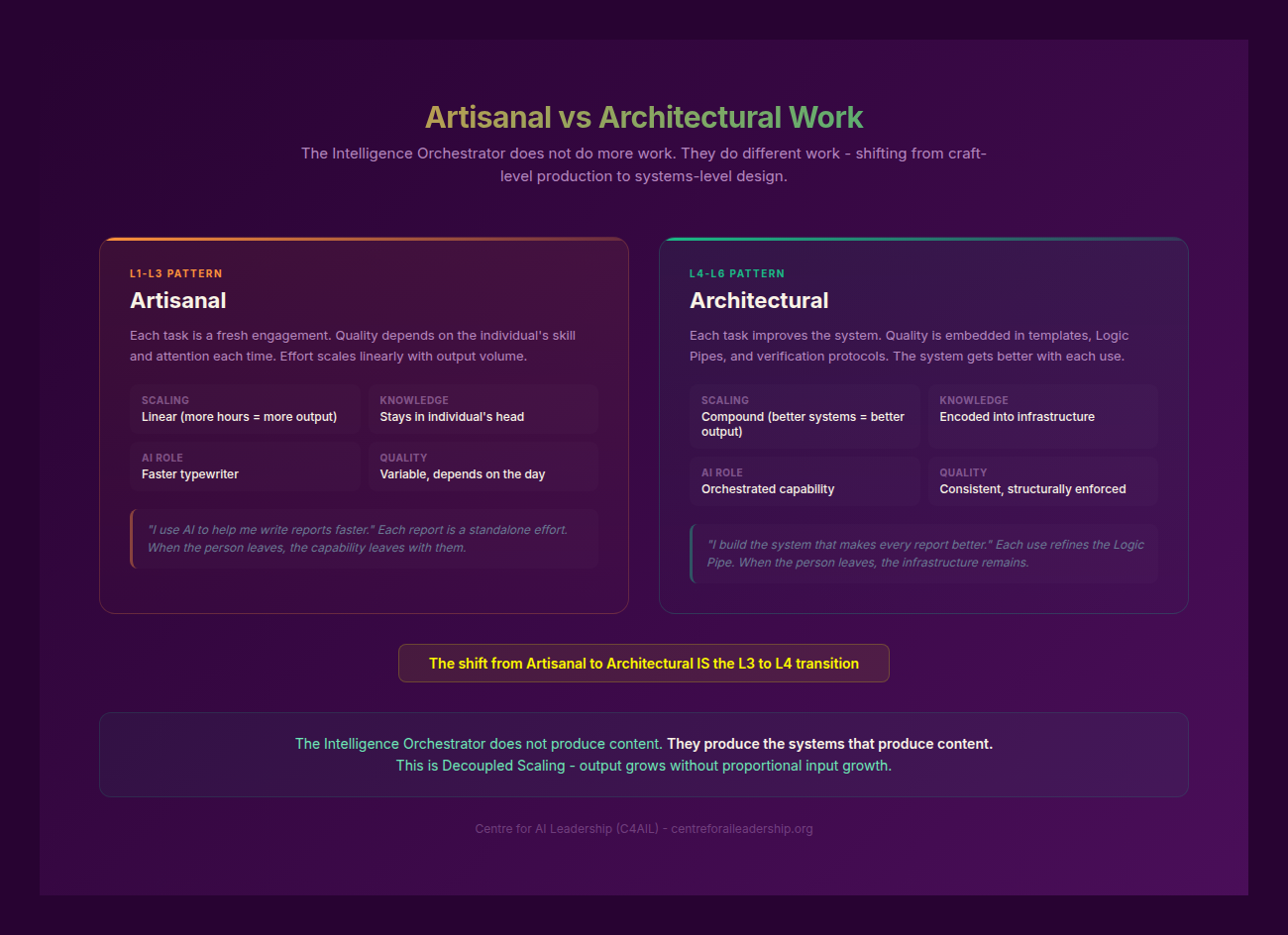
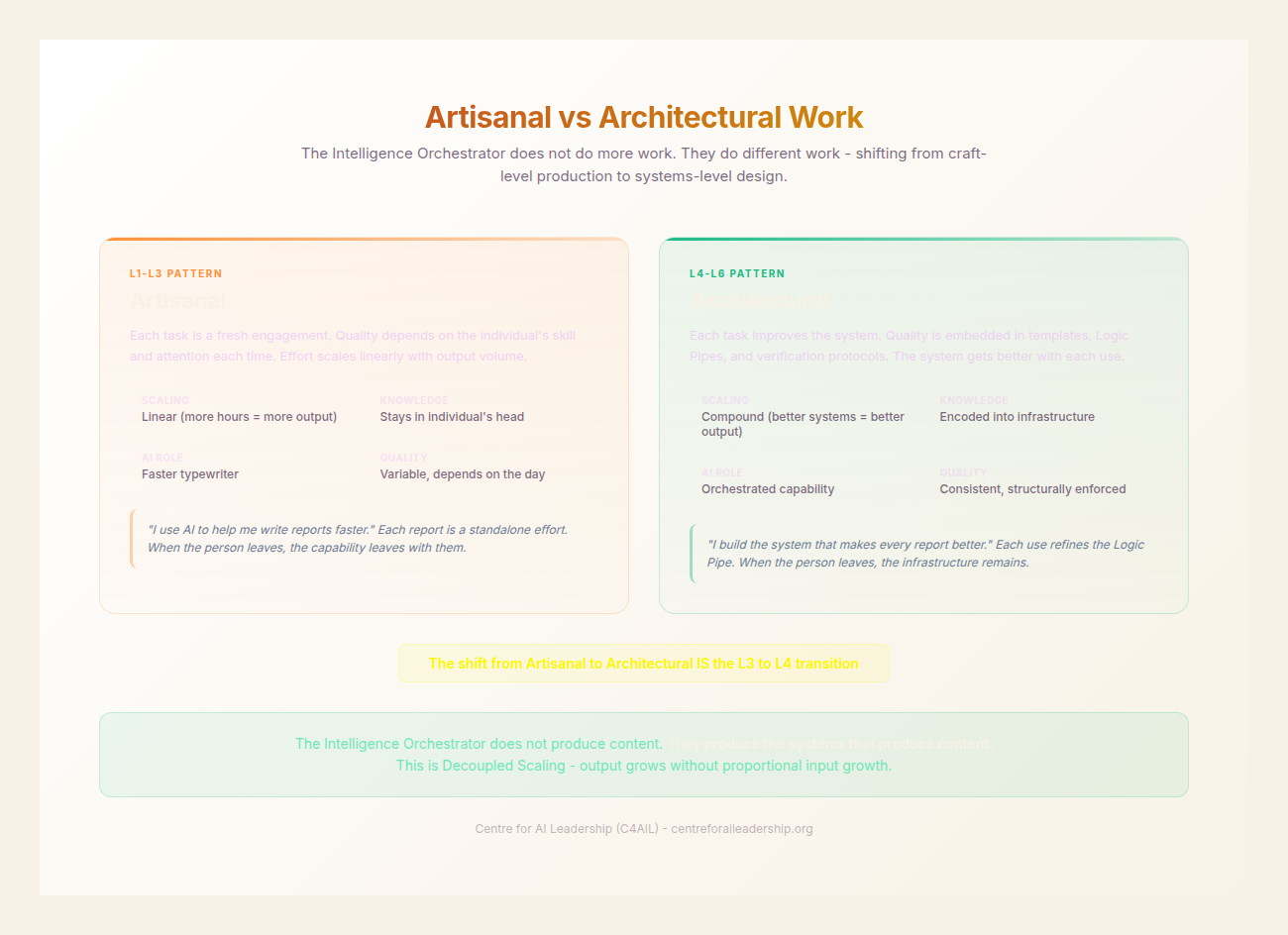
The Guildhall is not a training provider. It does not sell courses. It is not a platform where you watch videos and earn badges. There is no shortage of those, and they have not solved the problem.
The Guildhall is a developmental environment — a space, both physical and virtual, where practitioners develop through progressive accountability rather than progressive content consumption. The difference matters. Content consumption produces people who know about AI. Progressive accountability produces people who can be trusted with AI.
The reason the distinction is not pedantic is that professional capability has two layers. There is surface — the tools, interfaces, workflows, vocabulary, and credentials — which is fast to learn and useless on its own. And there is substrate — the tacit domain knowledge, the accountability experience, the peer-calibrated judgment — which is slow to build and transfers across tool eras. The AI transition is a substrate problemthe AI transition is fundamentally about substrate, but industry treats it as a surface problem; why ~95% of initiatives fail.See full entry → that the industry keeps treating as a surface problem, which is why most initiatives fail. Courses sell surface. The Guildhall builds substrate. That is the whole difference, and it splits the work into two services running on the same infrastructure:
Building substrate (the Novice Pathway). People who do not yet have substrate build it the only way substrate is ever built — consequential work under mentors, progressive accountability, community calibration, the signing momentthe formal, irreversible threshold where accountability becomes personal ("I built this, I stand behind it"); "would you sign this?" replaces "did you catch the errors?"See full entry →. There is no compressing this; it is constrained by the rate at which judgment forms under real stakes. Three to five years to Orchestrator.
Porting substrate (the Adjacency Pathway). Mid-career domain experts — senior analysts, experienced lawyers, veteran auditors, practising clinicians — already carry ten to twenty years of substrate in their field. They are not building it; they are porting it. What they need is the new surface layer and the reframing from execution to design to governance. Because the slow layer is already there, the timeline collapses to nine to eighteen months to Orchestrator. This is the Guildhall’s largest near-term opportunity: most organisations are sitting on a stock of mid-career experts whose substrate is a strategic asset currently written off because surface-level upskilling cannot see it.
The environment provides five accountability mechanisms that individual organisations struggle to maintain alone:
Graduated autonomy. Practitioners encounter progressively harder challenges — not in a simulation, but in real work with real constraints. An Architect candidate does not study Logic Pipe design in the abstract; they build one for a real organisational problem, with a real deadline, and a real stakeholder who needs it to work.
Consequential decisions. The work has stakes. Not the artificial stakes of a graded assignment, but the genuine stakes of someone depending on the output. This is what separates development from training. You cannot develop judgment without consequences.
Reflective accountability. After-action reviews, structured peer review, and honest assessment of what went wrong. Not as a punitive exercise, but as the mechanism through which tacit knowledge — the kind that cannot be written in a manual — transfers between practitioners.
The signing moment. At defined milestones, practitioners submit portfolio work and put their name on it. Not “here is what I learned” but “here is what I built, here is my reasoning, and I stand behind it.” This is the moment where accountability is claimed and the practitioner’s judgment is put on the record.
Community of practice. Practitioners from different organisations working alongside each other, reviewing each other’s work, challenging each other’s assumptions. The cross-pollination is essential — an Architect who has only ever built Logic Pipes for one industry develops narrower judgment than one who has seen how the same principles apply across healthcare, finance, and manufacturing.
The physical and virtual expression of this is what we call the AI Guildhall Studio: a supervised practice space that operates in what Amy Edmondson calls the Learning Zone. High psychological safety — you can admit what you do not know without career consequences — combined with high accountability — the work is real, the review is honest, and the standards are maintained. Most organisations achieve one or the other. The Guildhall is designed to hold both simultaneously.
The Progression Model
The Guildhall maps to the C4AIL maturity framework (L0-L6) but translates it into a concrete developmental pathway — what you do, how long it takes, and what signals readiness for the next stage.
Floor Users: Entry (3-6 months)
Practitioners enter the Guildhall for AI literacy and validation skills. They learn to recognise what AI actually does versus what it appears to do — the Eloquence TrapAI is fluent before it is correct; accepting output because it sounds right. The smoother the output, the more you must verify. Turned inward = mistaking your own fluent confidence for…See full entry →, the Reliability Traperrors compound multiplicatively across multi-step / agentic chains (0.95^5 = 77%); each step looks sound alone, so failure is invisible until the end.See full entry →, the Confidence PlateauAI removes the visible failure that normally corrects overconfidence, so users grow more confident while growing less capable.See full entry →. They develop the basic discipline of verifying AI output against domain knowledge rather than accepting fluent text at face value.
The waypoint here is CompTIA AI Essentials — an industry-recognised credential that validates foundational AI literacy. It is not the destination. It is proof that you have built the floor.
Translator Development (6-12 months)
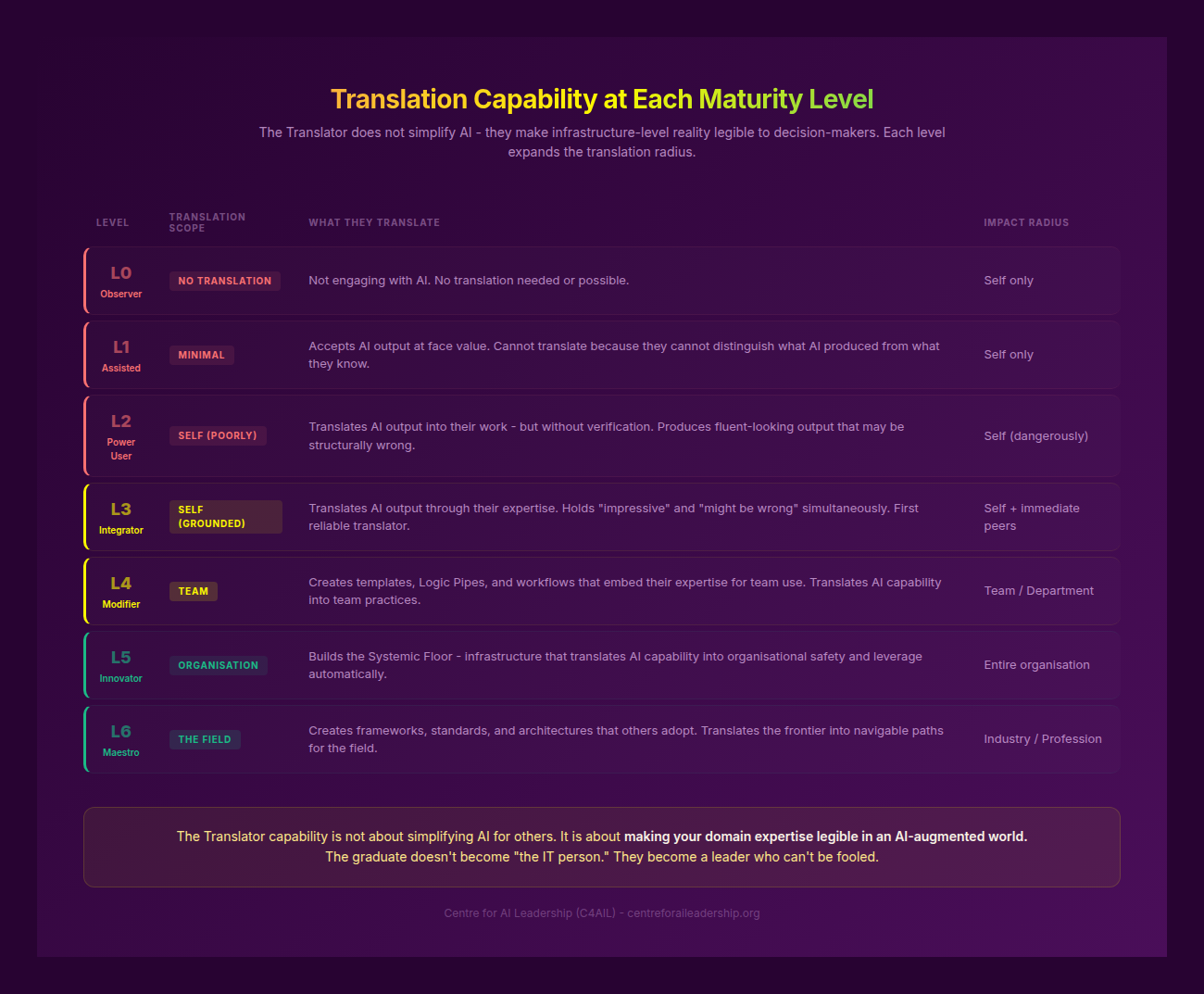
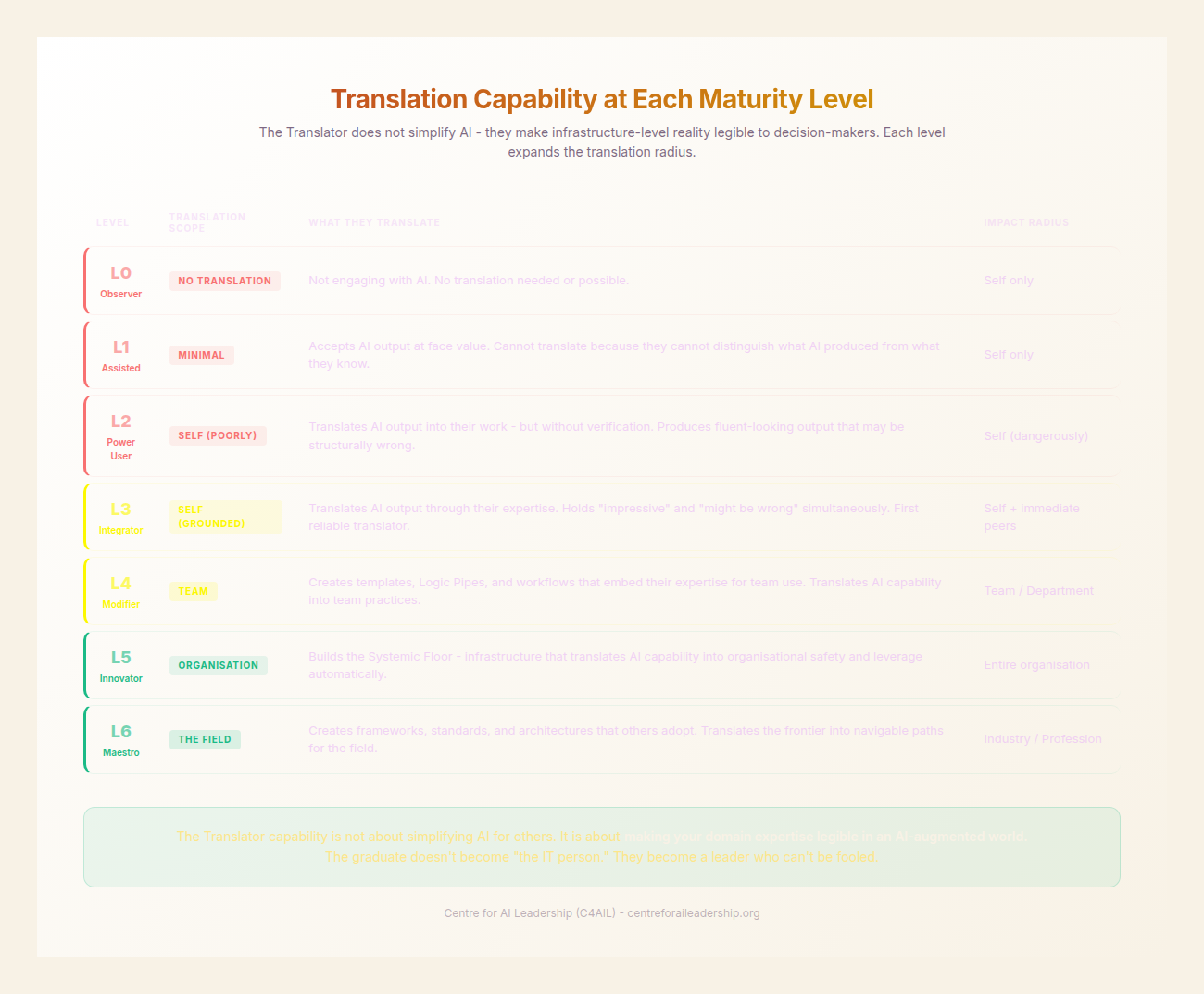
Translators are bilingual. They speak the language of their domain — finance, healthcare, law, engineering — and they speak enough AI to commission, interrogate, and challenge technical work. They do not need to build the systems. They need to know when a system is being built badly.
The Guildhall runs bilingual capability workshops: structured exercises where domain experts and AI practitioners work the same problem from different angles and learn to communicate across the gap. The Translatordomain-fluency + AI-fluency + judgment + legibility; a trait overlaying every seat (meant to distribute), not a maturity rung. Commands a ~15-25% premium. Failures: fluent mistranslator /…See full entry → does not become a technologist. They become a leader who cannot be fooled.
Architect Pipeline (12-24 months)
This is where the Guildhall’s infrastructure becomes essential. Architect candidates build real things under mentorship: Logic Pipes that structure AI workflows for specific organisational problems, CAGEthe front half of directing AI: Context (all situational/institutional/domain context), Align (the AI plays back its plan before running), Goals (granular, incl. the Must NOT / Must FLAG…See full entry → templates that constrain AI output within domain-appropriate boundaries, verification engines that check AI work against ground truth.
The work is mentored by L4+ practitioners — Orchestrators and Trainers who review designs, challenge assumptions, and ensure that the Architect is developing judgment, not just technique. The waypoint is CompTIA AI Architect+ — an industry credential that validates the ability to design AI systems, not merely use them.
Assessment is portfolio-based. What we call Level 3 Submissions: real work, annotated with reflection, reviewed by practitioners from outside the candidate’s own organisation. No exam can test whether someone can build a system that works under pressure. A portfolio can.
Orchestrator Development (2-3 years)
Orchestrators govern. They do not just build AI systems; they build the organisational structures — governance frameworks, quality assurance processes, human oversight mechanisms — that make AI systems trustworthy at scale. This is system-level thinking, and it takes years of progressive accountability to develop.
The Guildhall provides this through what amounts to a structured residency: Architect-level practitioners take on progressively larger scopes of responsibility, moving from single-workflow governance to department-level and eventually organisation-level AI oversight. They fail. They reflect. They try again with better judgment.
Assessment at this level is what we call Level 4-5 Reviews: portfolio-based, peer-reviewed by other Orchestrators, and evaluated not just on technical correctness but on governance quality — did this person build something that an organisation can trust?
Trainer Pipeline (18-30 months adjacency / 5+ years novice)
The scarcest resource. Trainers are Orchestrators who have demonstrated the additional capability of developing others. Not teaching — developing. The distinction is critical. Teaching transfers knowledge. Development builds judgment, and judgment cannot be transferred through instruction alone.
Trainers in the Guildhall carry dual reporting: operational accountability for the AI systems they govern, and developmental accountability for the practitioners they are growing. This dual burden is what makes the Trainer role so demanding and so scarce.
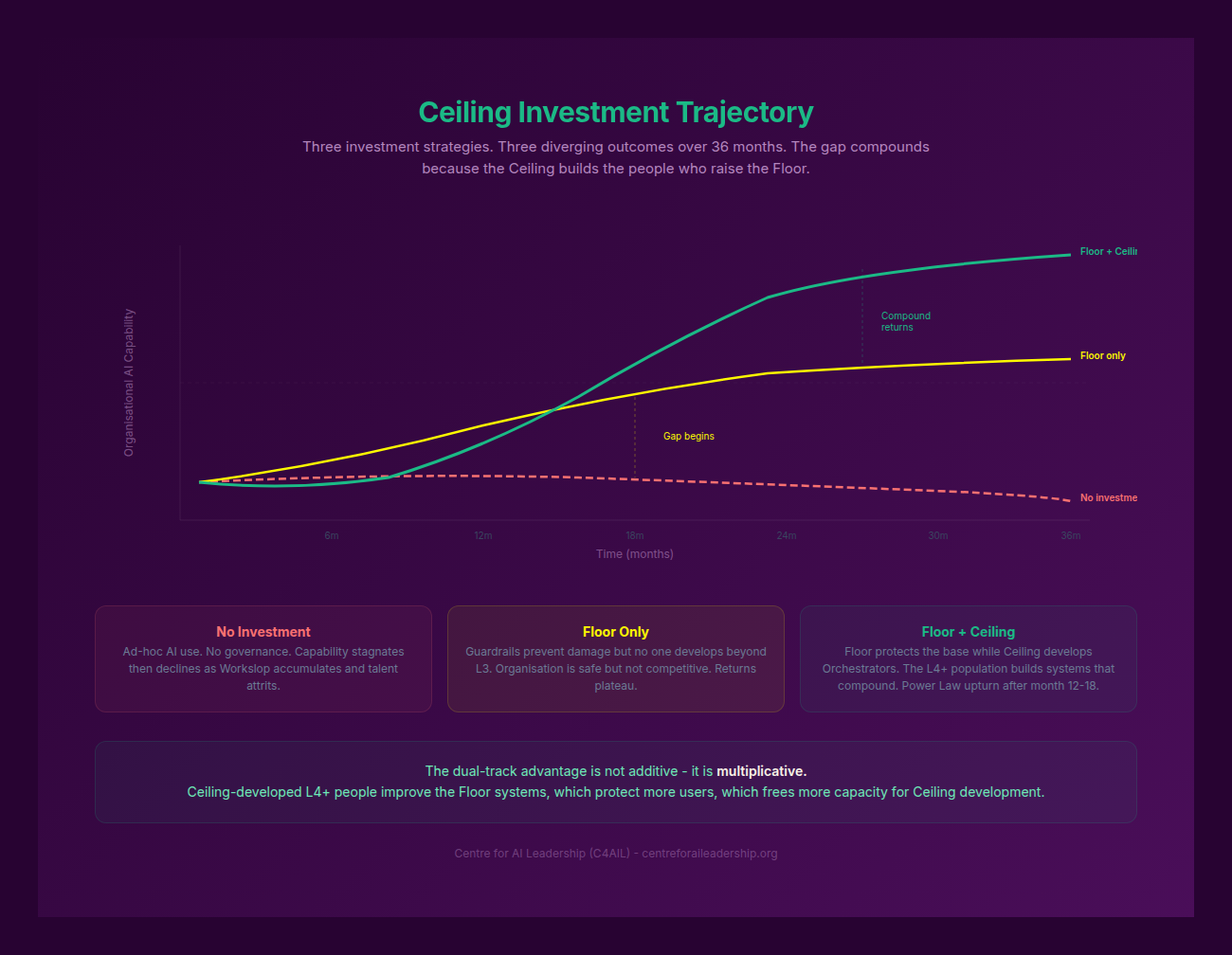
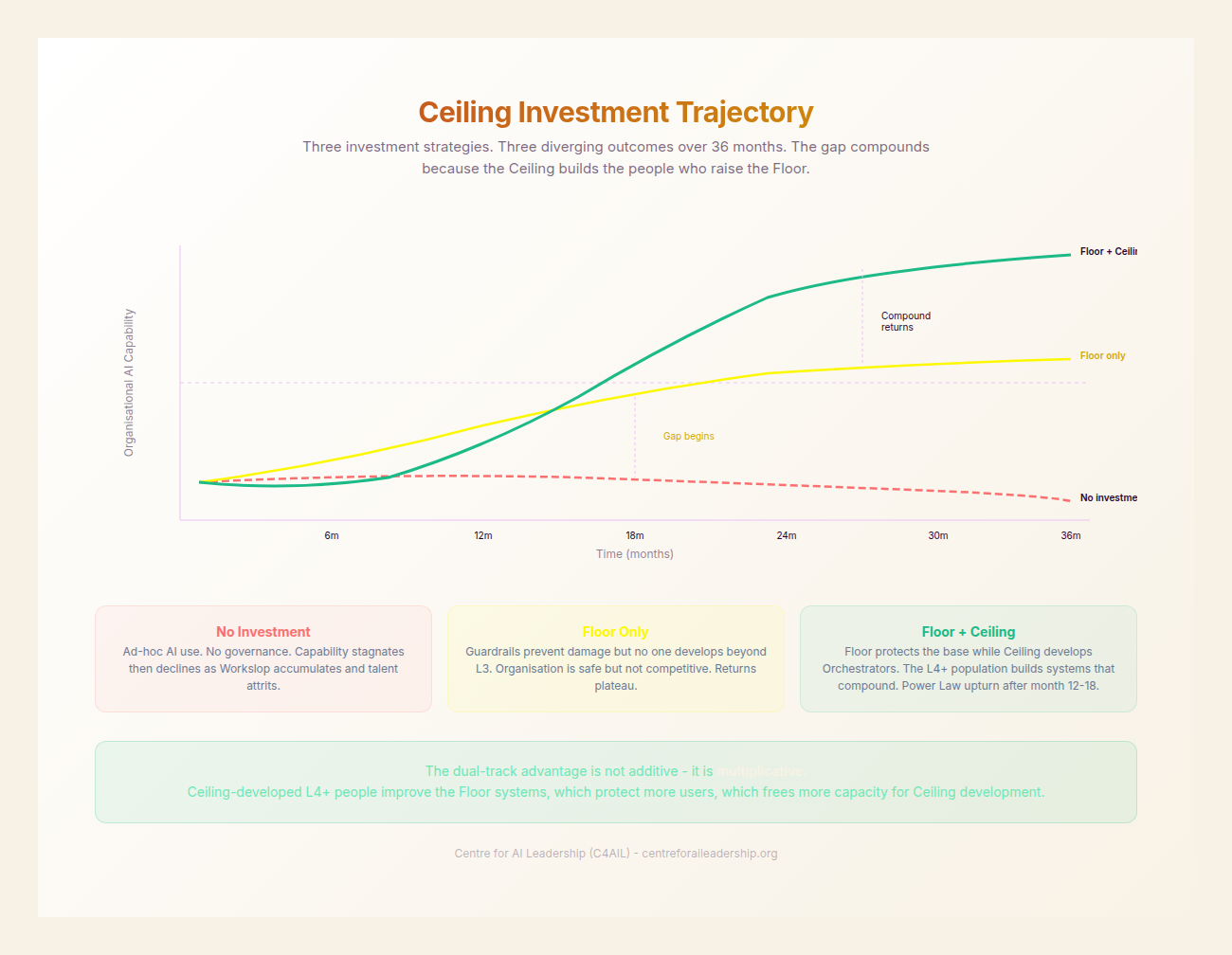
The timeline is honest, and it is two timelines. FloorFloor = the 90-95% who work through AI (mass literacy, 3-6 months); Ceiling = the 5-10% who design and govern AI: Architects, Orchestrators, Trainers (years).See full entry → capability takes three to six months for everyone. Above the Floor, the pathway depends on whether the candidate is building substrate or porting it. On the Novice Pathway — building substrate from scratch — Architects arrive in 12-24 months, Orchestrators in three to five years, a functioning Trainer pipeline in 5+ years; this is constrained by the rate at which judgment forms under consequential stakes and cannot be compressed. On the Adjacency Pathway — porting ten to twenty years of existing substrate — Architect comes in three to six months, Orchestrator in nine to eighteen months, Trainer readiness in 18-30 months, because the slow layer is already built and only the surface is being added. Systemic cultural shift takes a decade regardless. Anyone promising faster across the board is selling content consumption, not capability development. Anyone denying the adjacency track exists is wasting the strategic asset the organisation already has.
The Portfolio System
Medieval guilds required a masterpiece — a work of sufficient quality that the guild’s masters would accept the apprentice as a peer. Not a test of what you know. A demonstration of what you can make, judged by people whose own reputation depends on maintaining the standard.
The AI Guildhall’s portfolio systemthe medieval masterpiece modernised: real consequential work + structured reflection, judged by cross-org L4+ reviewers on "would we trust what you make?" (phronesis), not "did you pass?"…See full entry → is this idea, modernised.
Exams test reception — can you recognise the right answer when you see it? Portfolios test creation — can you produce work that meets the standard when no one gives you the answer to recognise? The distinction maps to an ancient taxonomy: episteme is knowledge (do you know?), techne is skill (can you do?), but phronesisthe felt sense of quality (practical wisdom) that separates the competent from the accountable; AI has episteme and techne but no phronesis.See full entry → is practical wisdom (would we trust what you make?). Exams test episteme. Practical exercises test techne. Only portfolios test phronesis — and phronesis is what the AI economy actually needs.
A portfolio in the Guildhall contains real work with real consequences. Not case studies. Not simulations. Actual Logic Pipes built for actual organisations, CAGE templates deployed in actual workflows, governance frameworks implemented in actual teams. Each piece is annotated with structured reflection: what the practitioner intended, what happened, what went wrong, and what they would do differently. The reflection is not optional decoration. It is the primary evidence of judgment.
Review is conducted by L4+ practitioners from different organisations — people who have no institutional loyalty to the candidate, no incentive to be generous, and whose own credibility is staked on maintaining the standard. They are not grading. They are answering a single question: would we trust this person to do unsupervised work at this level?
This is the signing moment. The point where the community judges whether a practitioner has earned the right to practice without a safety net. It is uncomfortable by design. It is what makes the credential mean something.
The Partnership Model
No single organisation has everything the Guildhall requires. The model depends on a partnership where each contributor brings what the others lack.
C4AIL provides the theoretical framework — the maturity model (L0-L6), the diagnostic instrument (assess.c4ail.org), the pedagogical architecture, and the portfolio assessment methodology. C4AIL’s role is to define what “good” looks like at each stage and to ensure that the developmental pathway is grounded in research rather than marketing.
CompTIA provides workforce methodology, cross-industry reach, and certification waypoints. AI Essentials validates the floor. AI Architect+ validates the Architect transition. SecAI+ validates the security dimension. CompTIA’s infrastructure — exam development, global delivery, employer recognition — gives practitioners credentials that travel across borders and industries.
CirroLytix/Ligot provides services economy expertise and research into AI workforce development in the Philippines and across Southeast Asia. Their work on how AI capability develops in emerging economies — where the guild infrastructure is being built from scratch rather than evolved from existing institutions — informs the Guildhall’s design for contexts beyond the developed world.
ClassDo provides programme development and credentialing innovation. Their expertise in structuring learning pathways and building assessment systems that work across institutional boundaries is essential for a model where practitioners move between organisations while maintaining a coherent developmental trajectory.
Kingston International College provides institutional accreditation and employer networks. The Guildhall needs academic credibility to operate within regulated training frameworks, and it needs employer relationships to ensure that the developmental pathway connects to real career progression.
The Guildhall operates at the intersection of these contributions — shared infrastructure that none of the partners could build alone, producing outcomes that none of them could achieve separately.
The Business Model
The Guildhall’s economics must be sustainable without depending on the goodwill of any single organisation. The model has five revenue streams, designed to align incentives across all participants.
Enterprise subscription. Annual access for a cohort of employees to the full Guildhall infrastructure: the AI Guildhall Studio, the portfolio platform, structured mentoring, community of practice. Priced per cohort, not per seat, to encourage organisations to send teams rather than individuals.
SME pooled access. Multiple small firms share Trainer capacity and development infrastructure through a consortium model. A 20-person cybersecurity firm and a 15-person legal tech company cannot each maintain a Studio — but together, with three or four other firms, they can sustain one collectively. The IHK model, applied to AI.
Individual practitioner membership. For professionals investing in their own development — independent consultants, career changers, practitioners whose employers have not yet joined. Access to the community of practice, portfolio review, and the Studio on a scheduled basis.
Certification revenue. C4AIL L3-5 portfolio assessments, conducted by qualified reviewers, producing credentials with genuine market signal. The assessment is rigorous enough that passing means something, which is what makes the credential worth paying for.
Partner programme. Organisations that contribute Trainers — practitioners who spend part of their time mentoring others in the Guildhall — receive priority access to development infrastructure for their own teams. This creates a virtuous cycle: the organisations that invest most in developing the ecosystem get the most back from it.
The economics mirror the German chamber model: the net cost of participation is low because practitioners produce genuine value while developing. Architect candidates build real Logic Pipes for real problems. The Guildhall is not a cost centre that produces graduates — it is a practice environment that produces both capability and output simultaneously.
The Safeguard
There is an obvious danger in everything above. Every certification body in history has followed the same arc: living teaching becomes structure, structure becomes revenue-dependent, standards drop to maximise throughput, and the credential decays into a purchase. The moment certification revenue starts paying the bills, the institution has a quiet incentive to pass more people. A Guildhall that succeeds commercially is, by default, on the road to becoming worthless.
The Guildhall is built to assume that corruption rather than promise to prevent it — the same move cybersecurity made when it gave up on “prevent all breaches” for “assume breach, detect fast, respond faster.” The structural protection is that revenue and rigour are deliberately decoupled. The layers that make money — the open community, the Studio, the programmes — are not the layer that proves mastery, and the elite assessment tier is funded out of that revenue rather than generating its own. It never needs to pass more people, so it never acquires the incentive to lower the bar. On top of that sit a published set of corruption-detection metrics, a standing invitation for any external body to formally challenge the institution’s standards, and — if the interior is ever found to be gone — a charter that mandates dissolution and reconstitution rather than reform. This is the governance that keeps the Guildhall honest as it scales, set out in full in the Antifragile Institution (Whitepaper VIII).
This paper describes the operational design of the AI Guildhall. For the full theoretical argument — the maturity model, the evidence base, and the research behind the developmental framework — see “The Labour Architecture: Redesigning Work for the AI Age” (Whitepaper II) and “Sovereign Commandthe state where an org owns its AI-informed decisions, can defend them, and can scale them without losing control; human judgment kept above machine fluency. The outcome ARGS produces. "Not…See full entry →: Leadership in the Age of Intellectual Automation” (Whitepaper I) from the Centre for AI Leadership, available on request.
The AI Guildhall is currently in development with founding partners. If your organisation is interested in participating — as an enterprise subscriber, an SME consortium member, or a contributing partner — we would like to hear from you.
Contact: [email protected]
Where this sits in the C4AIL canon (2026). This is a popular entry point into the consolidated whitepaper stack. The macro-thesis is The Moat Inversion (Whitepaper 0): for two centuries value flowed to the explicit; AI exhausts it, so the moat inverts to the irreducibly human. The mechanism — substrate vs surface, Epistemic Labourthe value-bearing work of *knowing*: reading what AI output means, catching fluent-but-hollow answers. Delegable (answers to reality); accountability is *owning* (non-delegable, answers to…See full entry →, the Squeezed Middle, ConcretisationAI's core economic act: making tacit substrate explicit, proprietary, and scalable. Concretise your own = a moat; depend on generic = erosion.See full entry → — is The Labour Architecture (WP2). The operating model — the Institutional Vaultthe org's codified, executable knowledge store (processes, records, prompts, pipelines) - surface made durable. The three-way line: Holding (frees judgment), Executing codified rules (the…See full entry → and the four seatsDirect (Board), Operate (Manager), Build (Practitioner), Floor (User): one story told from four accountabilities. Plus the Assure / Governance fifth seat - the Brain made into a function…See full entry →, the CAIOthe Translator made institutional: a Direct-seat Orchestrator built on Build substrate, measured by dispensability, who succeeds by manufacturing Translators, not being the bottleneck.See full entry → and the AI Centre of Excellencethe hub-and-spoke unit that scales the CAIO from a person to an institution; three arms = Forge (develop Brains), Governance (govern the Vault), Practice (do the stakes-bearing work).See full entry → — is The Operating Model (WP4). The institution that builds and sustains the capability is the Forge (WP5), the Full Stackthe total infrastructure substrate development requires (educational + community + meaning layers); C4AIL owns "roughly a quarter" (the educational, high-leverage slice).See full entry → (WP6), the Guildhall (WP7), and the Antifragile Institution (WP8). → Read the whitepapers