The Complete Argument
The whole C4AIL stack in one read — from the Moat Inversion through the Labour Architecture and the Operating Model to the Forge, the Guildhall, and the Antifragile Institution.
From Sovereign Command to Labour Architecture
Paper 7: The Complete Argument
Centre for AI Leadership (C4AIL) - 2026
One Argument, in Nine Movements
We did not set out to write nine whitepapers. We set out to answer one question - what does it take for an organisation to be ready for AI? - and the answer kept opening downward, into the layer beneath the one we had just named. Each paper was published separately, months apart, and each reads as an independent piece. But they are not independent. They are movements of a single argument, and none of them makes full sense without the one above it and the one below.
This paper is the through-line. It states the whole argument once, end to end, so that the pieces stop looking like a stack of reports and start looking like what they are: a single claim about where value is going, and what an institution must build to stay on the right side of it.
The claim has a name. We call it The Moat Inversionas AI exhausts the explicit and surface goes free, competitive advantage inverts toward the irreducibly human (judgment, accountability, architectural design); value moves from what you can…See full entry →, and it is the macro-thesis the entire stack hangs from. For two centuries, economic value flowed to whatever could be made explicit, codified, and scaled - and the human was prized only as a scarce input to that machine. Generative AI drives that logic to its limit, exhausts it, and inverts it. When the explicit is universally cheap, the only scarcity left is the irreducibly human. This is the first reversal since roughly 1800 of the Industrial Revolution’s valuation of human labour: the human-as-human appreciates rather than depreciates. Everything downstream - substrate, Epistemic Labourthe value-bearing work of *knowing*: reading what AI output means, catching fluent-but-hollow answers. Delegable (answers to reality); accountability is *owning* (non-delegable, answers to…See full entry →, the Institutional Vaultthe org's codified, executable knowledge store (processes, records, prompts, pipelines) - surface made durable. The three-way line: Holding (frees judgment), Executing codified rules (the…See full entry →, the Forge - is a consequence of that one move.
Everything that follows is an unpacking of it: what AI exhausts, what becomes scarce, how an organisation deploys around the scarcity, and what institution it must build to keep the scarcity supplied. If you have read the whitepapers, this will sharpen the connections. If you have read none of them, it will tell you where to start and why you should bother.
The Macro-Thesis: The Moat Inversion
Start at the top, because everything else is downstream of it.
The defining economic project of the last two centuries was to take what humans knew and make it explicit, codified, and scalable - because the explicit scales and the human does not. The craftsman’s tacit method became the factory procedure; the procedure became the bureaucratic file; the file became the database; and the database became software - pure codified logic, copyable at zero marginal cost, the most explicit artefact ever built. At each step the human was valued precisely to the degree that they were a scarce input to the explicit machine. The software engineer was the apex of this: the finite resource that let a business convert capital into near-infinitely-scaling product.
Generative AI is the end of that road. It commoditises the last scarce human input to the explicit - the engineer itself - and it does so because you cannot make anything more explicit than software already was. Code is the maximally-explicit form. AI did not open a new explicit frontier; it automated the making of the most explicit thing there is. So the explicit frontier is not expanding. It is exhausting, against a hard floor: you cannot price below free-and-instant.
When the explicit is exhausted and universally cheap, the only scarcity left is the non-codifiable human. That is not a hope; it is Baumol’s cost disease run forward. As the automatable approaches zero marginal cost, the human-intensive necessarily appreciates in relative value. Stack onto that Moravec’s paradox - the things hardest for machines are the ordinary human ones, judgment, dexterity, reading a room - and Polanyi’s wall - codification stops at the embodied-tacit, “we can know more than we can tell” - and “the human is the moat” stops being inspirational and becomes structural.
This is the inversion: automation devalued the human-as-input; AI, at its apex, revalues the human-as-human. The thing the system spent two centuries trying to eliminate becomes the only thing that is scarce. The thesis carries exactly one burden, and it is the contribution - to argue that the human remainderthe irreducibly tacit, embodied, judgment-bound, relational, accountable residue that becomes the moat after AI commoditises the explicit.See full entry → is an unbounded frontier, not a shrinking residue: reframing is generative, not searchable; accountability is presence-bound and non-delegable; the embodied-tacit does not codify. Each is a frontier that opens as fast as it is worked.
There is a defensive face the value framing omits. AI is not only the tool you wield to build the moat; it is also the weapon external adversaries wield against you - AI-crafted phishing, deepfakesynthetic AI-generated audio/video/image impersonating a real person; defeats identity-based authorisation (Arup $25.6M). Mitigate with out-of-band callback + dual authorisation.See full entry → voice and video, commoditised vulnerability research, agentic prompt-injection against your own systems. The same human remainder is the moat, the shield, and the defence. The verification capacitythe competency that performs epistemic labour: epistemic depth (an oracle to check against), metacognitive calibration (when to trust the machine), and the disposition to engage rather than…See full entry → that makes substrate valuable is what catches the AI-crafted phish; the accountability that cannot be delegated is what owns the breach when it comes. An AI-armed adversary makes the human remainder matter more, not less.
Everything below is the unpacking. The rest of the stack answers three questions the inversion forces: if the human is the moat, what exactly is scarce now (the labour architecture); how does an organisation deploy around it (the operating model); and what institution keeps the scarcity supplied (the Forge and the school built around it).
What Is Scarce Now: The Labour Architecture
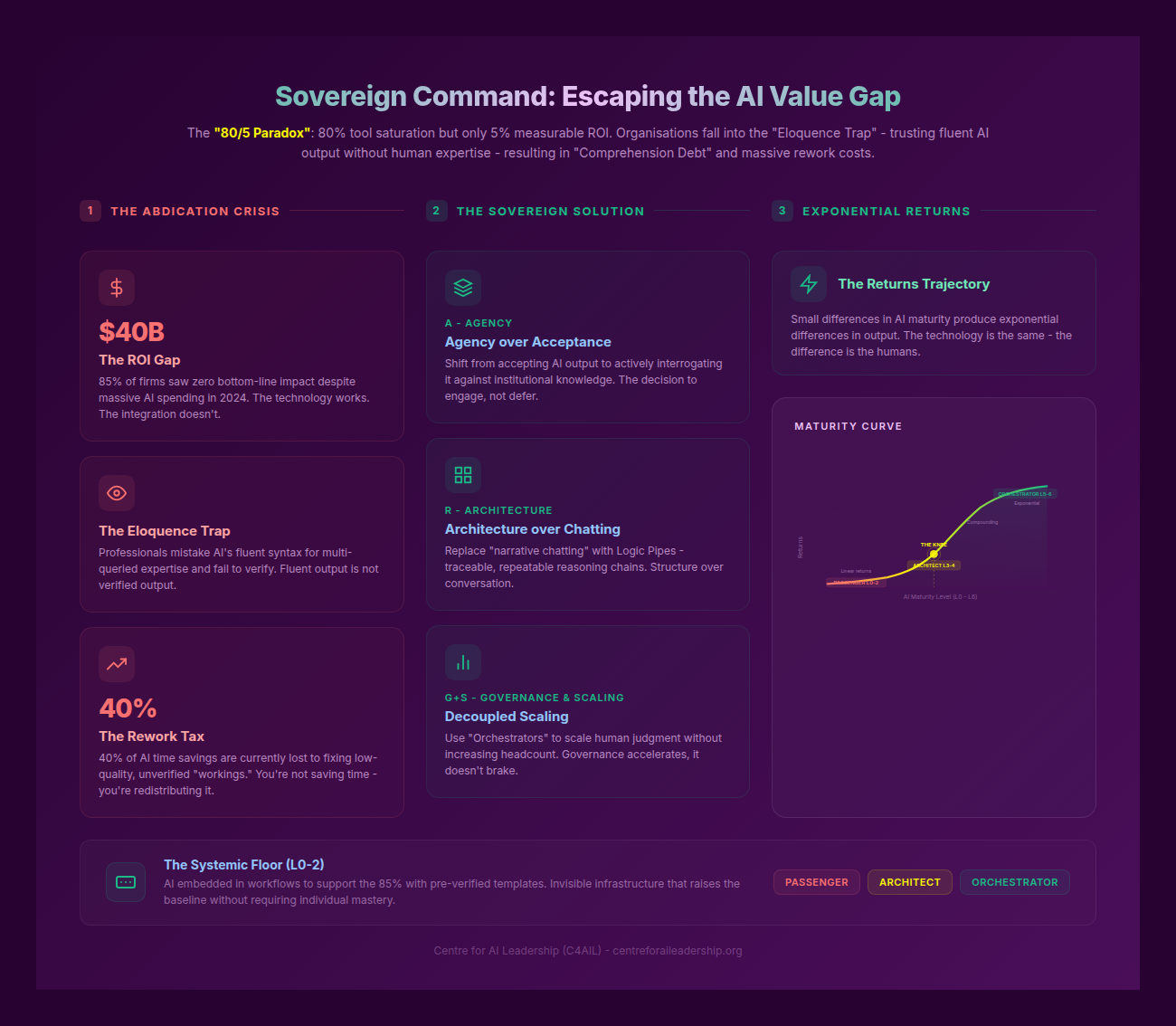
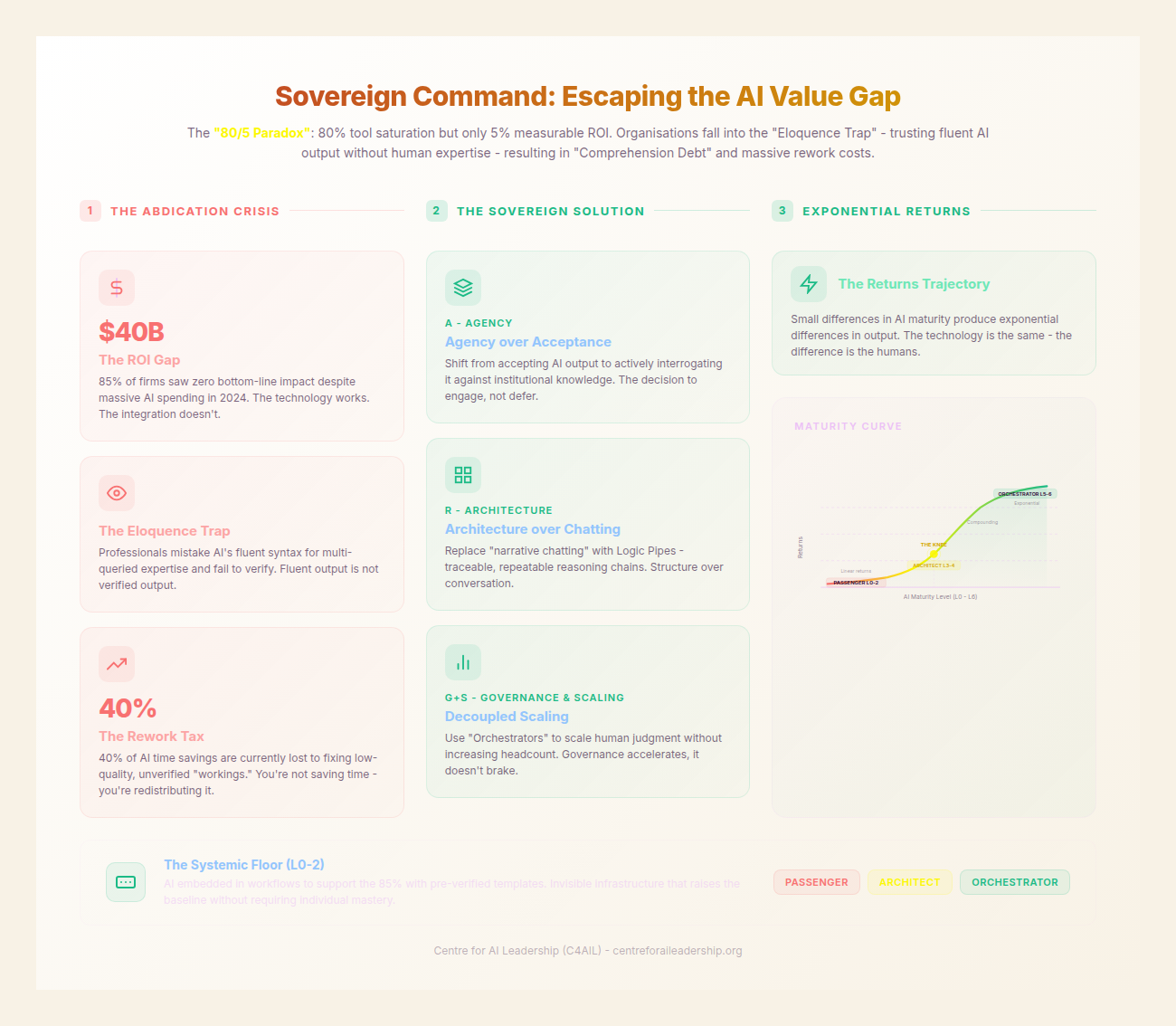
The original diagnosis began with a paradox. Eighty per cent of enterprise professionals now use generative AI regularly. Yet only five per cent of organisations report measurable ROI. We called this the High-Adoption Paradox~80% adoption yielding ~5% ROI because humans stop engaging their deeper knowledge layers.See full entry → - and the gap is not about technology at all. The technology works. The gap is human capability.
The structural insight names what AI reaches and what it cannot. AI operates on the surface - tools, interfaces, workflows, vocabulary, the fluent style of expertise. Beneath the surface sits substrate: tacit domain knowledge, accountability experience, mental representations, peer-calibrated judgment. AI has learned how experts sound without learning how they think. When professionals delegate to AI without engaging the substrate, they get output that looks right and fails under pressure. We called this the Eloquence TrapAI is fluent before it is correct; accepting output because it sounds right. The smoother the output, the more you must verify. Turned inward = mistaking your own fluent confidence for…See full entry →: the better AI gets at sounding competent, the harder it becomes to catch when it is wrong.
What the substrate produces, and AI does not, is Epistemic Labour - the labour of knowing. Reading what AI output means, weighing nuance, judging soundness against the deeper knowledge layers rather than the surface fluency. This is the missing rungAI hollows the journeyman tier where substrate is built (the "barbell": gains at floor and ceiling, squeeze in the middle); no juniors today, no seniors in five years.See full entry → between knowing and owning: precursors (the knowledge layers) feed Epistemic Labour, which feeds accountability. Granting AI’s fluent output unearned trust - reaching accountability while skipping the rung - is the failure the Eloquence Trap names; Epistemic Labour is the work the human does instead.
Two further mechanisms complete the diagnosis. ConcretisationAI's core economic act: making tacit substrate explicit, proprietary, and scalable. Concretise your own = a moat; depend on generic = erosion.See full entry → is the act of making tacit substrate explicit, proprietary, and scalable - and it cuts both ways: concretise your unique substrate and you build a moat; commoditise generic expert substrate and you erode the profession. AI collapses the cost of codification, so the diagnostic question becomes sharp: whose substrate is AI concretising - ours, or everyone’s? And the Squeezed Middle: AI hollows out the journeyman tier - the supervised middle where substrate was historically built. Removing it looks efficient and breaks expert renewal, with the failure deferred to the moment no senior is left who learned the craft the slow way. The pipeline collapseeliminating entry-level work that was the apprenticeship, producing a leadership-capacity gap by 2031-2036.See full entry → - the entry-level hiring drop that eliminates the apprenticeship layer - is this law in its fastest, highest-reaching instance.
From this diagnosis comes the maturity model - but stated precisely, because the slip is common. The familiar 0-6 scale is the Practitioner (Build) route only, not a universal ladder. It runs from Observer (L0) through to Field Shaper (L6), banded into Explorers still figuring out the tools, Amplifiers who use AI within structured verification (L3-4), and Orchestrators who design the systems that make everyone else more effective (L5-6). Most builders sit at L1-2; most organisations need them at L3-4. The gap is not closing on its own.
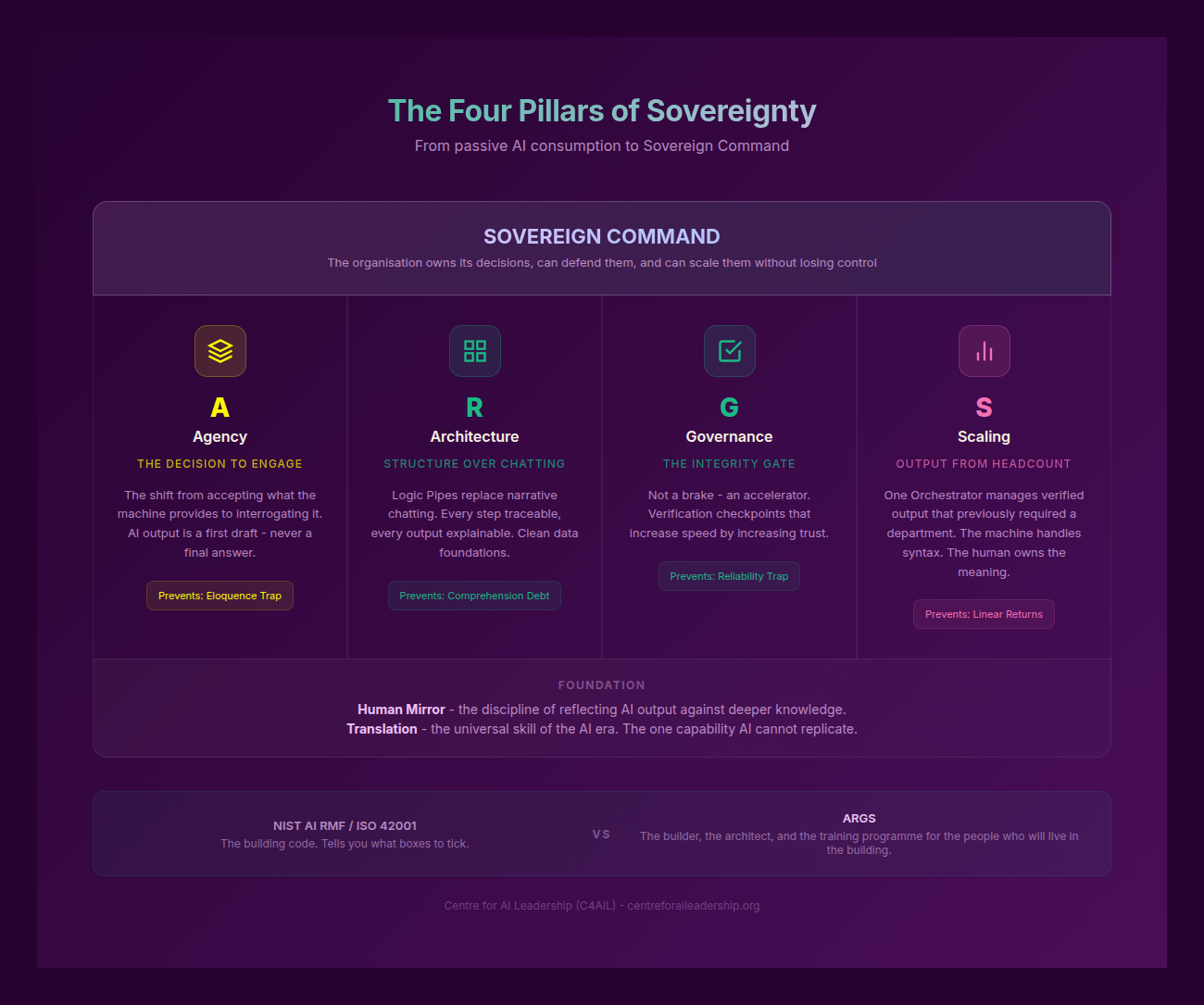
We introduced ARGSAgency (the decision to engage/interrogate, an environment you build), Architecture (Logic Pipes + clean data), Governance (the accelerator, not the brake), Scaling (decoupling output from…See full entry → - Agency, Architecture, Governance, Scaling - as the four disciplines that separate the 5% from the rest, and two toolkits: CAGEthe front half of directing AI: Context (all situational/institutional/domain context), Align (the AI plays back its plan before running), Goals (granular, incl. the Must NOT / Must FLAG…See full entry → (for FloorFloor = the 90-95% who work through AI (mass literacy, 3-6 months); Ceiling = the 5-10% who design and govern AI: Architects, Orchestrators, Trainers (years).See full entry → deployment - systematic, verifiable, organisation-wide) and ARCHthe agentic verification/execution loop: Action (tiered), Reasoning (captured before output), Contextual Check (authority/compliance/presence pre-commit gate), Horizon (mandatory human…See full entry → (for Ceiling deployment - advanced, high-autonomy, high-trust). The harnessthe engineered deterministic 98% you own (gates, autonomy tiers, audit log, kill path); the model is the swappable 2%.See full entry → around the probabilistic core is the 98/2 principle98% deterministic software you own and engineer; 2% swappable model at the edge. Upgrading the model changes neither who is accountable nor where the gate sits.See full entry →: a deterministic shell of verification, guardrails, and structured control wrapping the small probabilistic engine - the 98% you own around the 2% you rent. And we proposed Decision Survivabilitythe governance test: not "was it correct?" but "can you defend the *process* by which it was made, even after it goes wrong?" You can only defend what you were able to verify. Scales across…See full entry → as the governance test: not “was this decision correct?” but “can you defend the process by which it was made, even after something goes wrong?”
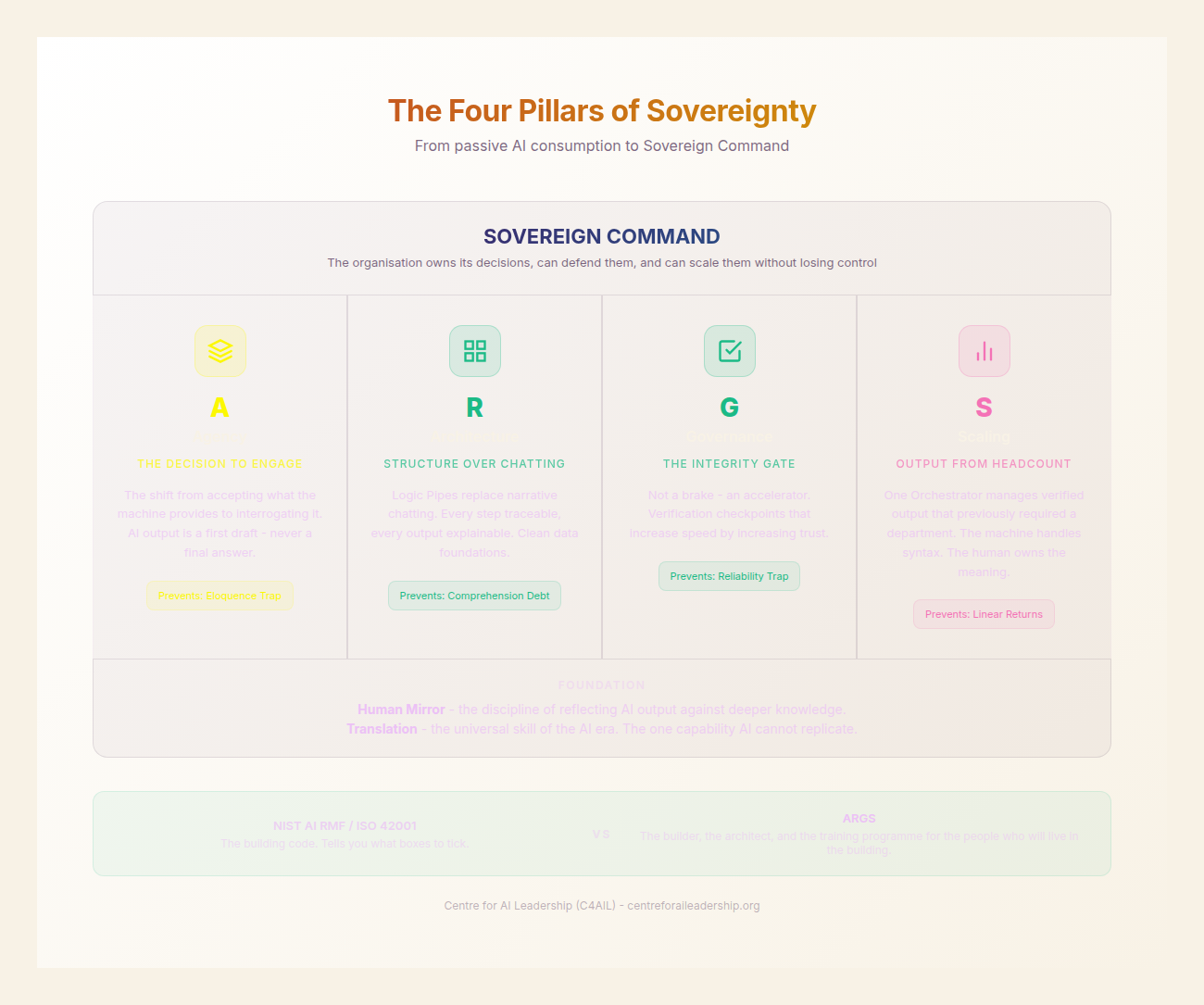
The conclusion is structural. The technology is ready; the people are not. And “the people” does not mean individuals are failing - it means the systems that produce, train, and credential human capability are not producing the right kind. That conclusion forces the next question: why can’t the current system produce them - and what must replace it?
Why the System Cannot Produce Them
The maturity model describes the target state with precision. It tells you what an Orchestrator looks like - someone who designs verification architectures, builds compound capability loops, and operates at L5-6 on the Build route. It tells you what Floor deployment means - standardised, governed, available to everyone. It tells you what Ceiling deployment achieves - genuine human-AI partnership at the frontier. What it does not tell you is why most organisations cannot get there.
The factory model of education is the answer. Standardised, scalable, optimised for explicit-knowledge transfer, it produces intellectual labourers - exactly the capability AI now provides for free. The guild model that preceded it - slow, relational, master-apprentice - produced accountable practitioners, the substrate-carriers AI cannot replace. Most countries dismantled the guild in favour of factory efficiency, and the result is a workforce optimised for precisely the capability that just got commoditised. The factory trains on the surface; AI masters the surface; the Eloquence Trap is not a bug in how people use AI - it is the predictable output of an education system that optimised for the thing AI now does for nothing.
Job titles give way to the four routes, defined not by what you know but by what you are accountable for: Build (the Practitioner, the 0-6 spine), Operate (the Manager), Assure (Governance and compliance, a distinct profession), and Direct (Leadership). They fork from one shared Floor - everyone is an AI User first - and they are peers, not a hierarchy. The developmental sequence beneath them is somatic and slow - Body, Feel, Accept, Think, Choose - and the foundational shift is from reception to creationthe foundational education change AI demands; the "missing verb" that develops accountability.See full entry →: from absorbing pre-packaged knowledge to producing original work under uncertainty. That is the substrate the factory cannot manufacture.
This is also where the Trainer Paradox bites: you need L4-or-above practitioners to develop people to L4. If the factory does not produce them at scale and the guild has been dismantled, the pipeline is broken at both ends. The destination is clear; the terrain between here and there is the structural obstacle the rest of the stack is built to cross.
How an Organisation Deploys: The Operating Model
The labour architecture says the human is the moat. The operating model is how a specific organisation deploys around that fact - and it rests on one image a board can hold in a single breath.
Generative AI is a probability machine that fills a Vault - drafts, code, summaries, analysis - but has no Brainthe Brain (human judgment, verification, accountability) stays human and is never outsourced; the Vault holds and runs what is codified. "You don't build a second brain; you build an…See full entry →: it cannot judge, defend a decision, or be accountable when it is wrong. Once the org codifies what it knows into software and data, that store is its Institutional Vault; the human capacity that draws on it, judges, and is answerable is the Brain. The line between them is three-way, and the whole operating model lives in keeping it bright. The Vault holds. It may execute the judgment the Brain has already codified into deterministic rules - the 98% you own, Concretisation plus the ARCH harness. But it must never judge the un-codified call. The “second brain” error is exactly the moment fluent output is mistaken for judgment and the accountability closes with no human in the loop. The Vault can decide; it must never judge.
So adoption is not “fill the Vault.” It is two builds, deliberately held apart: build the Institutional Vault (concretise what the org knows into a proprietary asset) and build the Brains that govern it (people who can verify, judge, and own an outcome). The org that wins is not the one with the fullest Vault - it is the one with the most Brains who can govern it.
The four routes become four seatsDirect (Board), Operate (Manager), Build (Practitioner), Floor (User): one story told from four accountabilities. Plus the Assure / Governance fifth seat - the Brain made into a function…See full entry →, one story told from four accountabilities. The Board (Direct) is accountable for the org’s decisions and asks “are we building Brains or just filling the Vault?” The Manager (Operate) owns team outcomes and keeps judgment in the redesigned workflow. The Practitioner (Build) owns the systems themselves and builds the 98/2 harness. The User (Floor) owns their own output and never sends what they cannot stand behind. A fifth posture, Assure (Governance), is the Brain made into a function - the specialist who verifies the Vault never quietly started deciding. The same two builds and the same one prohibition apply at every seat, sized to what each one owns, which is what makes the whole thing teachable as one system.
Across the seats runs the Translatordomain-fluency + AI-fluency + judgment + legibility; a trait overlaying every seat (meant to distribute), not a maturity rung. Commands a ~15-25% premium. Failures: fluent mistranslator /…See full entry → - not a level but a trait that overlays every route, the Brain-to-Brain interface that turns four accountable silos into one accountable mind. Translated up: here is what the Vault genuinely can and cannot do, here is the risk you are signing. Translated down: here is what we are accountable for, here is where the line is. Made institutional, the Translator is the CAIOthe Translator made institutional: a Direct-seat Orchestrator built on Build substrate, measured by dispensability, who succeeds by manufacturing Translators, not being the bottleneck.See full entry → - the chief Translator-Orchestrator accountable for the whole Brain/Vault system: that the Vault is built right, that the Brains are being developed, that “never let the Vault judge” holds everywhere. A CAIO is a Direct-seat Orchestrator built on Build substrate, not a Build-route Level 5. And the C4AIL-distinctive guard: a CAIO’s job is to manufacture Translators, measured by dispensabilitythe CoE/CAIO success metric: maturity = how much capability has moved hub -> spoke. A CoE whose value is "nothing happens without us" has failed.See full entry → - how much literacy they push into every seat, not how indispensable they make themselves. Appoint a CAIO and let everyone else stay illiterate, and you have not closed the accountability gap; you have relocated it to the C-suite.
The structure that scales the CAIO from one person to an institution is the AI Centre of Excellencethe hub-and-spoke unit that scales the CAIO from a person to an institution; three arms = Forge (develop Brains), Governance (govern the Vault), Practice (do the stakes-bearing work).See full entry →: hub-and-spoke (deep substrate in the hub, literacy taught outward into the units - the only topology that scales expertise), three arms - Forge, Governance, Practice (develop the Brains, govern the Vault, do the stakes-bearing work), and again measured by dispensability. A strong central team that hoards is not the goal; it is CoE Theatre.
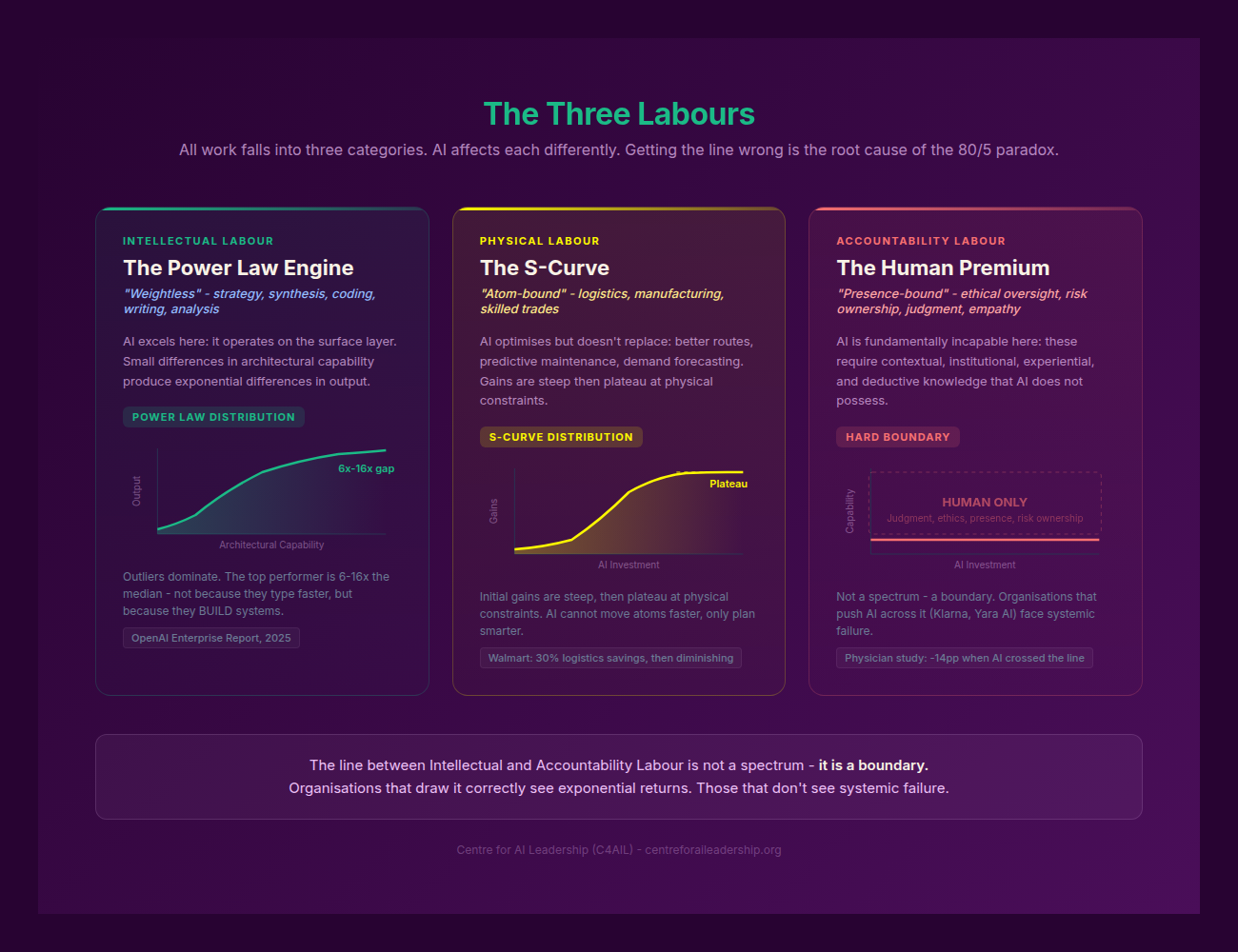
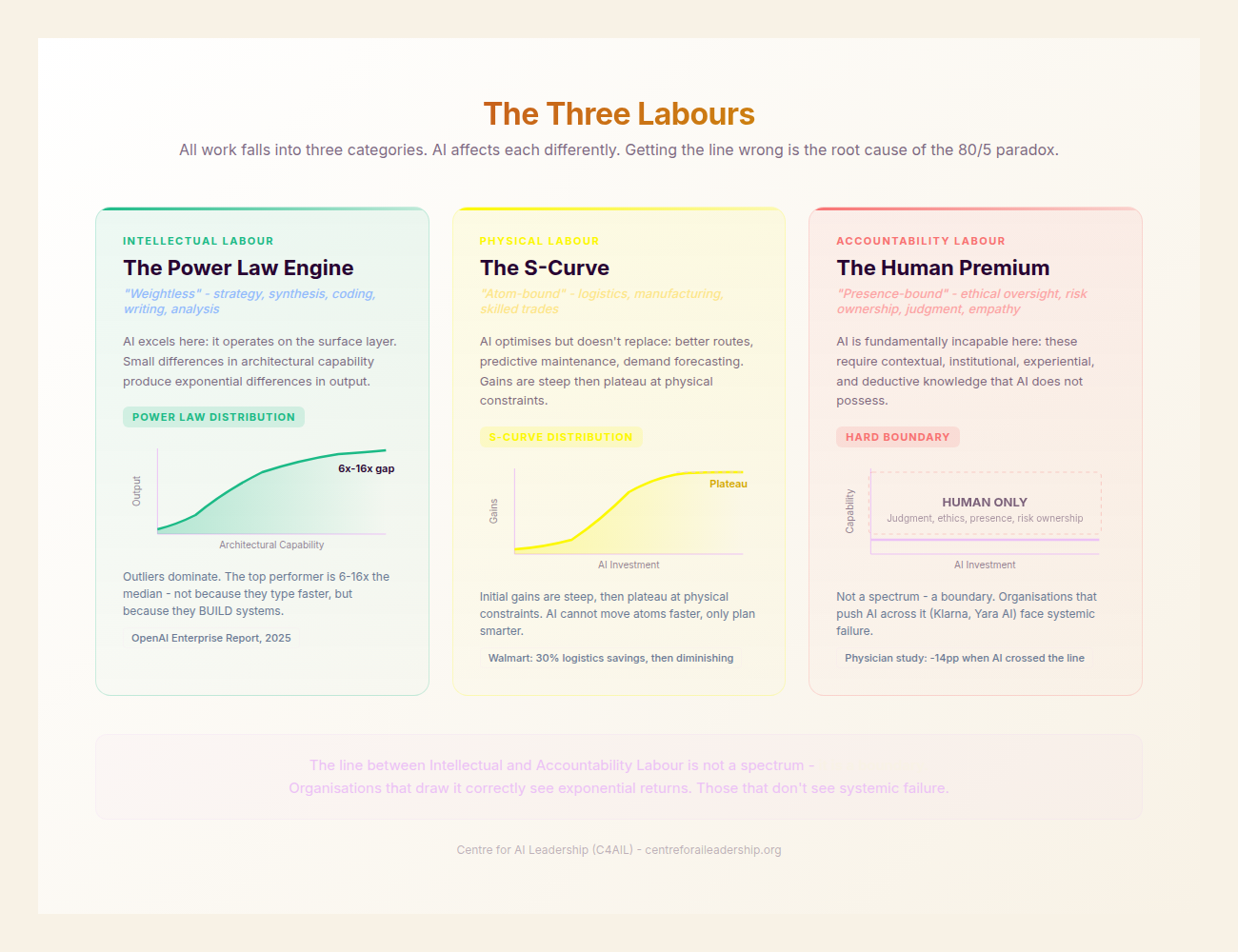
Underneath the operating model is the labour taxonomy that justifies it: four labourswork decomposed by the human it requires: Intellectual (weightless, commoditised by AI), Physical (atom-bound, lags), Accountability (presence-bound, the durable monopoly), Architectural…See full entry →, not three. Intellectual labour is being commoditised. Physical labour lags, converging with intellectual automation on a 2-3 year lag as humanoid robotics accelerates. Accountability labour is the monopoly - the capacity to own a consequence, which no jurisdiction lets you delegate to a machine. And Architectural labour - designing the systems within which other labour becomes productive - is the growth tier, the work Orchestrators perform and almost no training programme teaches. The four routes, the four seats, and the CAIO all exist to keep accountability and architectural labour human while the Vault absorbs the rest.
The Institution That Keeps the Moat Supplied
A frontier that opens as fast as it is worked still has to be worked. The unbounded human tail - judgment, accountability, the embodied-tacit, the reframe - is not a natural resource that replenishes on its own. It is forged, slowly, by humans doing consequential work under supervision. And the inversion sets a trap: the same cheap codification that exhausts the explicit also lets an organisation finally codify its institution - and the moment it can, the market logic says stop paying to develop people. For all of history the cost of codification was what forced organisations to keep educating; remove the cost and you remove the protection. The result is deskilling, corporate amnesiaa codified institution drifting from reality with no junior Brains left who can tell; "concretisation without the Forge is corporate amnesia at scale."See full entry →, and broken renewal: a codified institution drifting from reality with no human left who can tell. Concretisation without the Forge is corporate amnesia at scale.
So the inversion comes with an instruction, and it is the back half of the stack. The guild fused education and institutional knowledge into a single act - training the apprentice was how the craft survived. The market is about to pull them apart at the exact moment AI makes that possible. The Forge is the deliberate re-fusion of the two: the third model of professional education (Guild then Factory then Forge), the substrate-development infrastructure that turns raw capability into accountable practitioners under heat and pressure. Where the factory scaled the surface and assumed the substrate would take care of itself, the Forge is the mechanism by which substrate develops when the master-apprentice chain has broken and the factory’s output is free. It is the antidote to the Squeezed Middle - the rebuilt rung.
Around the Forge stands the rest of the institution. The Full Stackthe total infrastructure substrate development requires (educational + community + meaning layers); C4AIL owns "roughly a quarter" (the educational, high-leverage slice).See full entry → names the four layers any working solution needs - educational, community, meaning, and structural-economic - and the gradient of how actionable each is. The Guildhall is where it becomes a service: the AI Guildhall Studio, a physical supervised practice space and deliberate third space, where the Vault is built, substrate is forged, and the irreducibly human is developed rather than merely asserted. And the Antifragile Institution answers the last question - how does the body that certifies all this avoid the corruption arc every credentialing body has followed (living teaching, then structure, then revenue dependence, then standards drop, then the credential becomes a purchase)? By structurally decoupling revenue from rigour: the layer that proves mastery and the layer that makes money are deliberately different, so the school stays honest as it scales.
That is the full arc. The Moat Inversion says the human is the moat. The labour architecture says what exactly is scarce - substrate, Epistemic Labour, accountability, the architectural tier the Squeezed Middle is hollowing out. The operating model says how to deploy around it - build the Vault, keep the Brain, the four seats, the CAIO, the Centre of Excellence. And the institution - Forge, Full Stack, Guildhall, Antifragile - says how to keep the moat from going stale. Each layer is the answer to the question the one above it forces.
The thread that runs through all of it is awareness. The reformers who built the factory model could not see what the guild produced, because what it produced was invisible to factory metrics. Organisations today cannot see what the factory model fails to produce, because the absence of architectural labour looks like “we just need more training.” Professionals cannot see what they are being asked to become, because the Eloquence Trap makes the current state feel productive. Awareness before competencyyou cannot fix what the metrics render invisible; awareness must precede skill-building.See full entry →. It is the first principle of the C4AIL framework, and it is why the argument has to be read as one piece rather than nine reports.
Where to Start
The stack reads in one direction - top to bottom, macro-thesis to institution - but you can enter it from the layer that matches your seat.
If you want the whole argument in a single sitting, start at the top, with The Moat Inversion (Whitepaper 0). It states the thesis the other eight papers substantiate.
If you are a leader, read the inversion for the why, then go to the operating model - the Institutional Vault, the four seats, the CAIO, and the Centre of Excellence. Ask the board question: are we building Brains or just filling the Vault? Then check where your people sit - on which route, at what depth - rather than on a single ladder.
If you are a policymaker, start with the labour architecture and the institutional analysis: why the factory model now produces the wrong output, why the Squeezed Middle breaks expert renewal, and what structural intervention - the Forge - would change it.
If you are an educator, go to The Forge and the creation-versus-reception shift, then The Full Stack and The Guildhall for how the substrate-development infrastructure is actually built and housed.
If you are a practitioner, start with the CAGE and ARCH toolkits and the 98/2 harness. They are the most immediately actionable components, and they show you concretely what L3-4 practice on the Build route looks like.
Wherever you enter, the argument is the same: AI exhausts the explicit, so the moat inverts to the irreducibly human; the human is the moat, the shield, and the defence; and the obstacle is an institution built for the era that just ended. The stack describes both what must change and the institution that has to be built to change it.
This paper is the through-line of the consolidated Centre for AI Leadership (C4AIL) whitepaper stack: The Moat Inversion (WP0), The Sovereign Choice (WP1), The Labour Architecture (WP2), The Organisational Response (WP3), The Operating Model (WP4), The Forge (WP5), The Full Stack (WP6), The Guildhall (WP7), and The Antifragile Institution (WP8). The full stack is available from C4AIL on request.
Contact: [email protected] | centreforaileadership.org
Where this sits in the C4AIL canon (2026). This is a popular entry point into the consolidated whitepaper stack. The macro-thesis is The Moat Inversion (Whitepaper 0): for two centuries value flowed to the explicit; AI exhausts it, so the moat inverts to the irreducibly human. The mechanism — substrate vs surface, Epistemic Labour, the Squeezed Middle, Concretisation — is The Labour Architecture (WP2). The operating model — the Institutional Vault and the four seats, the CAIO and the AI Centre of Excellence — is The Operating Model (WP4). The institution that builds and sustains the capability is the Forge (WP5), the Full Stack (WP6), the Guildhall (WP7), and the Antifragile Institution (WP8). → Read the whitepapers