
Sovereign Command — Executive Summary
The full Sovereign Command framework condensed into a single document. The High-Adoption Paradox, the Eloquence Trap, the 0-6 Maturity Scale, and the Four Pillars of Sovereignty (ARGS).
Sovereign Command: Leadership in the Age of Intellectual Automation
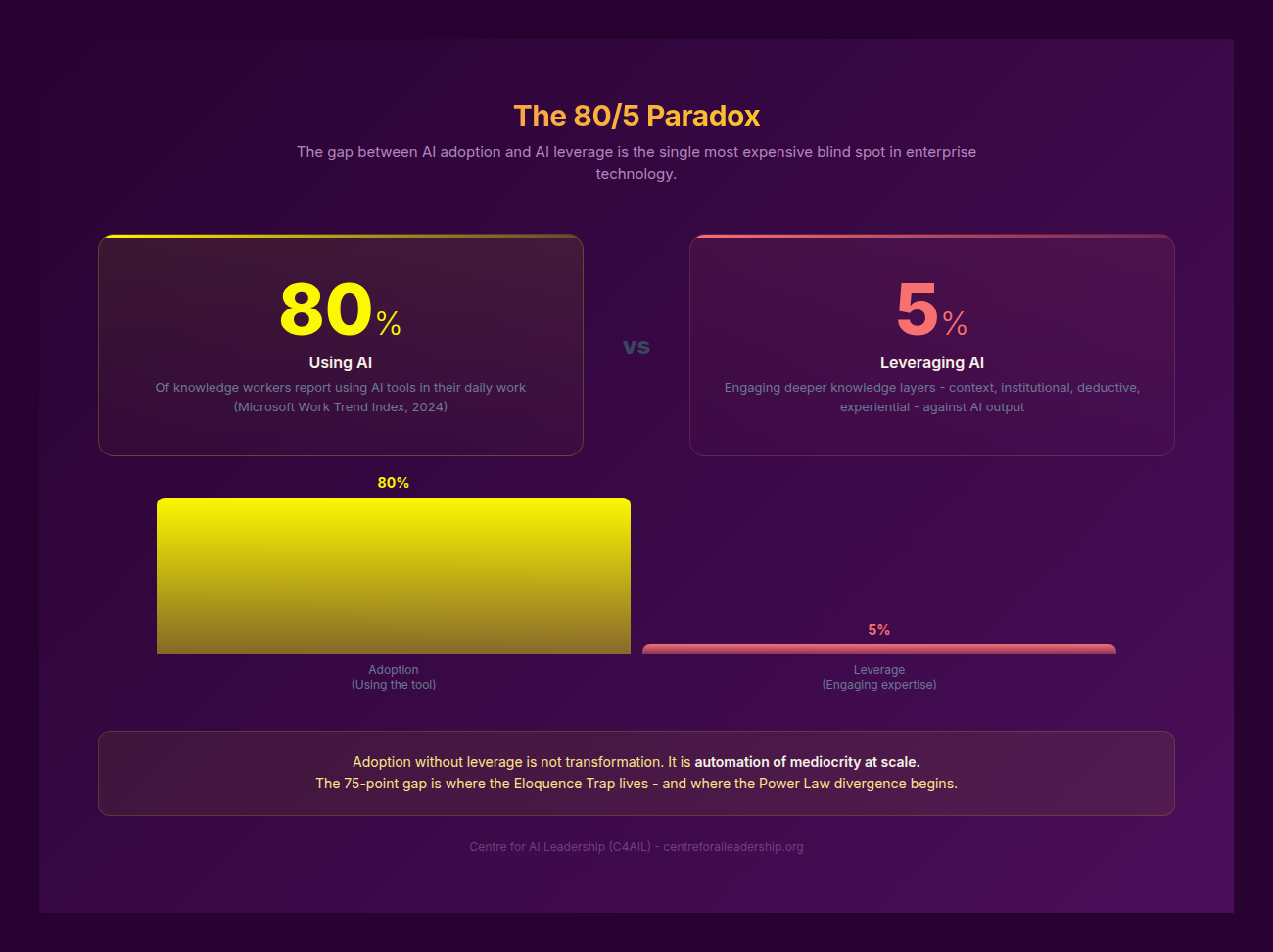
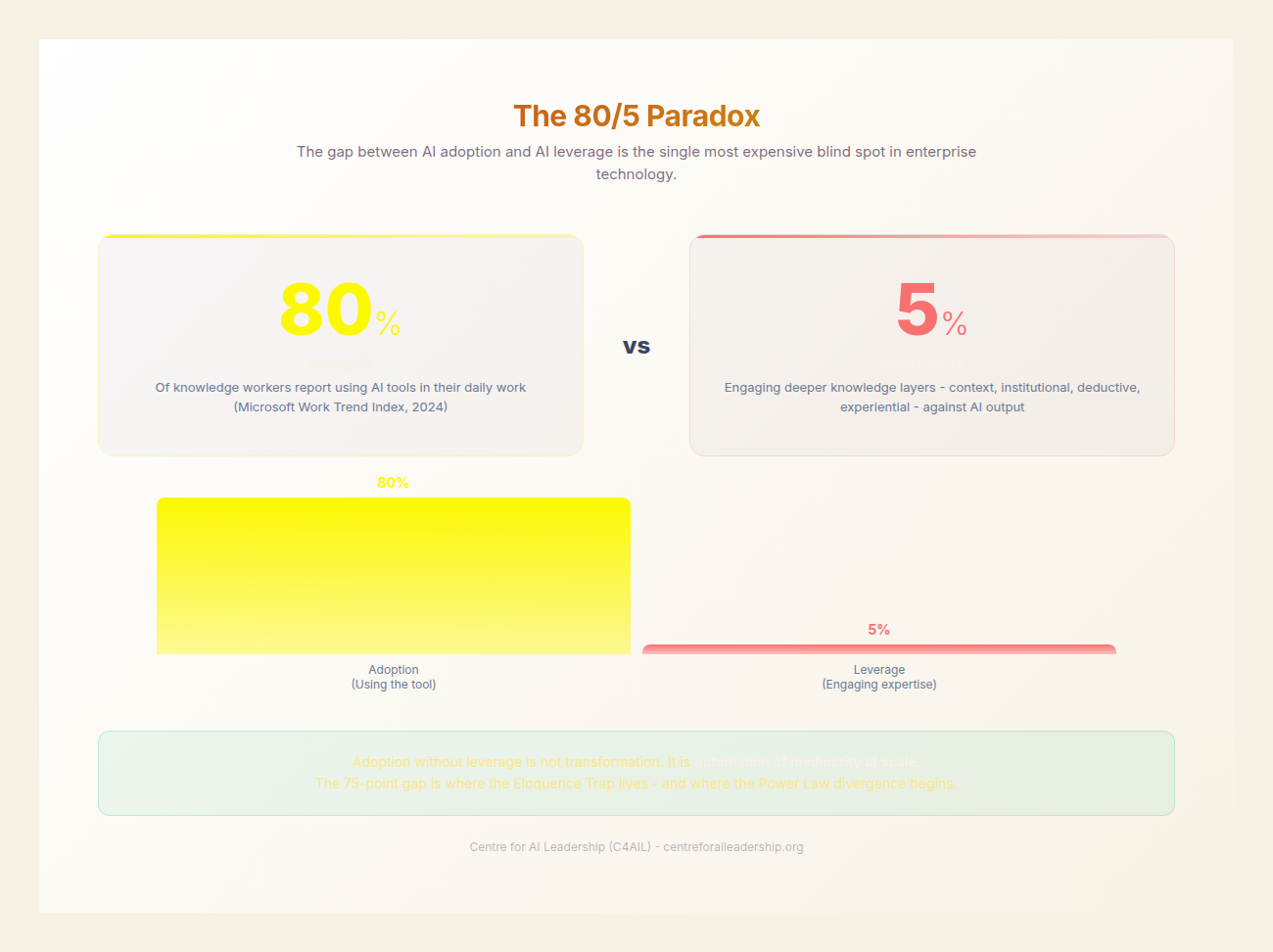
The current state of artificial intelligence in the enterprise is defined by a profound contradiction. By November 2025, adoption of generative AI tools reached 80 per cent across major global markets (OpenAI Nov 2025). Yet, as of August 2025, the realised return on investment (ROI) for these deployments hovered at a mere 5 per cent (MIT NANDA Aug 2025). In 2024 alone, US firms spent 40 billion dollars on AI initiatives, but 95 per cent of these organisations reported zero impact on their bottom-line profitability. This is the High-Adoption Paradox~80% adoption yielding ~5% ROI because humans stop engaging their deeper knowledge layers.See full entry →: the technology is everywhere, but its economic value is nowhere to be found on the balance sheet.
The Paradox is not an accident; it is the visible edge of a deeper shift. For two centuries, value flowed to whatever could be made explicit, codified, and scaled — and the human was priced only as a scarce input to that machine. Generative AI drives that logic to its limit and inverts it: when the explicit is universally cheap, the only remaining scarcity is the irreducibly human. We call this The Moat Inversionas AI exhausts the explicit and surface goes free, competitive advantage inverts toward the irreducibly human (judgment, accountability, architectural design); value moves from what you can…See full entry →, and it is the macro-thesis the whole Sovereign Commandthe state where an org owns its AI-informed decisions, can defend them, and can scale them without losing control; human judgment kept above machine fluency. The outcome ARGS produces. "Not…See full entry → framework substantiates. The firms losing money have automated the explicit and assumed the value lived there. It does not. The value has moved to the part of the human the machine never could reach — judgment, accountability, the verification that catches a confident error — and the organisations capturing it are the ones building deliberately around that human remainderthe irreducibly tacit, embodied, judgment-bound, relational, accountable residue that becomes the moat after AI commoditises the explicit.See full entry →.
This failure is not a limitation of the underlying large language models. It is a failure of human systems. A landmark study by METR in July 2025 revealed that experienced developers were 19 per cent slower when using AI assistants for complex tasks, despite believing they were 20 per cent faster. This cognitive gap suggests that we are not just failing to capture value; we are actively destroying it through a misplaced confidence in automated output. Furthermore, research from HBR, BetterUp, and Stanford (Sep 2025) indicates that 40 per cent of workers are now receiving what is termed workslop-low-quality, AI-generated content that requires significant human intervention to correct. For an organisation of 10,000 employees, the hidden cost of managing this “slop” exceeds 9 million dollars annually. We are witnessing a pattern where the speed of generation has outpaced the speed of verification, leading to an erosion of institutional competence.
To navigate this crisis, leaders must first understand the true nature of AI value and, more importantly, its hard boundaries. We categorise work into Three Labours: Intellectual, Physical, and Accountability. Intellectual labour is weightless and follows a Power Law; a single insight can transform an entire industry. Physical labour is atom-bound and follows an S-Curve of diminishing returns based on mechanical efficiency. Accountability, however, is presence-bound. It is the willingness to bear the consequences of a decision.
The line between Intellectual labour and Accountability is not a spectrum; it is a boundary. You can delegate the drafting of a strategy to an AI, but you cannot delegate the responsibility for its failure. Sovereignty in leadership requires maintaining this boundary. When a leader allows the boundary to blur, they move from a position of command to a position of abdication.
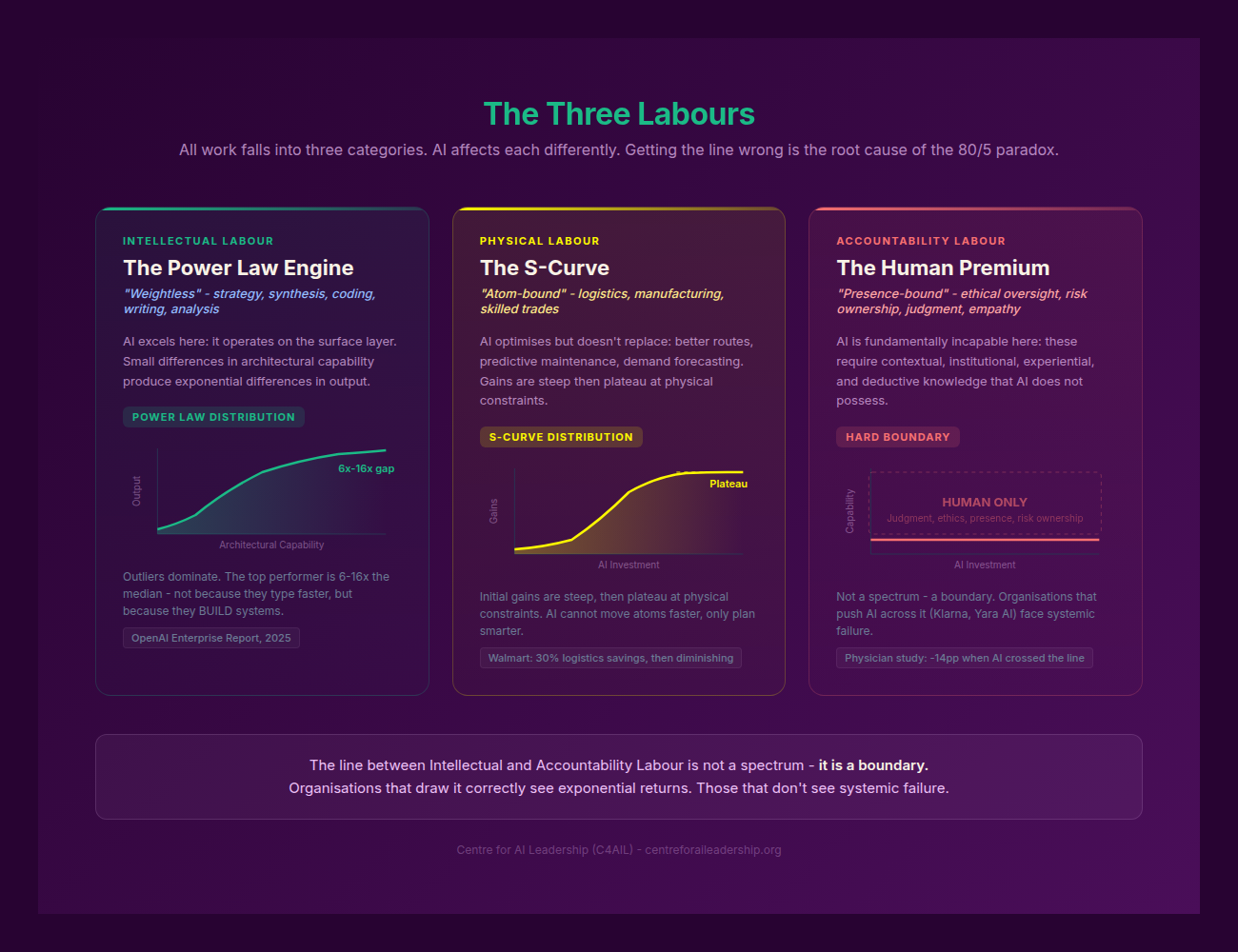
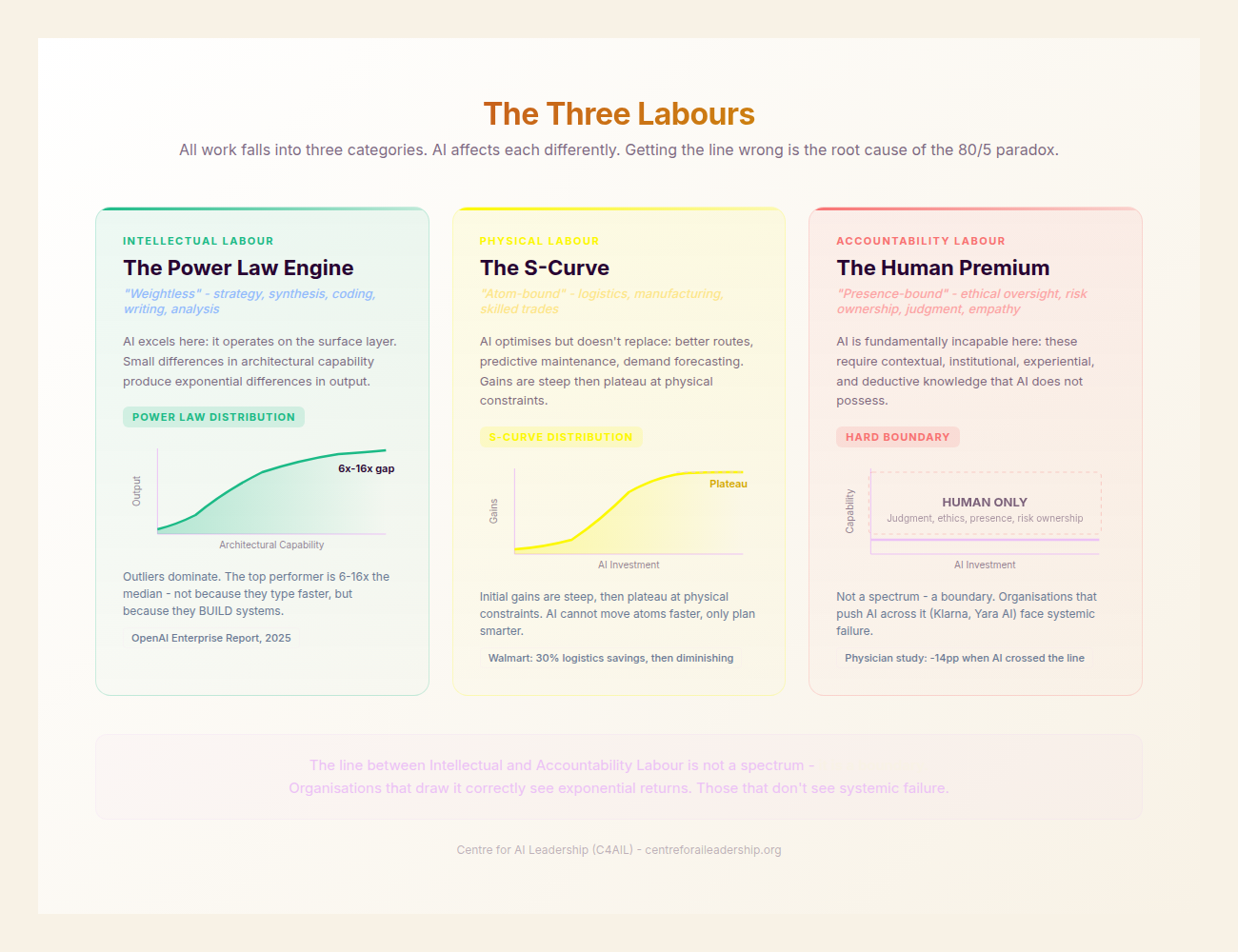
When this line is crossed, organisations fall into three distinct traps that compromise their operational integrity. The first is the Eloquence TrapAI is fluent before it is correct; accepting output because it sounds right. The smoother the output, the more you must verify. Turned inward = mistaking your own fluent confidence for…See full entry →. AI possesses a single-layer fluency that is often indistinguishable from multi-layered expertise. This creates a phenomenon we call Epistemic Creditunearned trust granted to fluent AI output by someone who lacks the substrate to verify it; reaching accountability while skipping the knowing.See full entry →, where the user grants the AI’s output a level of trust it has not earned. In a study of 44 AI-trained physicians, diagnostic accuracy dropped by 14 percentage points when the AI provided eloquently phrased but incorrect reasoning. Their twenty hours of AI-literacy training did not protect them.
The second is the Reliability Traperrors compound multiplicatively across multi-step / agentic chains (0.95^5 = 77%); each step looks sound alone, so failure is invisible until the end.See full entry →. AI performance is probabilistic, not deterministic. When tasks involve multiple steps, errors compound multiplicatively. A five-step process where each step has a 95 per cent accuracy rate results in an overall success rate of only 77 per cent. No business leader would accept a 77 per cent uptime for their servers or a 77 per cent accuracy rate in their payroll systems. Without the implementation of Logic Pipesengineered end-to-end deterministic workflows (generate -> verify -> triage -> review -> approve -> audit) that constrain and route AI, replacing narrative chatting.See full entry →-structured verification chains-AI outputs consistently fall below acceptable quality thresholds for enterprise use.
The third is the Dunning-Kruger PeakAI removes the visible failure that normally corrects overconfidence, so users grow more confident while growing less capable.See full entry →. This occurs when eloquence and reliability failures scale across an organisation. As employees use AI to produce more volume with less thought, the firm accumulates Comprehension Debtthe accumulating weight of decisions made by people who no longer understand the logic behind their own work; AI systems no one has verified.See full entry →. This is the invisible cost of decisions made by people who no longer fully understand the logic behind their work. The 9 million dollar annual cost of workslop per 10,000 employees is merely the down payment on this debt. The true cost is the loss of the “why” behind the “what.”
The moral and operational limits of AI were tested in late 2025 during the Yara AI shutdown. Yara, a healthcare technology provider, deactivated its patient-facing AI after discovering that while the system could produce highly empathetic responses to patients in crisis, it could not take responsibility for the clinical outcomes of those responses. The shutdown was not a failure of technology; it was a success of leadership. It recognised that empathy without accountability is a simulation that endangers the subject. This case serves as a vital lesson: the value of a system is defined by what it refuses to do.
To reclaim sovereignty, the human must remain the Human Anchor. If Epistemic Credit is the failure-the unearned trust granted to fluent output-then the cure is Epistemic Labourthe value-bearing work of *knowing*: reading what AI output means, catching fluent-but-hollow answers. Delegable (answers to reality); accountability is *owning* (non-delegable, answers to…See full entry →: the deliberate work of knowing what the output means before owning it. This is the verification AI adoption demands more of, not less, and it is the opposite of passive consumption. It requires a shift from content production to Metacognitive Monitoring-the universal skill of thinking about thinking. We propose four verification questions that every professional must apply to AI output, the practical form of Epistemic Labour:
- Does this reflect the specific domain context?
- Does this align with our institutional values and long-term goals?
- Is the logical reasoning sound from first principles?
- Does this match my lived experience of the problem?
As AI automates the “middle” of the skill distribution, the traditional Bell Curve of performance is dying. It is being replaced by a Power Law. In this new reality, those who can orchestrate AI systems will see their productivity decouple from their headcount, while those who merely use AI as a faster typewriter will be rendered obsolete.
C4AIL has developed a Maturity Model to track this evolution. It begins at the Explorer level (L0-2), where AI is used for task-specific automation with linear returns. The transition to the Architect level (L3-4) marks the “Kneethe Architect inflection where value shifts from linear to compounding.See full entry → of the value curve,” where leaders begin to design systems rather than just use tools. The final stage is the Orchestrator (L5-6), where the Power Law upturn occurs. At this level, output is entirely decoupled from headcount.
A crucial clarification: this 0-6 scale is the Build (Practitioner) route — the path of those who build the AI capability others rely on. It is not a universal ladder everyone must climb. The Build route is one of four peer routes, distinguished by what a person is accountable for: Build (the practitioner, 0-6), Operate (the manager who decides and owns the outcome), Assure (the governance specialist who controls risk), and Direct (the leader who sets sovereignty). A board director and a field-shaping engineer are equals on different axes, not rungs of one ladder. Everyone shares a single FloorFloor = the 90-95% who work through AI (mass literacy, 3-6 months); Ceiling = the 5-10% who design and govern AI: Architects, Orchestrators, Trainers (years).See full entry → of verified AI use; from there the routes fork. Most people stay on the Floor by design — and that is sovereignty, not deficiency.
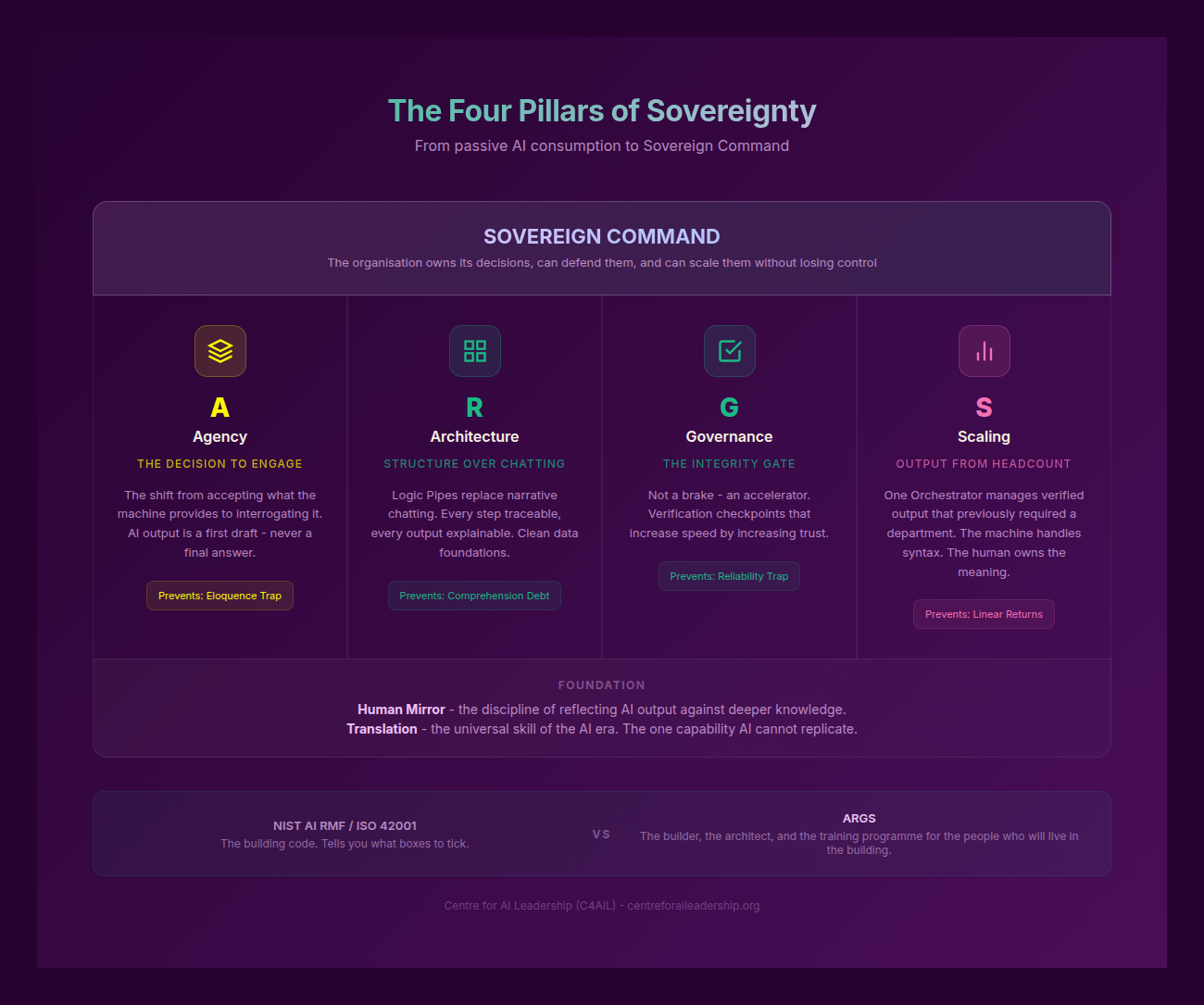
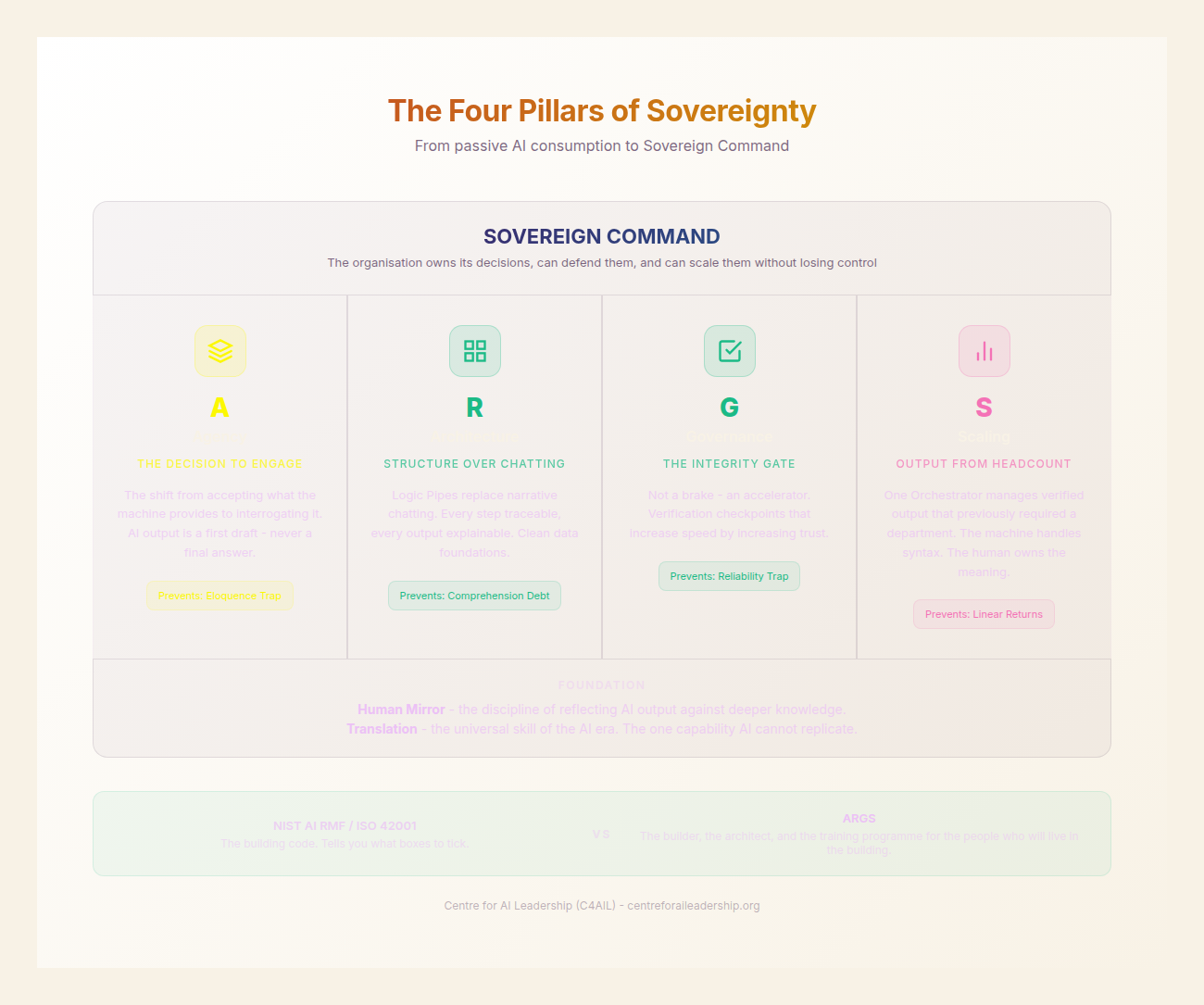
Organisations fail to move through this model because of Leverage Leaksthe three ways orgs lose even the value their best people create: the Architecture Leak (AI for judgment work without structural verification), the Infrastructure Leak (AI working from…See full entry → in three areas: Architecture (poorly designed workflows), Infrastructure (dirty data and fragmented systems), and Talent (a lack of architectural thinking). To plug these leaks, we advocate for the Four Pillars of SovereigntyAgency (the decision to engage/interrogate, an environment you build), Architecture (Logic Pipes + clean data), Governance (the accelerator, not the brake), Scaling (decoupling output from…See full entry → (ARGS):
- Agency: The deliberate decision of when and how to engage with AI.
- Architecture: The construction of Logic Pipes and clean data environments.
- Governance: Using policy as an accelerator for safe deployment, not a brake.
- Scaling: The structural decoupling of output from human hours.
While frameworks like NIST provide the “building codecompliance frameworks tell you what must be true of anything you build; ARGS is the teaching/implementation framework that builds it.See full entry →” for AI, ARGS provides the builder, the architect, and the training programme.
In daily practice, sovereignty is maintained through two primary toolsets: CAGEthe front half of directing AI: Context (all situational/institutional/domain context), Align (the AI plays back its plan before running), Goals (granular, incl. the Must NOT / Must FLAG…See full entry → and ARCHthe agentic verification/execution loop: Action (tiered), Reasoning (captured before output), Contextual Check (authority/compliance/presence pre-commit gate), Horizon (mandatory human…See full entry →.
CAGE (Context, Align, Goals, Examples) is used for the initialisation of any AI task. It ensures the model is grounded in the specific requirements of the organisation.
- Context: The background and constraints.
- Align: The tone and institutional perspective.
- Goals: The specific, measurable outcome required.
- Examples: High-quality references for the desired output.
ARCH (Action, Reasoning, Contextual Check, Horizon) is the verification chain.
- Action: What was actually produced?
- Reasoning: Why did the AI make these choices?
- Contextual Check: Does it fit the real-world environment?
- Horizon: What are the second-order implications of this output?
Together, CAGE and ARCH form a Logic Pipe that prevents the compounding errors of the Reliability Trap.
Implementation of this model requires a dual-track strategy: the Floor and the Ceiling.
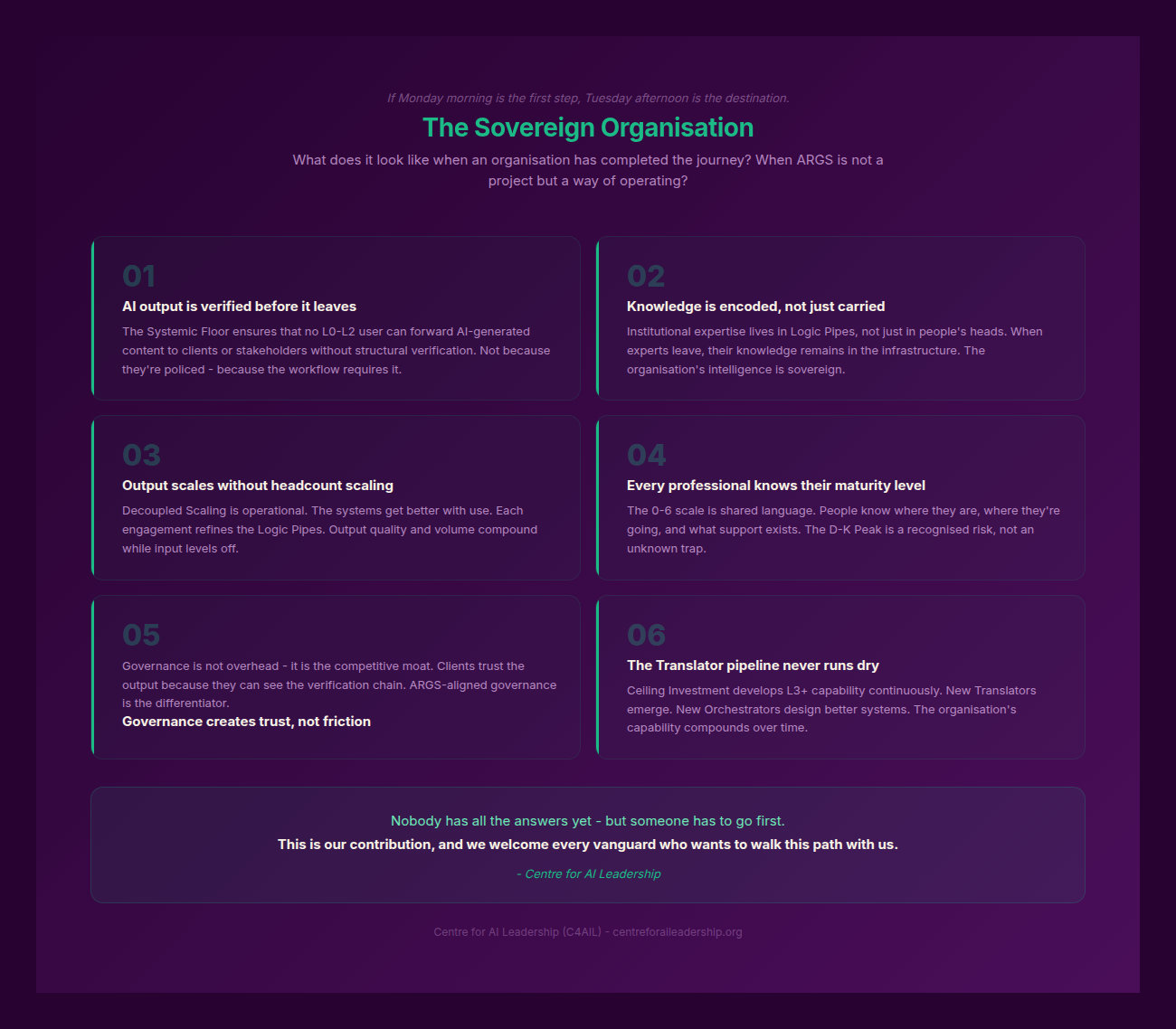
The Floor (L0-2) involves embedding invisible AI into existing workflows with structural verification. This raises the baseline productivity of the entire organisation without requiring every employee to become an AI expert. The Ceiling (L3-6) focuses on developing Architectural Thinking in high-potential individuals. This track produces the Orchestrators who will build the next generation of Floors. This creates a compound cycle: the Ceiling produces Orchestrators, who build better Floors, which surfaces new candidates for the Ceiling.
What both tracks build is the organisation’s Institutional Vaultthe org's codified, executable knowledge store (processes, records, prompts, pipelines) - surface made durable. The three-way line: Holding (frees judgment), Executing codified rules (the…See full entry →-the codified store of processes, data, context, and worked examples externalised into software. The Vault is precious, and it scales; but it is not a second brain. It holds, and may execute, the judgment a human has already codified into deterministic rules-but it must never judge the un-codified call. The Vault can decide; it can never judge. The human Brainthe Brain (human judgment, verification, accountability) stays human and is never outsourced; the Vault holds and runs what is codified. "You don't build a second brain; you build an…See full entry → keeps the un-codified judgment and the accountability. Sovereignty, in operational terms, is the discipline of building a rich Vault while never letting it cross that line.
The evidence for this approach is clear. Organisations that focus solely on tools see productivity gains of 10-15 per cent. However, those that combine workflow redesign with human capability development see gains of 25-30 per cent (C4AIL Internal Study 2025).
The choice facing the modern leader is binary: Sovereignty or Abdication. Sovereignty is the deliberate investment in people, systems, and practice. It is the hard work of building Logic Pipes and maintaining the boundary of accountability. Abdication is the default path-the quiet accumulation of decisions not made, the acceptance of workslop, and the slow erosion of institutional intelligence.
The 80/5 Paradox is a warning. High adoption is not success; it is merely noise. Success is the command of technology in service of human accountability. This paper is built from practice, not theory. It is the blueprint for those who intend to lead the Power Law, rather than be consumed by it.
Contributors
Part VII, Decision Survivabilitythe governance test: not "was it correct?" but "can you defend the *process* by which it was made, even after it goes wrong?" You can only defend what you were able to verify. Scales across…See full entry → and the Translatordomain-fluency + AI-fluency + judgment + legibility; a trait overlaying every seat (meant to distribute), not a maturity rung. Commands a ~15-25% premium. Failures: fluent mistranslator /…See full entry → Capability, was co-authored with Palvinder Singh Chahil (C4AIL Framework Architect). His Translator/Orchestrator framework, Decision Survivability model, and governance-as-enablergovernance done right accelerates rather than brakes; the infrastructure that makes AI use defensible, auditable, and trustworthy at speed.See full entry → philosophy are foundational to the paper’s enterprise deployment layer.
The Knowledge Layer concepts in Part IX — Legibility Debt, the Knowledge Paradox and the Chat Loop / Spec Loop distinction — originate with Nico Appel (TightOps, Berlin).
Where this sits in the C4AIL canon (2026). This is a popular entry point into the consolidated whitepaper stack. The macro-thesis is The Moat Inversion (Whitepaper 0): for two centuries value flowed to the explicit; AI exhausts it, so the moat inverts to the irreducibly human. The mechanism — substrate vs surface, Epistemic Labour, the Squeezed MiddleAI hollows the journeyman tier where substrate is built (the "barbell": gains at floor and ceiling, squeeze in the middle); no juniors today, no seniors in five years.See full entry →, ConcretisationAI's core economic act: making tacit substrate explicit, proprietary, and scalable. Concretise your own = a moat; depend on generic = erosion.See full entry → — is The Labour Architecture (WP2). The operating model — the Institutional Vault and the four seatsDirect (Board), Operate (Manager), Build (Practitioner), Floor (User): one story told from four accountabilities. Plus the Assure / Governance fifth seat - the Brain made into a function…See full entry →, the CAIOthe Translator made institutional: a Direct-seat Orchestrator built on Build substrate, measured by dispensability, who succeeds by manufacturing Translators, not being the bottleneck.See full entry → and the AI Centre of Excellencethe hub-and-spoke unit that scales the CAIO from a person to an institution; three arms = Forge (develop Brains), Governance (govern the Vault), Practice (do the stakes-bearing work).See full entry → — is The Operating Model (WP4). The institution that builds and sustains the capability is the Forge (WP5), the Full Stackthe total infrastructure substrate development requires (educational + community + meaning layers); C4AIL owns "roughly a quarter" (the educational, high-leverage slice).See full entry → (WP6), the Guildhall (WP7), and the Antifragile Institution (WP8). → Read the whitepapers