Your Reskilling Budget Is Training for Yesterday
Your reskilling budget is training people for tasks AI already does better. What people leaders need to build instead: human capabilities that compound with AI, not compete against it.
Your Reskilling Budget Is Training for Yesterday
Paper 6: For People Leaders
Centre for AI Leadership (C4AIL) - 2026
The Reskilling Paradox
Here is a number that should haunt every CHRO in the world: US firms spent $40 billion on AI in 2024, and 95% of them saw zero measurable impact on their bottom line.
Now here is the number that should haunt you specifically: 82% of employees received no AI training at all in 2025 (Deloitte). Of the 18% who did, the vast majority completed prompt-writing courses - how to get the machine to produce what you want. Not how to verify what it produces. Not how to redesign work around it. Not how to build the human capabilities that AI cannot replace.
The reskilling gap is not small. Pearson and Faethm estimate it at $1.1 trillion annually - the aggregate cost of workforces trained for roles that are being structurally transformed underneath them. That is not a training budget problem. That is a strategic misallocation of human capital at civilisational scale.
But the uncomfortable truth is this: even if you tripled your training spend tomorrow, you would be wasting most of it. Because the problem is not insufficient training. It is the wrong kind.
Standard AI reskilling produces better intellectual labourers - people who can draft faster, synthesise more, generate more polished output. But AI commoditises intellectual labour. It does intellectual labour better than any individual human, at near-zero marginal cost, 24 hours a day. Every dollar you spend making your people faster at the thing the machine already does is a dollar that feeds the machine you are supposed to be competing with.
There is a deeper logic underneath this, and naming it tells you exactly where to point the budget. For two centuries, economic value flowed to whatever could be made explicit, codified, and scaled - and the human was valued only as a scarce input to that machine. Generative AI drives that logic to its limit and inverts it: when the explicit is universally cheap, the only remaining scarcity is the irreducibly human - judgment, accountability, the earned tacit capacity to know when a fluent answer is wrong. This is the Moat Inversionas AI exhausts the explicit and surface goes free, competitive advantage inverts toward the irreducibly human (judgment, accountability, architectural design); value moves from what you can…See full entry →: the competitive advantage moves out of the explicit, which your people can no longer differentiate themselves by producing, and into the human capacities AI cannot reach. A reskilling budget aimed at making people better at the explicit is aimed at the side of the inversion that just lost. The whole strategic task is to point it at the side that just became the moat.
Your reskilling budget is training for yesterday. The question is: what does training for tomorrow look like?
The Four Labours - What HR Needs to Understand
The first thing to understand is that “work” is not one thing. Every job, every role, every task in your organisation is a bundle of four fundamentally different types of labour. Getting this wrong is the reason most workforce planning is failing.
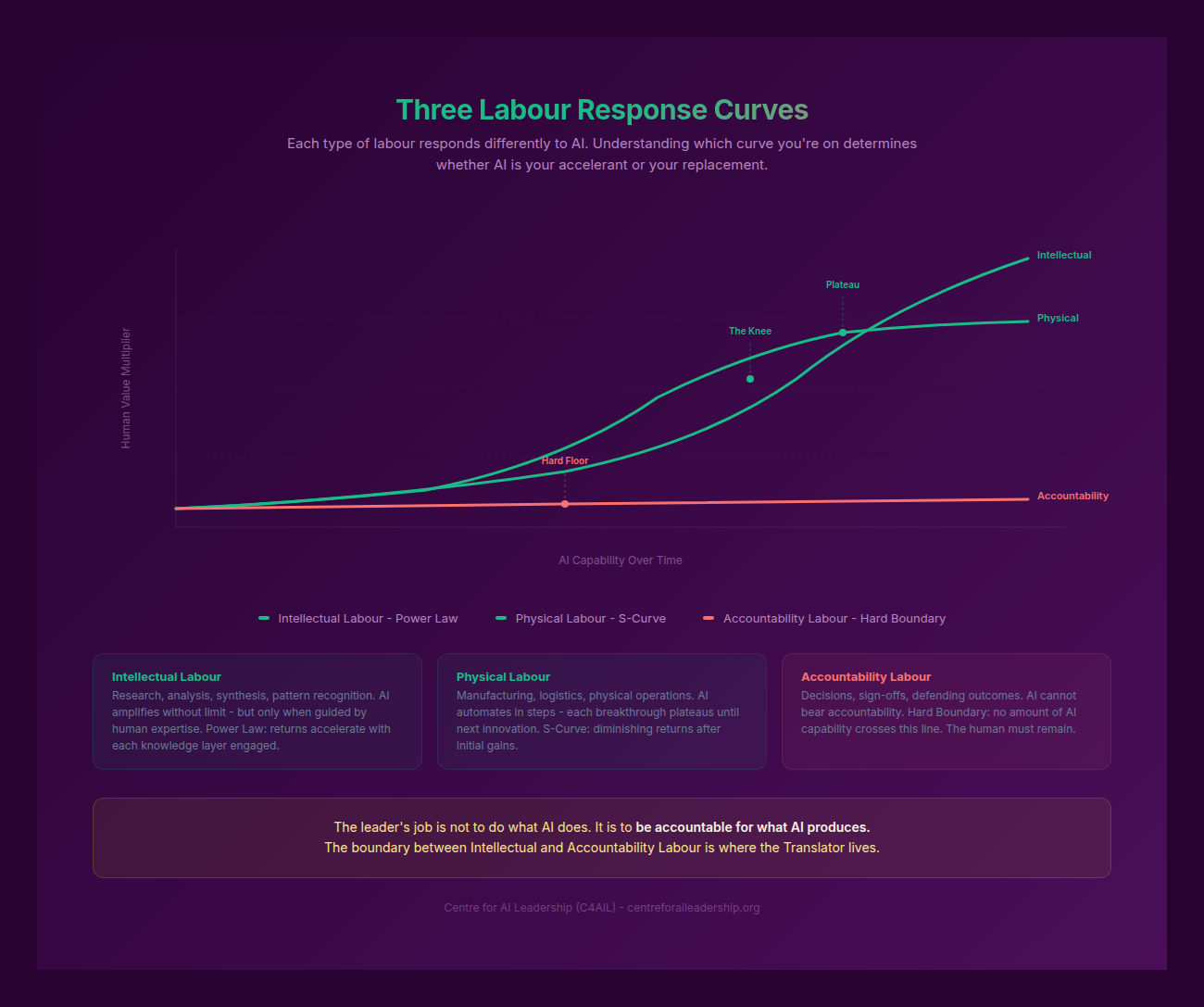
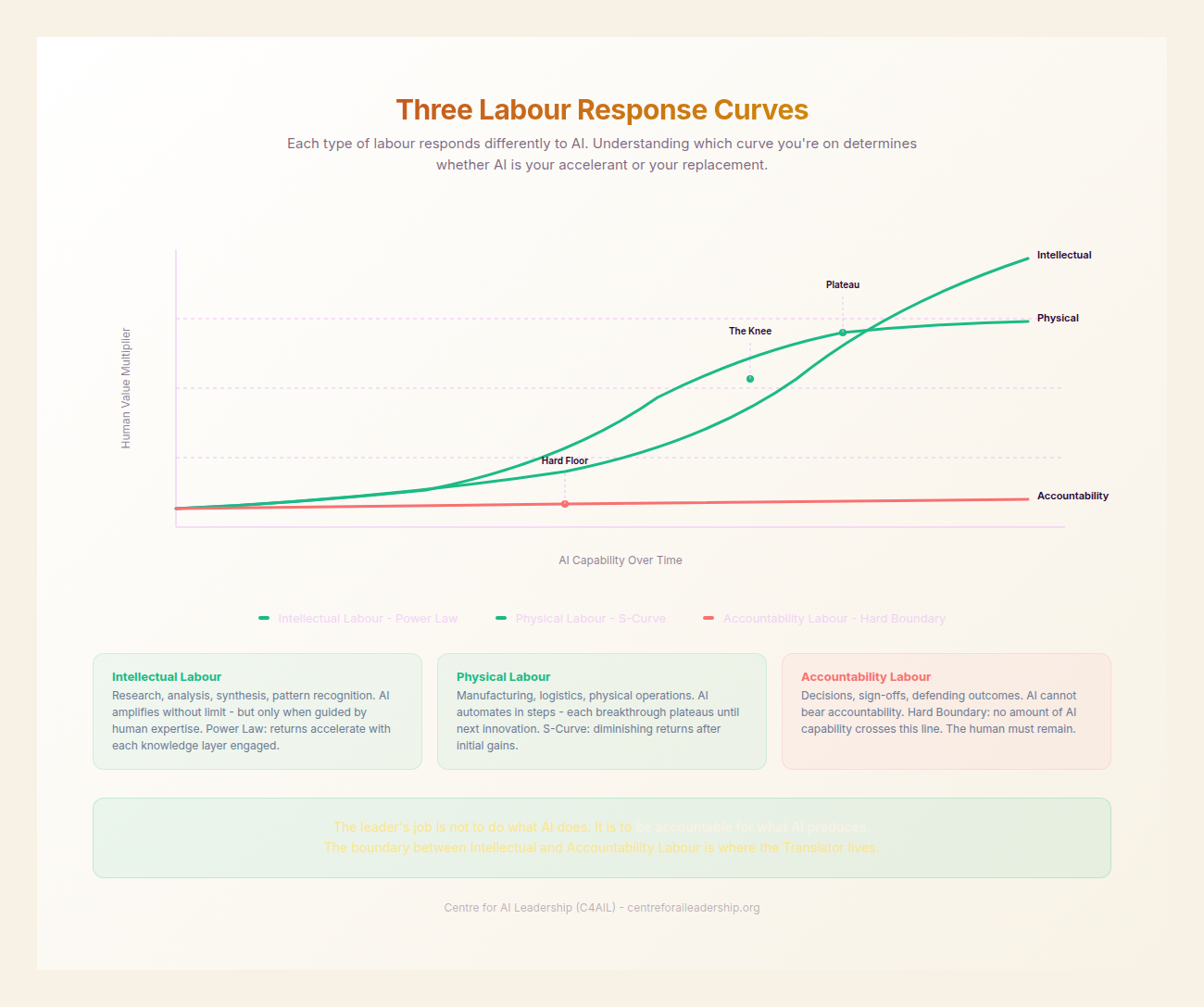
Intellectual Labour is strategy, synthesis, coding, writing, analysis, research - the production of ideas and documents. This is the category being commoditised. AI does it faster, cheaper, and at scale. Not perfectly - but well enough that the human version is no longer the competitive differentiator it was.
Physical Labour is converging on the same trajectory, but on a 2-3 year lag. Robotics, autonomous systems, and warehouse automation are doing to physical tasks what language models did to knowledge tasks. For most white-collar workforce planning, this category matters less immediately - but it matters.
Accountability Labour is the human monopoly. This is judgment, oversight, decision-making under uncertainty, and ownership of outcomes. It is the act of saying “I reviewed this, I stand behind it, and I will answer for it when it goes wrong.” AI cannot do this - not because it lacks some future capability, but because accountability requires a person who can be held responsible. You cannot sue an algorithm for malpractice. You cannot hold a language model to account when the strategy it drafted fails. This labour type was always the real value in most senior roles. We just never measured it, because it was invisible next to the intellectual output.
Architectural Labour is the growth category. This is building the systems, templates, verification enginesdeterministic (rule-based, not AI-judging-AI) checks that validate AI output against domain rules before human review.See full entry →, and structured workflows through which AI operates. It is the difference between giving someone a chatbot and giving someone a guided process with built-in quality checks. Architectural labour is what the 5% of organisations seeing real AI returns have invested in. The other 95% have not - because their workforce planning does not even have a category for it.
Every job is a bundle of tasks across these four columns. Take a Compliance Officer. Before AI: roughly 40% intellectual (drafting policies, analysing regulations, writing reports), 10% physical (site visits, document handling), 30% accountability (signing off on compliance status, defending decisions to regulators), 20% coordination that is now architectural (building compliance frameworks, maintaining verification systems).
AI handles the 40% intellectual. The 30% accountability was always the real value - but your performance system measures the 40% being automated. Your annual review template rewards the person who produced the most reports. Not the person who caught the error that would have cost you a regulatory fine.
If your workforce planning does not distinguish between these four types, you are optimising for the wrong column.
The Five Roles - Your New Org Chart
Job titles describe reporting lines. They tell you who reports to whom and what budget code to charge. They do not tell you what kind of labour a person actually performs - and in the AI era, that is the only thing that matters.
The Five RolesFloor User (L0-2, works through AI, validates output, the backbone), Translator (L2-3, bridges domain + AI), Architect / Amplifier (L3-4, builds Logic Pipes / CAGE templates / verification…See full entry → describe labour functions, not positions on an org chart. A single person might hold one job title and perform across multiple roles. The roles are:
FloorFloor = the 90-95% who work through AI (mass literacy, 3-6 months); Ceiling = the 5-10% who design and govern AI: Architects, Orchestrators, Trainers (years).See full entry → Users make up 90-95% of your workforce. They work through AI-structured interfaces - guided workflows, templated processes, verification-enabled tools. Their job is not to be AI experts. Their job is to be domain experts who use AI-enhanced systems to do their actual work better. The Floor is not a demotion. It is where value is delivered. A senior claims adjuster working through a well-architected AI system produces more accurate, more consistent, more defensible output than the same person with a blank ChatGPT window.
Translators bridge domain expertise and AI capability. They are the people who can look at a business process and say “this is where AI helps, this is where it hurts, and this is how we verify the output.” The Translatordomain-fluency + AI-fluency + judgment + legibility; a trait overlaying every seat (meant to distribute), not a maturity rung. Commands a ~15-25% premium. Failures: fluent mistranslator /…See full entry → does not need to write code. They need Minimum Viable Literacythe distributed baseline AI literacy (enough not to be fooled) that the Atrophy Trap's fix requires; leaders' capacity to commission, interrogate, escalate.See full entry → - enough technical understanding to commission, interrogate, and challenge the systems they use. Lightcast and Revelio Labs data shows the Translator capability commands a 15-25% salary premium in 2025 - and the premium is growing as demand outstrips supply.
One correction matters more than any other here, because getting it wrong distorts the whole workforce plan. The Translator is a trait, not a track. It is the conjunctionthe bundle AI supercharges (substrate + mastery of directing AI + motivation); not a property of seniority.See full entry → of domain fluency, AI fluency, and judgment about what matters - and that conjunction is meant to overlay every role, not to divert a chosen few onto a separate ladder. Your best Floor Users carry it; your Architects and Orchestrators carry it; it deepens along each person’s own path. A dedicated Translator seat exists only where an organisation needs that bridging concentrated full-time in one role - and even then it should be a transitional concentration, because the goal is to distribute the literacy, not to hoard it. The failure mode is the permanent dedicated Translator: the moment the organisation says “we have someone for that,” it stops building its own evaluative power, loses the ability to tell good AI advice from bad, and hard-codes its processes around one person’s presence. Treat the Translator as a capability to grow everywhere, not a job to hire once.
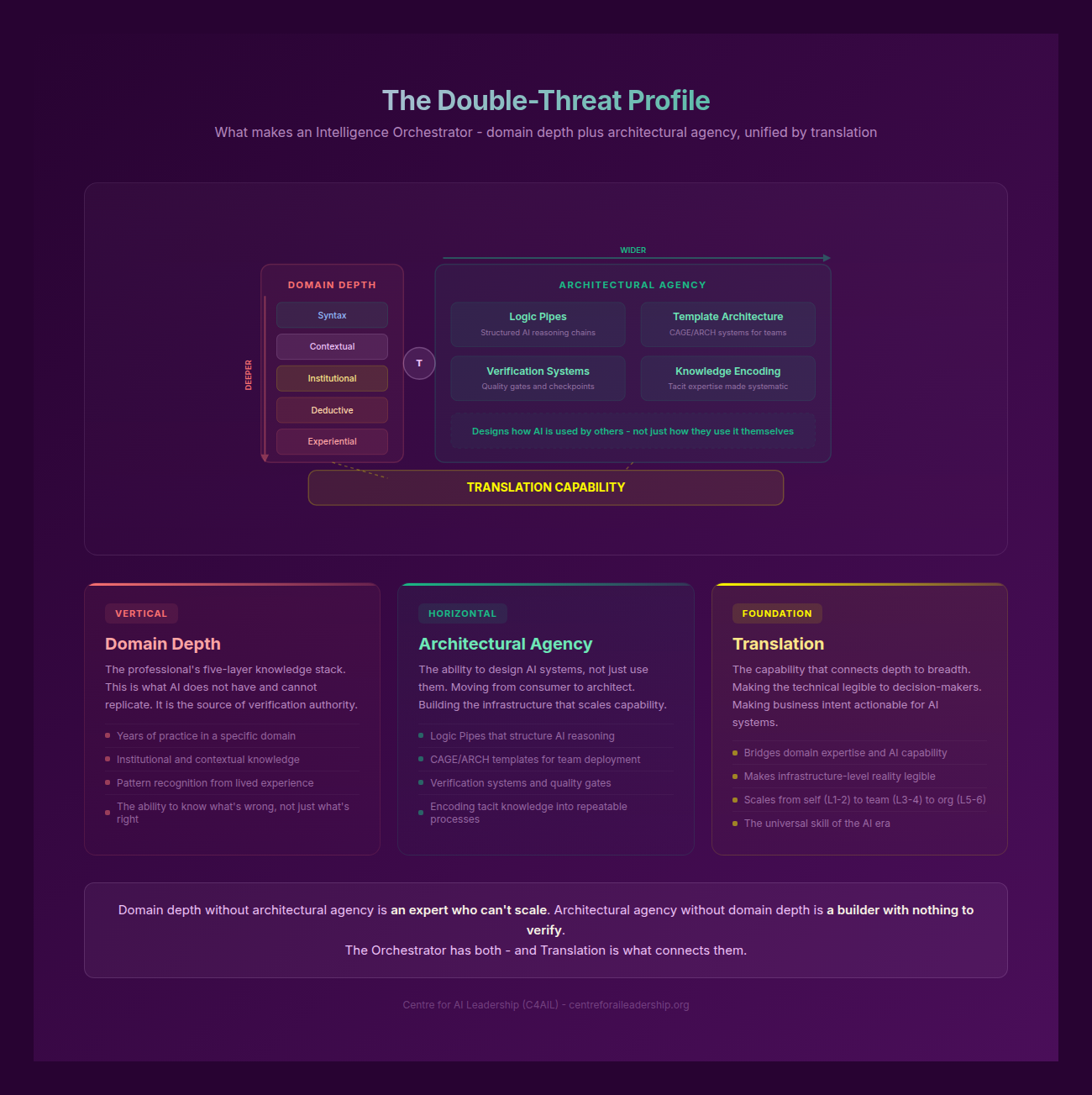
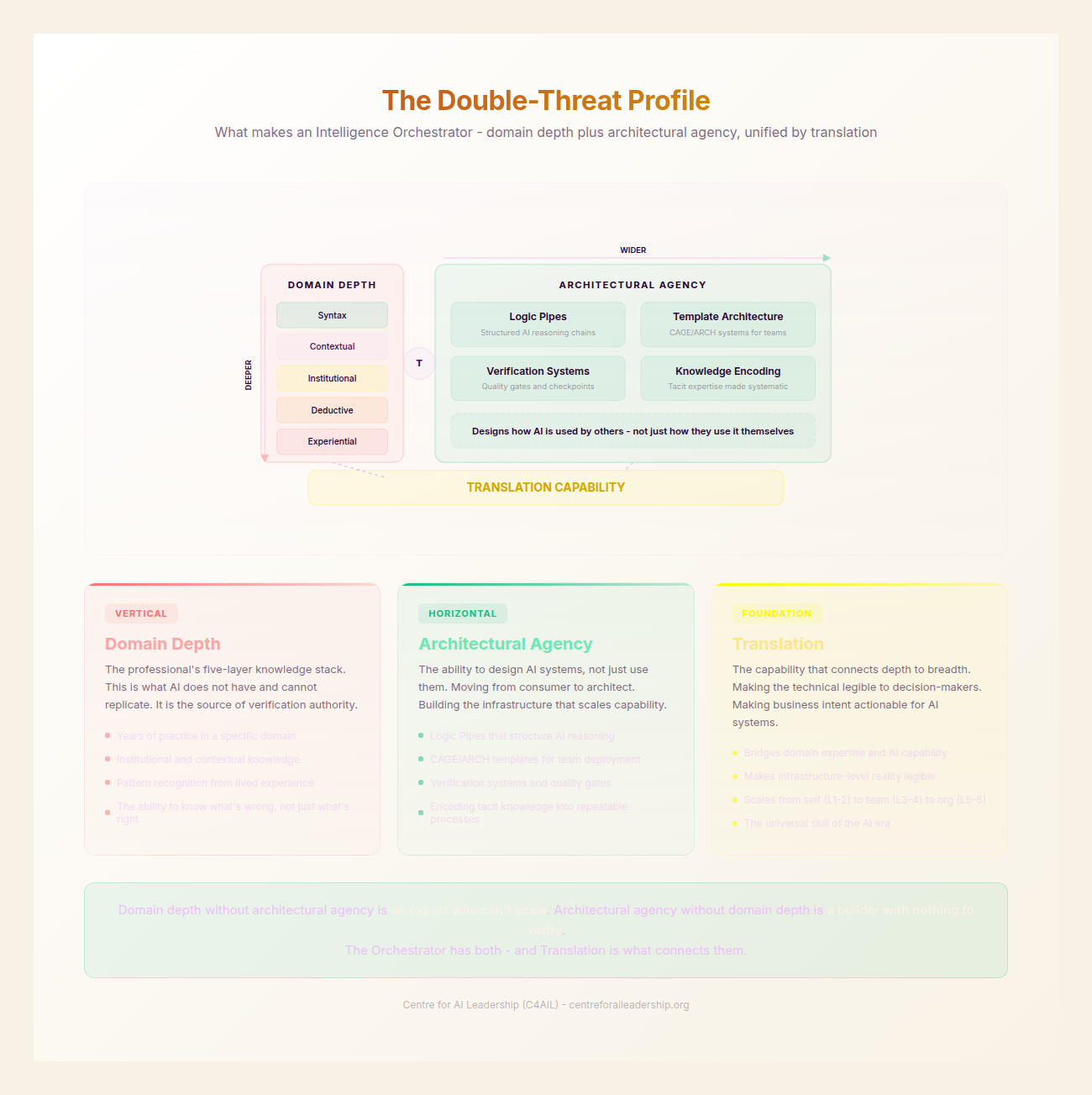
Architects build the systems. They design the Logic Pipesengineered end-to-end deterministic workflows (generate -> verify -> triage -> review -> approve -> audit) that constrain and route AI, replacing narrative chatting.See full entry → - structured workflows that constrain AI behaviour, embed verification steps, and route output through quality checks before it reaches a human decision-maker. They build the templates, the specifications, the verification engines that make Floor Users effective. An Architect is not an AI prompt engineer. They are a systems designer who happens to work with AI as one of their materials.
Orchestrators operate at the system-of-systems level. They design and govern the entire pipeline - how multiple AI-enabled workflows interact, how verification cascades across departments, how the organisation adapts when the AI capability shifts (which it does, quarterly). Orchestrators are developed from Architects over 2-3 years of progressive responsibility. They are never hired externally, because the role requires deep understanding of your specific organisational systems, not generic AI knowledge.
Trainers maintain the human pipeline. They identify capability gaps, develop Floor Users into Translators, mentor Architects, and ensure the organisation does not lose the domain expertise that makes everything else work. The Trainer role is not a full-time position for most people - it is a capability that sits alongside another role. Your best practitioners are already Trainers. They just are not identified, resourced, or measured for it.
The workforce planning question is not “how many AI experts do we need?” It is: “across these five roles, where are the gaps - and which gaps are costing us the most?”
The Squeezed Middle - Why You Cannot Deskill the Journeyman Tier
Here is the most expensive mistake a people leader can make right now, and it looks, in the moment, like the most obvious efficiency.
When AI arrives, the work it does most cheaply is mid-level work - the drafting, the first-pass analysis, the routine research that junior and mid-career practitioners have always done. The barbell is real: AI helps the novice (who knows little) and the master (who knows a lot), and squeezes hardest the person in between - the journeyman, past novice and short of mastery, doing the reps. The locally rational move is to hand that mid-level work to the machine and thin out the tier that did it. Every cost model rewards you for it this quarter.
But the middle is not just middle-income work. The middle is where substrate is built. The journeyman tier - the supervised, consequential reps - is the developmental rung that turns a Floor User into an Architect and an Architect into an Orchestrator. It is the on-the-job pipeline through which tacit judgment, accountability experience, and peer-calibrated taste are actually forged. When AI absorbs that production, the squeeze is not only economic. It removes the rung. The path from borrowed output to earned judgmentthe variable AI supercharges is live, exercised judgment, not accumulated tenure. "Experience is not expertise."See full entry → is the very thing being automated away.
And that makes the cut self-undermining in a way the spreadsheet cannot see. Your Orchestrators and senior Architects - the people who can supervise AI because they built their judgment before the tools arrived - are a non-renewing population the moment you stop minting their successors. The failure is invisible because it is deferred: the masters already in place keep the system running, concealing that none are being made behind them. You discover the gap five years out, when the people who held the conjunction retire and there is no one calibrated to replace them. This is not a software-industry quirk. The crafts lost it to the factory; aviation traded hand-flying hours for cockpit automation and found out only when the automation disengaged and the crew could no longer fly; medicine strains its residencies against throughput; armies that lose their experienced non-commissioned backbone field capable commanders and raw recruits and remain ineffective. Economists named the visible half - job polarization, the hollowing of the routine middle. The deeper fact is where the experts were made.
The people-leadership implication is direct and it overrides the cost model: do not deskill the journeyman tier - redesign it. The answer is not to resist automating junior work; it is the co-creation modelAI does the volume, the junior does judgment under a senior who develops their taste; the volume-to-judgment ratio inverts to 30/70 from day one.See full entry → below, which keeps the reps while AI does the volume. What you must not do is let the rung disappear quietly because no line item defends it. The replacement for the eroded rung has to be built deliberately - substrate-development infrastructure, the master-apprentice chain rebuilt for an age when the apprentice’s first draft is done by a machine. C4AIL calls that institution the Forge: the third model of professional education (after the Guild that could not scale and the Factory whose output AI made free), built to develop the irreducibly human capacities on purpose, because nothing in the market will do it for you. The Trainer role and the co-creation model are how the Forge runs inside your organisation.
Three Career Tracks, Not One Ladder
Traditional career progression assumes a single ladder: junior to mid to senior to manager to director. AI breaks this model, because the skills that make someone a good Floor User are not the skills that make someone a good Architect - and forcing everyone onto the Architecture Track wastes talent and creates miserable Architects.
The Depth Track: Floor User → Senior Floor User → Domain Expert. This is the choice to go deep - to become the person whose domain knowledge makes the AI system trustworthy. The senior claims adjuster who catches the edge case. The regulatory specialist who knows which AI output to trust and which to override. This track is not a consolation prize. It is where 70-80% of your value is generated. Depth Track professionals are compensated through domain-expertise premiums, not management responsibilities they never wanted.
The Architecture Track: Floor User → Architect → Orchestrator (carrying Translator capability throughout, not as a separate rung). This is the systems-building path. It requires a specific combination of domain knowledge, technical literacy, and systems thinking that not everyone has or wants. Promotion on this track is portfolio-based: you advance by demonstrating that you have built systems that measurably improved output quality, not by accumulating years of service.
There is one fact about this track that changes your entire sourcing strategy, and most organisations get it exactly backwards. There are two ways onto it, and they run on radically different clocks. The Novice Pathway - a person building both their domain substrate and their AI surface from scratch - takes 3-5 years to Orchestrator readiness, and that timeline is non-negotiable, because it tracks the rate at which human judgment forms under consequential stakes. No curriculum compresses it. But the Adjacency Pathway - a mid-career domain expert who already has 10-20 years of substrate (a senior analyst, a veteran auditor, a practising clinician, a senior engineer) - is not building substrate. They are porting it. Their pattern library and accountability experience transferred into the AI-augmented version of their work the moment the surface changed; what they need is the new surface layer and the architectural reframing, which is a matter of months. Adjacency reaches Architect in roughly 3-6 months and Orchestrator in 9-18 - about a quarter of the novice time cost. The industry routinely enrols these experts in generic “AI upskilling” built for novices, then wonders why senior practitioners disengage. The problem is not their age or “digital readiness” - it is that the programme is building substrate they already have. Your primary source of Ceiling capacity over the next five years is not graduates. It is the mid-career experts already inside your organisation, whose substrate you are currently writing off.
The Capability Track: Any level → Trainer. This is the pipeline-maintenance path. It is available to anyone at any point - a senior Floor User who mentors juniors, an Architect who documents their methods, an Orchestrator who develops the next generation. Trainer capability is measured by the performance of the people they develop, not by training hours delivered.
What nobody is measured on, in any track: hours worked, volume of AI output, or number of prompts run. Those metrics measure the commoditised labour type. Measuring prompts-per-day is like measuring keystrokes-per-hour in the typing pool. It tells you nothing about value.
Performance Management That Measures the Right Thing
If your performance system was designed before 2023, it almost certainly measures intellectual output - reports produced, cases closed, code shipped, proposals written. AI makes all of those metrics meaningless as measures of individual contribution. The machine can produce infinite volume. Volume is no longer a differentiator.
Here is what performance measurement looks like when you measure the labour types that matter:
Floor Users are measured on validation accuracy (did they catch the errors?), interrogation quality (did they challenge the output with the right questions?), and domain-specific throughput (not raw volume, but verified output per unit time). A Floor User who produces 10 verified reports is more valuable than one who produces 30 unverified reports - even though the dashboard shows the second person as 3x more productive.
Architects are measured on template quality (do the systems they build actually improve Floor User output?), specification maintainability (can someone else maintain and update what they built?), and verification engine effectiveness (what is the false-positive rate? The false-negative rate? How often does bad output slip through?).
Orchestrators are measured on system-level output (not individual productivity, but the productivity of the entire pipeline they govern), pipeline health (uptime, adaptation speed, error cascade rates), and business outcome verification (can you trace a measurable business result back to the system they designed?).
The compensation model follows the measurement model. Domain-expertise premiums for Floor Users who go deep. System-output premiums for Architects whose templates improve measurable quality. Verified-business-outcome premiums for Orchestrators whose pipelines deliver traceable results. Each track has its own compensation logic, its own advancement criteria, and its own definition of “excellent.”
What nobody is measured on: hours worked, prompts-per-day, “AI adoption score.” Those are vanity metrics. Measuring them actively incentivises the wrong behaviour - generating more unverified output, which creates more rework, which consumes more senior review time, which degrades the very capability you are trying to build.
The Attitude Contradiction
If this sounds obvious, consider why most organisations resist it. The answer is structural, not intellectual.
In cybersecurity, the hiring mantra is “hire for attitude, train for skill.” The attitude they mean - initiative, accountability, the willingness to push back when something looks wrong - is exactly the capability that AI deployment depends on. It is the capacity to say “this output looks right but my experience says otherwise” and act on that judgment rather than defer.
But the management structures those hires enter reward the opposite. Follow the process. Defer to the senior partner’s conclusion. Do not slow down the team. Get your ticket count up. Organisations hire people who can challenge authoritative-sounding output - and then build cultures where challenging the output means challenging the person who approved it.
The “attitude” does not fade after two years. It is trained out by the performance system. And AI makes this lethal. The Eloquence TrapAI is fluent before it is correct; accepting output because it sounds right. The smoother the output, the more you must verify. Turned inward = mistaking your own fluent confidence for…See full entry → specifically exploits deference: accept the confident, well-structured output, do not question it, move on. An organisation that hires for independent judgment but measures compliance is building the exact workforce profile that the Eloquence Trap is designed to exploit.
This is why changing the performance system is not a nice-to-have. It is the structural prerequisite for every other AI capability investment. You can build the best Logic Pipes, the most rigorous verification engines, the most sophisticated CAGE templatesversioned repositories of validated reasoning chains (structure + constraints + quality bar + known failure modes).See full entry → - and none of it matters if the management culture punishes the person who slows down to use them.
The Cost Model - It Is Less Than You Think
Here is the number that makes most CHROs pause: for a 500-person enterprise, the full Year 1 investment in this capability model is $410,000-$680,000.
That breaks down as:
- Floor deployment: $130,000-$210,000. Structured onboarding, guided workflow rollout, verification training for 90-95% of staff. This is not “AI training.” It is workflow redesign with embedded capability development.
- Translator development: $80,000-$120,000. Identifying and developing the 5-8% of your workforce who have the domain expertise and technical curiosity to bridge the gap. Intensive, cohort-based, 6-month programmes.
- Architect pipeline: $120,000-$200,000. Building the small team (2-4% of workforce) who will design your Logic Pipes, verification engines, and structured AI systems. This is your highest-value investment per person.
- Trainer capacity: $50,000-$100,000. Identifying existing L4+ practitioners, giving them time and tools to develop others, building the internal capability pipeline that makes you self-sustaining.
- Community infrastructure: $30,000-$50,000. Internal knowledge-sharing platforms, practice communities, cross-team learning mechanisms. The connective tissue that prevents capability from being siloed.
Per employee, that is $820-$1,360. The Association for Talent Development’s 2024 benchmark for average training spend per employee is $1,283. You are within the existing budget envelope. This is not an additional cost. It is a reallocation from training that produces commoditised intellectual labourers to training that builds the capability AI cannot replace.
Now compare that to your AI infrastructure spend. Cloud compute, hardware, API licenses, platform subscriptions - for most enterprises, that number is 3-5x the human capability investment. For every dollar spent on the humans who use the machines, most organisations spend $3-$5 on the machines themselves.
And here is the punchline: MIT’s NANDA Lab research shows that 95% of those machine investments fail to deliver measurable returns. Not because the machines do not work. Because the human capability to use them effectively was never built. You bought a Formula 1 car and hired drivers who learned on go-karts.
The ROI case is not “spend more on training.” It is “redirect existing spend from the column being automated to the columns that generate returns.” The gap between 10-15% efficiency gains (tools-only deployment) and 25-30% gains (workflow redesign plus capability building) is your budget justification. For a 500-person enterprise, that 15-percentage-point gap typically represents $2-4 million in annual productivity value. Against a $410-680K investment. The payback period is measured in months, not years.
Where to Start Monday Morning
You do not need a two-year transformation programme. You need three actions this week.
Action 1: Run the Four-Column Task Decompositionsort every task into Automated-Intellectual, Automated-Physical, Elevated (needs MORE human judgment), New (Architectural, did not exist before). Extends other frameworks by asking "what…See full entry → on your top 10 roles. Take your 10 highest-headcount or highest-cost roles. For each one, map every major task into the four labour columns: Intellectual, Physical, Accountability, Architectural. Be honest about which column each task falls into. You will discover that 30-50% of what you currently measure and reward is intellectual labour that AI already handles. You will also discover that the accountability and architectural work - the work that actually differentiates your organisation - has no metrics, no development pathway, and no recognition in your current performance system.
Action 2: Find your existing L4+ practitioners. They are already in your organisation. They are the people who have, without being asked, built their own verification methods, created their own structured workflows, developed their own quality checks for AI output. They are not in the “AI champions” programme - they are too busy doing actual work. They are your first Trainers. Identify them, resource them, and get out of their way.
Action 3: Stop measuring AI adoption rates. Start measuring verification quality. The number of people using AI tells you nothing about value creation. The percentage of AI output that passes structured verification on the first attempt tells you everything. Track first-time-right rates. Track rework hours. Track the gap between AI-generated output and verified output. Those are the metrics that predict whether your AI investment will generate returns or generate workslop.
The gap between where you are and where the 5% are is not a technology gap. It is a capability gap. And capability gaps close with investment in people, not in platforms.
Your reskilling budget is not too small. It is pointed in the wrong direction. Turn it around.
This is Paper 6 in the C4AIL series, written for HR leaders, CHROs, and people strategists navigating AI workforce transformation. It draws on the capability framework detailed in “The Labour Architecture: Redesigning Work for the AI Age” (Whitepaper II) - available from C4AIL on request.
Paper 1: “Why Your AI Investment Isn’t Working” | Paper 2: “What the 5% Do Differently” | Paper 3: “Monday Morning: Where to Start” | Paper 4: “Building for Amplifiers” (for software engineers)
Contact: [email protected] | centreforaileadership.org
Where this sits in the C4AIL canon (2026). This is a popular entry point into the consolidated whitepaper stack. The macro-thesis is The Moat Inversion (Whitepaper 0): for two centuries value flowed to the explicit; AI exhausts it, so the moat inverts to the irreducibly human. The mechanism — substrate vs surface, Epistemic Labourthe value-bearing work of *knowing*: reading what AI output means, catching fluent-but-hollow answers. Delegable (answers to reality); accountability is *owning* (non-delegable, answers to…See full entry →, the Squeezed MiddleAI hollows the journeyman tier where substrate is built (the "barbell": gains at floor and ceiling, squeeze in the middle); no juniors today, no seniors in five years.See full entry →, ConcretisationAI's core economic act: making tacit substrate explicit, proprietary, and scalable. Concretise your own = a moat; depend on generic = erosion.See full entry → — is The Labour Architecture (WP2). The operating model — the Institutional Vaultthe org's codified, executable knowledge store (processes, records, prompts, pipelines) - surface made durable. The three-way line: Holding (frees judgment), Executing codified rules (the…See full entry → and the four seatsDirect (Board), Operate (Manager), Build (Practitioner), Floor (User): one story told from four accountabilities. Plus the Assure / Governance fifth seat - the Brain made into a function…See full entry →, the CAIOthe Translator made institutional: a Direct-seat Orchestrator built on Build substrate, measured by dispensability, who succeeds by manufacturing Translators, not being the bottleneck.See full entry → and the AI Centre of Excellencethe hub-and-spoke unit that scales the CAIO from a person to an institution; three arms = Forge (develop Brains), Governance (govern the Vault), Practice (do the stakes-bearing work).See full entry → — is The Operating Model (WP4). The institution that builds and sustains the capability is the Forge (WP5), the Full Stackthe total infrastructure substrate development requires (educational + community + meaning layers); C4AIL owns "roughly a quarter" (the educational, high-leverage slice).See full entry → (WP6), the Guildhall (WP7), and the Antifragile Institution (WP8). → Read the whitepapers