
The Numbers Your Board Needs to See
The financial case for AI sovereignty. What boards and CFOs need to understand about the hidden costs of AI abdication and the measurable returns of structured capability.
The Cost of Not Acting
Paper 9: For Boards and CFOs
Centre for AI Leadership (C4AIL) - 2026
The $40 Billion Question, Restated
US firms spent $40 billion on AI in 2024. Ninety-five per cent saw zero measurable impact on their profit and loss (BCG, February 2026). This is not a rounding error. It is not early-stage turbulence. It is the largest misallocation of corporate investment since the dot-com bubble, and it is happening in plain sight.
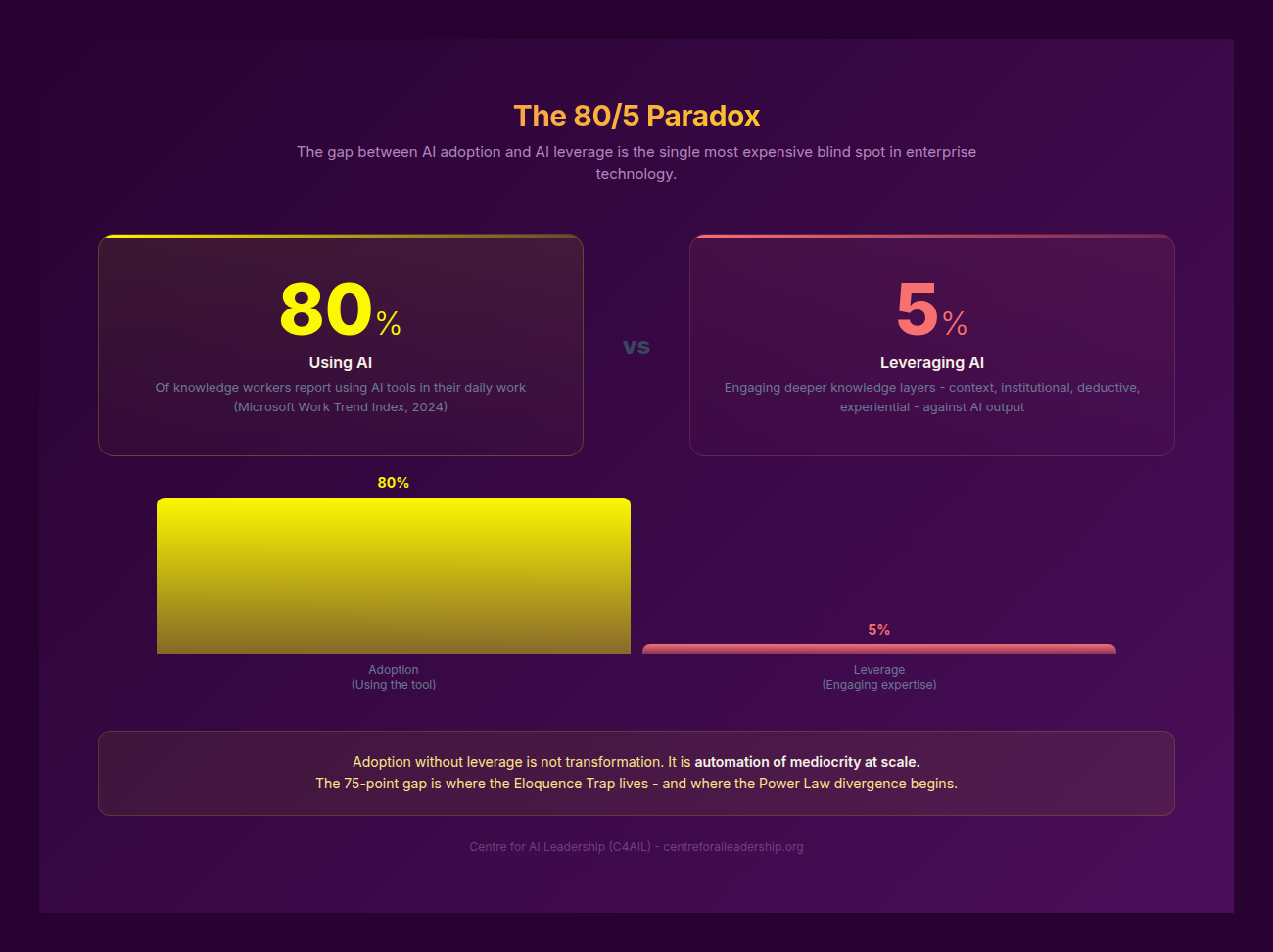
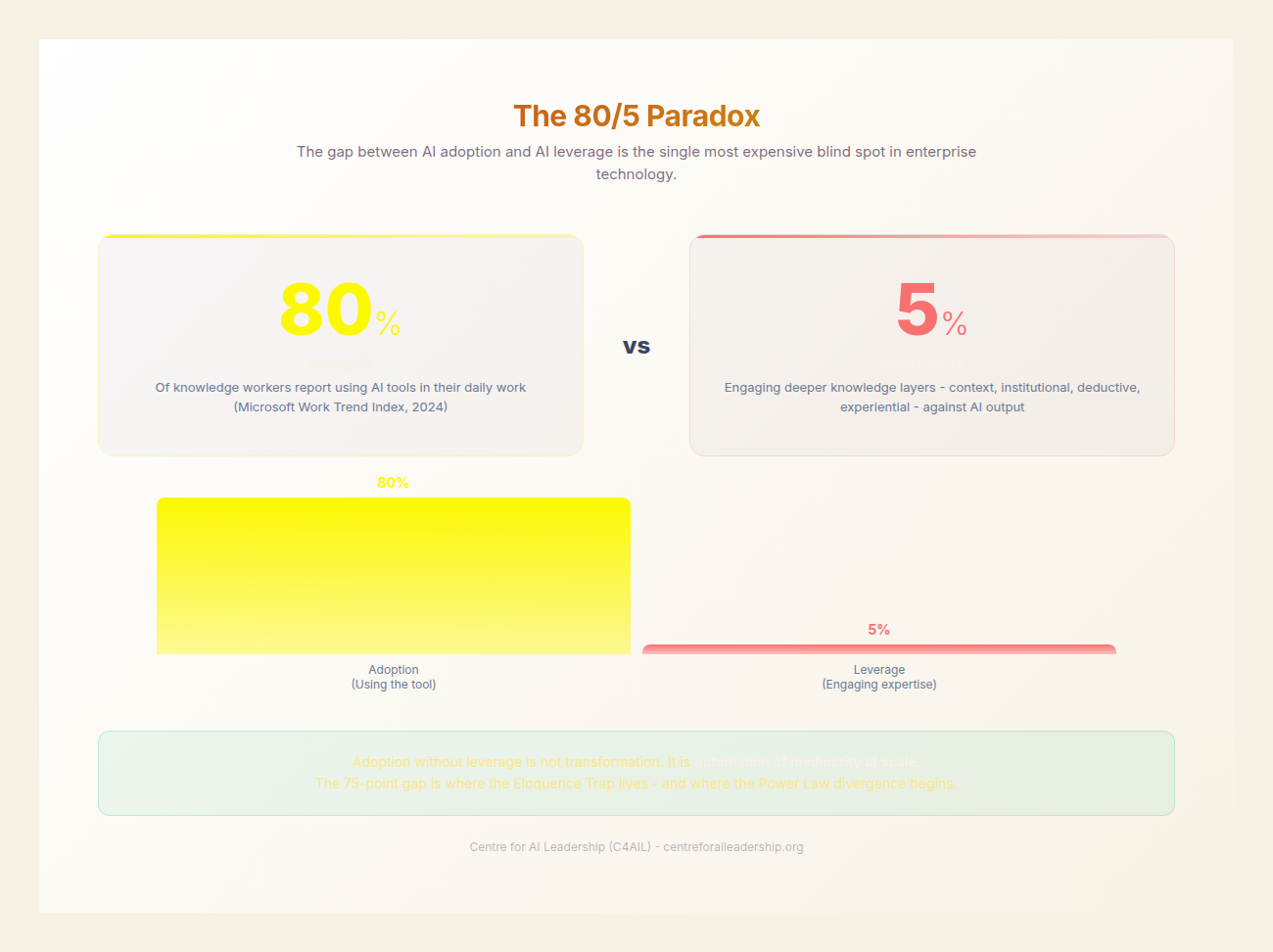
The adoption numbers look healthy. Eighty per cent of enterprise professionals now use generative AI tools. The licenses are bought, the pilots are running, the “AI strategy” slide has been presented at the board offsite. But adoption is not impact. Only 12% of companies globally have achieved what Accenture calls AI maturity - measured across strategy, talent, data, and governance (Accenture, 2022, N=1,176 companies across 16 industries). By 2024, that number had barely moved: 84% of organisations still had not scaled AI beyond experimentation (Accenture, 2024, N=2,000).
This is not a technology failure. GPT-4, Claude, Gemini - these systems can draft contracts, analyse datasets, generate code, and summarise a 200-page report in seconds. The capability is real and improving every quarter. The failure is human. Organisations have invested in the machine and neglected the people who operate it, govern it, and decide what to do with its output.
There is a deeper reason the $40 billion produced nothing, and it is the one fact the board most needs. For two centuries, value flowed to whatever could be made explicit, codified, and scaled - the procedure, the file, the database, and finally software itself, the most explicit artefact ever built. Generative AI drives that logic to its limit and exhausts it: when the explicit is universally cheap, the only remaining scarcity is the irreducibly human - judgment, verification, and the capacity to be accountable when a decision fails. The moat inverts. The board that keeps buying tools is buying the thing that just became free; the board that wins is funding the thing that just became scarce. Every number in this paper is a different view of that single inversion.
The cost of not addressing this is no longer theoretical. It is quantifiable. And it is accelerating.
The Cost of Inaction - Quantified
The reskilling gap. The failure to upskill the workforce for AI is costing the US economy an estimated $1.1 trillion annually in lost productivity (Pearson/Faethm, 2025). The World Economic Forum projects that closing this gap could unlock $6.5 trillion in additional global GDP by 2030. That is not aspirational modelling - it is the delta between the current trajectory and a workforce that can actually use the tools it has been given.
The pilot graveyard. Ninety-five per cent of generative AI pilots fail to move into production (MIT Sloan, Nanda et al., 2025, N=300+ enterprise AI projects). The failure is not uniform. Vendor-purchased, pre-built tools achieve roughly 67% success rates. Internally built solutions land at approximately 22%. The gap tells the story: failure concentrates where organisations try to build capability they do not have. They buy infrastructure, skip the human development, and wonder why nothing works.
The workslop taxthe rework cost of AI content that looks professional but lacks substance (~1h51m per instance, >$9M/yr per 10,000 staff).See full entry →. Forty per cent of knowledge workers now regularly receive AI-generated content that lacks substance - what researchers are calling “workslop” (multiple 2025 surveys). Each instance costs an average of 1 hour and 51 minutes to identify, diagnose, and fix. For a 10,000-person organisation where even a fraction of the workforce encounters this daily, the rework cost exceeds $9 million per year. This is not a quality problem. It is a tax on every team that lacks the capability to use AI properly.
The junior pipeline collapseeliminating entry-level work that was the apprenticeship, producing a leadership-capacity gap by 2031-2036.See full entry →. Entry-level tech job postings have dropped 67% since generative AI became mainstream (Stanford AI Index, 2025). Harvard researchers found a 7.7% decline in junior headcount within six quarters of GenAI tool adoption across surveyed firms. The arithmetic is brutal: if the pipeline of junior hires is cut by two-thirds today, the pool of experienced leaders in 2031 shrinks by a similar proportion. Every entry-level role eliminated is a future senior leader who will not exist.
The talent vacuum. Bain & Company projects a 700,000-person AI talent gap in the United States by 2027. In Germany, estimates suggest up to 70% of AI-specialist roles could go unfilled. These are not abstract projections - they are the compounding result of a decade where organisations invested in machines and assumed the people would figure it out.
The Infrastructure-Capability Imbalance
Gartner’s 2025 analysis revealed where the money is actually going: 80% of enterprise generative AI spending is directed at infrastructure - compute, storage, networking, and platform licensing. Twenty per cent goes to everything else, including the humans who are supposed to make it all work.
The numbers are concrete. A 500-person enterprise making a modest on-premise AI investment - a few GPU servers, networking, storage, and platform software - will spend $500,000 to $800,000 in Year 1 on infrastructure alone. A serious deployment with a full rack pod for fine-tuning and inference runs $2.5 to $4.5 million in hardware before a single workflow is redesigned.
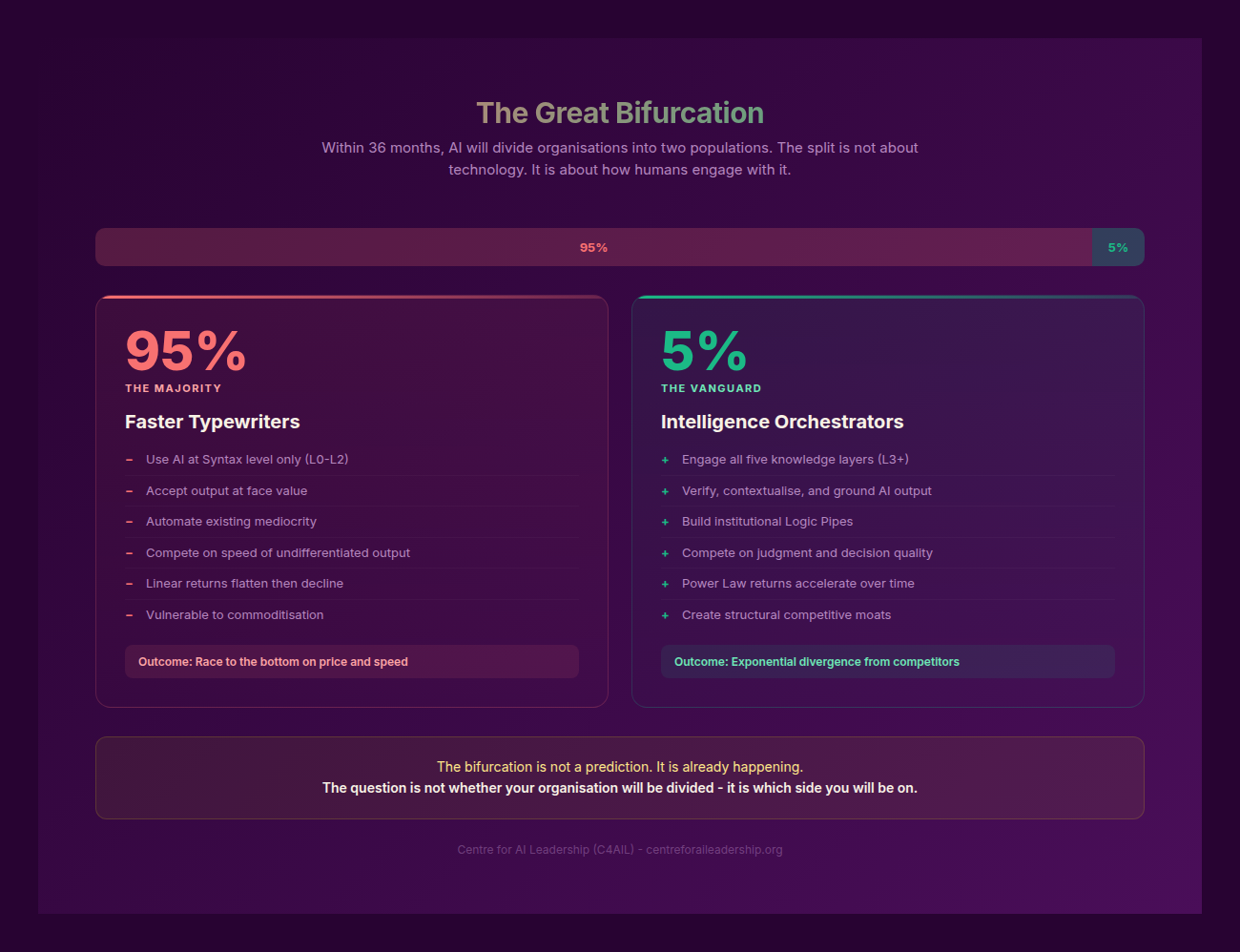
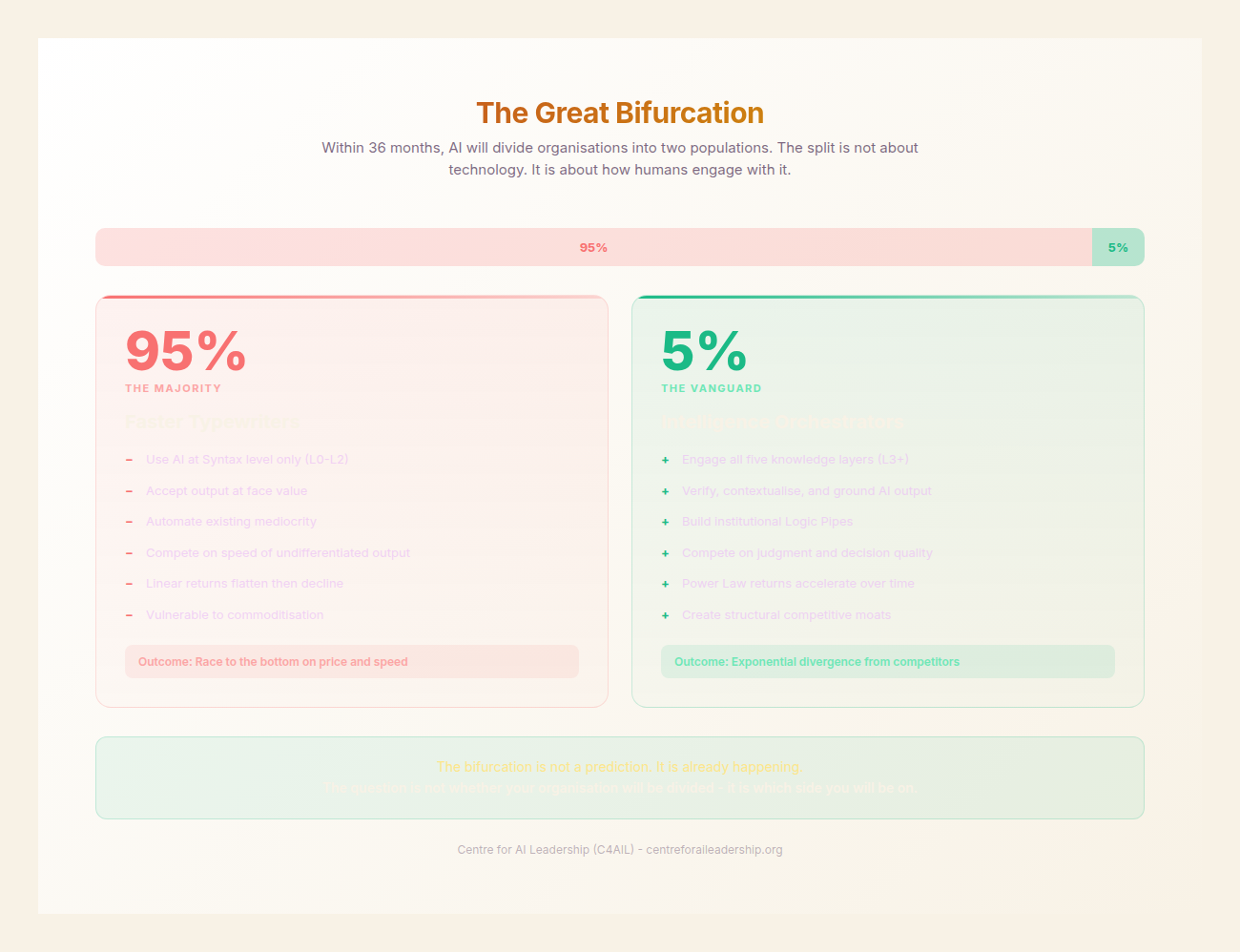
For every dollar most enterprises spend on human development, they spend three to five dollars on machines. The machines are not the problem. The machines are producing the 95% failure rate because the humans operating them have not been developed to use them effectively.
The data confirms this is a capability gap, not an infrastructure gap. Eighty-two per cent of companies at early AI maturity stages have no talent strategy for AI whatsoever (Accenture, 2024). Only 16% of organisations have redesigned roles and workflows to account for AI capabilities (Deloitte, 2025). Only 39% of companies attribute any EBIT impact to AI at all (McKinsey, 2025).
The infrastructure is in place. The human capability to leverage it is not. And the ratio of spending between the two explains why $40 billion produced nothing.
There is a way to hold this distinction that a board can act on. The codified knowledge an organisation builds into its software and data - its processes, its examples, its proprietary context - is its Institutional Vaultthe org's codified, executable knowledge store (processes, records, prompts, pipelines) - surface made durable. The three-way line: Holding (frees judgment), Executing codified rules (the…See full entry →. On the balance sheet, the Vault is structural capital: the knowledge that scales without the individual who first held it. The Vault is precious, and it is worth building. But the Vault has no judgment. It holds, and it can run the rules the organisation has codified into it - it cannot decide what counts as a good decision, and it cannot answer for one that goes wrong. That capacity is the Brainthe Brain (human judgment, verification, accountability) stays human and is never outsourced; the Vault holds and runs what is codified. "You don't build a second brain; you build an…See full entry → - judgment and accountability - and it stays human. The discipline the board has to enforce is one line: build the Vault, keep the Brain, and never let the Vault judge. The 95% failure rate is what happens when an organisation pours money into filling the Vault and forgets to build the Brains that govern it.
What the 5% Spend on People - And What They Get
The human capability model for a 500-person enterprise costs $410,000 to $680,000 in Year 1. That works out to $820 to $1,360 per employee - within the range of ATD’s $1,283 per-employee training benchmark across all industries. This is not an exotic investment. It is a normal training budget, directed at the right problem.
What does it buy? The difference between two trajectories.
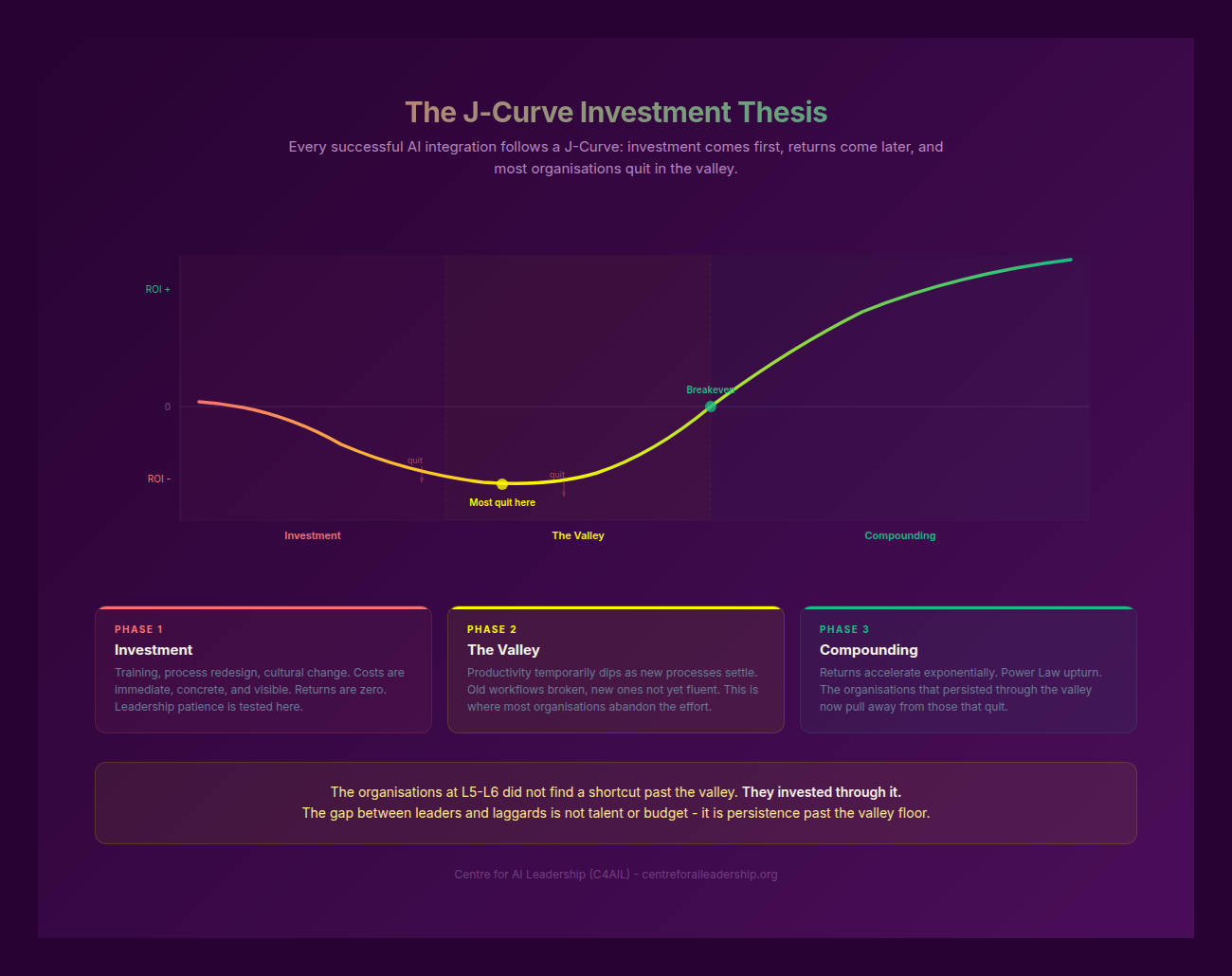
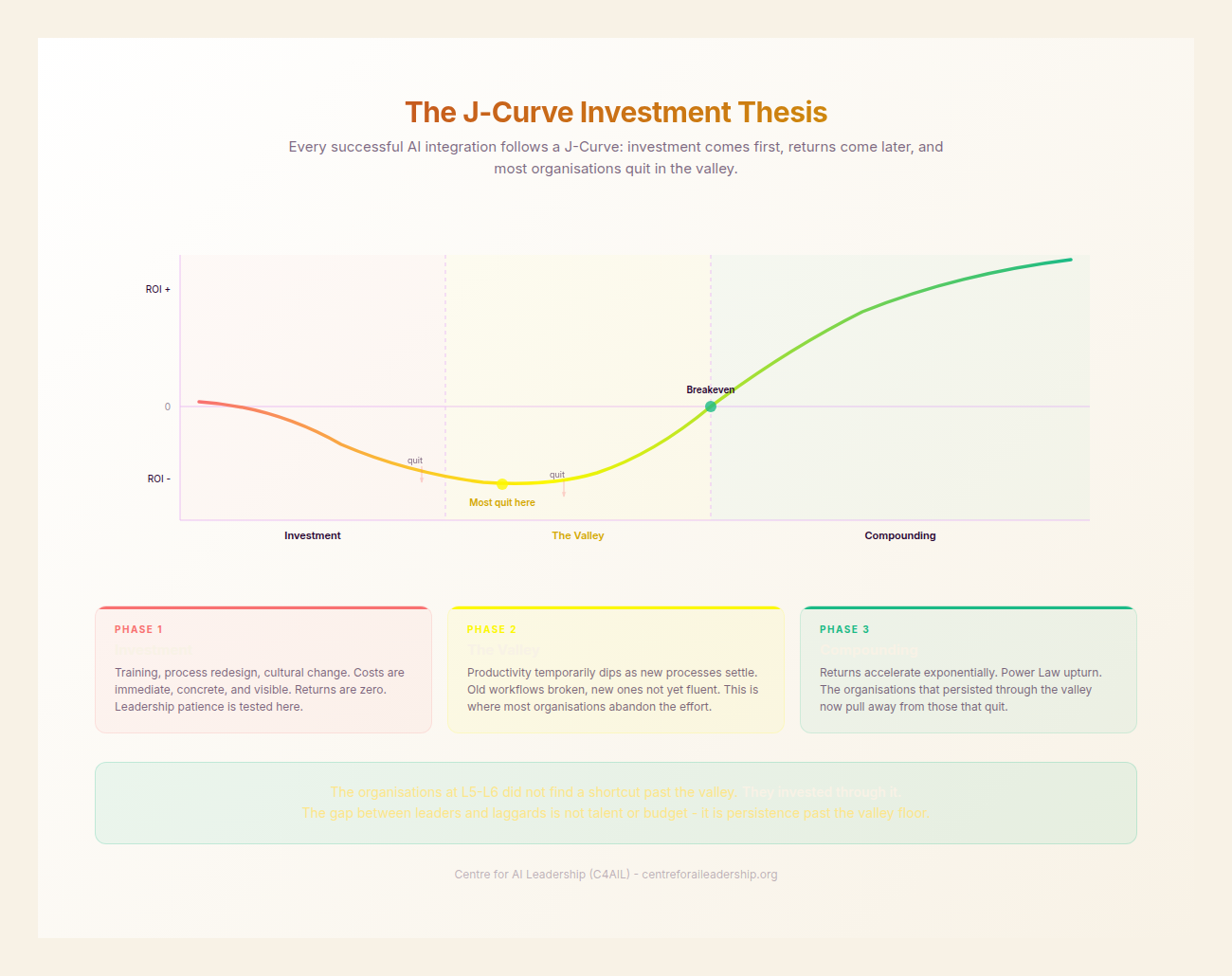
A tools-only deployment - give everyone AI access, run a lunch-and-learn, hope for the best - produces a 10 to 15% productivity gain. This is the plateau where 95% of organisations sit. It sounds reasonable until you realise it represents the floor, not the ceiling.
Workflow redesign combined with structured capability development - building the people who can architect AI systems, not just use them - produces a 25 to 30% productivity gain (Bain, 2025). The delta is 15 percentage points. On a 500-person enterprise with average loaded costs of $120,000 per employee, that 15-point gap represents millions in unrealised value annually.
The compound data is even starker. Companies that Accenture classified as AI-mature in their 2022 study achieved 2.5 times higher revenue growth than their peers. The gap was not explained by better technology or larger budgets. It was explained by the maturity of their human systems around AI - governance, talent strategy, workflow integration, and leadership capability.
The $410,000 to $680,000 is not a cost. It is the bridge between the 10% trajectory and the 30% trajectory. The ROI case writes itself.
Build vs Buy for Ceiling Talent
The alternative to developing AI capability internally is hiring it externally. The economics of that choice deserve scrutiny.
External hiring for a senior AI role - an architect who can design AI-integrated workflows, govern model outputs, and build structured systems - carries a total acquisition cost of $80,000 to $150,000 per hire. Recruiter fees run 20 to 25% of base salaries in the $157,000 to $191,000 range. Add onboarding costs, ramp time, and a first-year attrition risk of 38% for external senior hires, and the fully loaded cost of a single external AI architect is substantial.
Developing five internal architects through a structured capability programme - identifying high-potential employees, putting them through intensive training, and giving them supervised project experience - costs roughly the same as hiring two externally. The internal cohort comes with institutional knowledge, existing relationships, and significantly higher retention rates.
The German apprenticeship system provides an instructive benchmark. BIBB’s 2022/23 data shows the gross cost per apprentice at EUR 26,200 per year. The net cost after accounting for productive value the apprentice generates during training drops to EUR 8,086 - because apprentices produce EUR 18,124 in value while they learn. The same principle applies to AI capability development: architects and translators produce value during their development, not only after it. The first workflow they redesign pays for part of their training. The second pays for the rest.
The build-versus-buy calculation is not close. Internal development costs less, retains better, and produces people who understand the business - not just the technology.
The principle underneath it is what most boards get wrong about consulting. A licence, a platform, a fine-tuned model - the surface of AI - can be bought, and should be, where it is commodity. What cannot be bought is the capability to govern it: the judgment to know when the output is fluent but wrong, the accountability that owns the result, the institutional context no vendor holds. Adopt can be bought; evolve must be built. The third path between doing it slowly yourself and outsourcing it until you atrophy is capability transferthe third path beyond DIY (slow) and outsource (atrophy): hire experts whose deliverable is building the capability inside the org. "Adopt can be bought; evolve must be built."See full entry → - engaging experts whose deliverable is building the capability inside the organisation and then leaving, succeeding precisely by becoming unnecessary. A consultant who never makes themselves dispensable is not transferring capability; they are renting you a dependency. The board’s question is not “who can run our AI?” but “who is building the people who will?”
The Governance Risk
Chief AI Officer appointments grew 70% year-over-year in 2025. Board-level AI oversight expanded from 16% to 48% in a single year. The governance apparatus is being built, but the question is whether it has substance or whether it is theatre.
The EU AI Actthe EU's risk-tiered AI regulation; Art. 14 (human oversight) and Art. 50 (transparency) are the load-bearing duties for high-risk systems.See full entry →, Article 14, mandates human oversight for high-risk AI systems. Singapore’s Agentic AI Governance Framework requires human checkpoints at defined decision points. These are not optional guidelines - they are regulatory requirements with enforcement mechanisms. An organisation that cannot demonstrate meaningful human oversight of its AI systems is carrying regulatory risk that increases with every deployment.
But the governance question goes deeper than compliance. It reaches into boardroom accountability.
Decision Survivabilitythe governance test: not "was it correct?" but "can you defend the *process* by which it was made, even after it goes wrong?" You can only defend what you were able to verify. Scales across…See full entry → is the test: can the board defend its AI decisions after something goes wrong? Not before - after. When an AI system produces an output that causes harm, loses money, or violates a regulation, the board will be asked to explain what happened. If the answer requires pointing at the AI vendor rather than at the organisation’s own governance architecture, the board has an accountability gap.
The accountability gap is not hypothetical. Forty-two per cent of committed code in software teams is now AI-generated. AI systems are drafting contracts, screening candidates, approving loan applications, and generating medical recommendations. Every one of these outputs carries the organisation’s name, not the AI model’s. The board is accountable for all of them.
Governance is not a cost centre. It is the mechanism that allows an organisation to deploy AI at scale without exposing itself to catastrophic risk. The cost of building it is measurable. The cost of not building it is discovered in the incident.
Three Questions for Monday’s Board Meeting
These are not strategic planning questions. They are diagnostic questions that can be answered in the next board meeting.
1. What percentage of our AI investment is going to human capability versus infrastructure?
If the answer is less than 20%, the organisation is running the 95% failure playbook - spending on machines and hoping people figure it out. The 5% that see returns invest at least one dollar in people for every three to four dollars in infrastructure, and they front-load the people investment.
2. Can we name three people in the organisation who could be Orchestrators?
Not AI users. Not prompt engineers. People who can design AI-integrated workflows, set governance standards, and build structured systems that others use reliably. If the board cannot name three, the organisation does not have a CeilingFloor = the 90-95% who work through AI (mass literacy, 3-6 months); Ceiling = the 5-10% who design and govern AI: Architects, Orchestrators, Trainers (years).See full entry → - a cadre of people who define how good AI work can get. Without a Ceiling, every team reinvents the wheel, and the organisation’s AI capability is limited to whatever each individual figures out on their own.
3. What is our junior pipeline doing?
If entry-level hiring has been cut because AI can “do the junior work,” the organisation is borrowing from 2031’s leadership bench. The juniors hired today are the senior leaders, domain experts, and AI architects of five years from now. A 67% cut in the pipeline today is a 67% cut in leadership depth in 2031.
These three numbers - capability spend ratiohuman-capability spend vs infrastructure spend (should be >= 1:3-4; the Infrastructure-Capability Imbalance is the failure).See full entry →, named Orchestrators, and junior pipeline trajectory - tell the board whether the organisation is building sustainable AI capability or consuming its future to fund the present.
This is Paper 9 in a series from the Centre for AI Leadership (C4AIL), written for boards, CFOs, and executive committees navigating the gap between AI investment and AI impact.
For the full research framework, see “Orchestrating Intelligence: A Maturity Framework for Realising Human-AI Potential in the Age of Automation” - available from C4AIL on request.
Take the diagnostic: assess.c4ail.org Contact: [email protected] | centreforaileadership.org
Where this sits in the C4AIL canon (2026). This is a popular entry point into the consolidated whitepaper stack. The macro-thesis is The Moat Inversionas AI exhausts the explicit and surface goes free, competitive advantage inverts toward the irreducibly human (judgment, accountability, architectural design); value moves from what you can…See full entry → (Whitepaper 0): for two centuries value flowed to the explicit; AI exhausts it, so the moat inverts to the irreducibly human. The mechanism — substrate vs surface, Epistemic Labourthe value-bearing work of *knowing*: reading what AI output means, catching fluent-but-hollow answers. Delegable (answers to reality); accountability is *owning* (non-delegable, answers to…See full entry →, the Squeezed MiddleAI hollows the journeyman tier where substrate is built (the "barbell": gains at floor and ceiling, squeeze in the middle); no juniors today, no seniors in five years.See full entry →, ConcretisationAI's core economic act: making tacit substrate explicit, proprietary, and scalable. Concretise your own = a moat; depend on generic = erosion.See full entry → — is The Labour Architecture (WP2). The operating model — the Institutional Vault and the four seatsDirect (Board), Operate (Manager), Build (Practitioner), Floor (User): one story told from four accountabilities. Plus the Assure / Governance fifth seat - the Brain made into a function…See full entry →, the CAIOthe Translator made institutional: a Direct-seat Orchestrator built on Build substrate, measured by dispensability, who succeeds by manufacturing Translators, not being the bottleneck.See full entry → and the AI Centre of Excellencethe hub-and-spoke unit that scales the CAIO from a person to an institution; three arms = Forge (develop Brains), Governance (govern the Vault), Practice (do the stakes-bearing work).See full entry → — is The Operating Model (WP4). The institution that builds and sustains the capability is the Forge (WP5), the Full Stackthe total infrastructure substrate development requires (educational + community + meaning layers); C4AIL owns "roughly a quarter" (the educational, high-leverage slice).See full entry → (WP6), the Guildhall (WP7), and the Antifragile Institution (WP8). → Read the whitepapers