Building for Amplifiers: A Software Engineer's Guide to AI That Actually Works
For development teams: how to build structured AI systems that produce reliable code. Covers the Floor (context injection, verification chains), the Ceiling (AI architects), and the Amplifier pattern for L3-4 engineers.
Standalone Paper - For Development Teams
The Developer’s Version of the Problem
If you are a software engineer, you have already felt everything the business papers describe - you just know it by different names.
The Eloquence TrapAI is fluent before it is correct; accepting output because it sounds right. The smoother the output, the more you must verify. Turned inward = mistaking your own fluent confidence for…See full entry → is the pull request that passes code review because the AI-generated code looks clean, follows conventions, and has reasonable variable names - but silently swallows exceptions, introduces a race condition on the third edge case, or references a package that does not exist. The code looks like it was written by someone who understood the problem. It was not - it was predicted by a system that has learned how good code looks without understanding why it works. You have seen this. You may have shipped this.
The Reliability Traperrors compound multiplicatively across multi-step / agentic chains (0.95^5 = 77%); each step looks sound alone, so failure is invisible until the end.See full entry → is the five-step CI pipeline where each AI-assisted stage is 95% accurate and the overall output is 77% reliable. You would never accept that from your test suite. You are accepting it from your development workflow.
The Confidence PlateauAI removes the visible failure that normally corrects overconfidence, so users grow more confident while growing less capable.See full entry → is the junior developer who used to ask questions, read documentation, and struggle through problems - building the intuition that would make them a senior in five years - who now accepts Copilot suggestions and ships code they cannot debug when it breaks.
There is a deeper current under all three. For two centuries, value flowed to whatever could be made explicit, codified, and scaled - and code is the maximally explicit thing, the apex of that whole project. The software engineer was the last scarce human input to it: the bottleneck that let a business turn capital into near-infinite product. AI commoditises exactly that input. But this does not end the story - it inverts it. When generating the explicit is cheap and instant, the scarce work moves to the part of you the model cannot reach: the judgment that decides what to build, the verification that catches fluent-but-wrong output, and the accountability that owns what ships. The surface - syntax, boilerplate, the shape of clean code - is now free. The substrate - the earned, tested, peer-calibrated sense of what is actually correct for this codebase under these constraints - is the entire moat. Everything below is what that means for how you build, and for who you develop.
This paper is for the people who build software. Not the people who buy it. It applies the same framework - Agency, Architecture, Governance, Scaling - but translated into the language of systems, codebases, and engineering teams.
The Numbers You Already Know
The data from the software engineering world is the starkest evidence of the AI productivity paradox.
The speed illusion. METR found experienced developers were 19% slower with AI on familiar codebases - while believing they were 20% faster. A nearly 40-point perception gap, in the wrong direction. These were not juniors. They were experienced contributors working on their own projects.
The review burden. Teams are merging 98% more pull requests, but human review time has grown 91%. Senior developers review 6.5% more code while their own primary productivity has dropped 19%. The AI generates faster. The humans drown in review.
The trust gap. 96% of developers do not fully trust AI-generated code to be functionally correct - but only 48% always verify before committing. 38% say reviewing AI code is harder than reviewing human code. AI tools now account for 42% of all committed code.
The quality cost. AI-assisted pull requests generate 1.7x more issues than human-written ones. Incidents per PR are up 24%. Change failure rates are up 30%. Teams spend roughly a quarter of their week checking or fixing AI output.
The skills erosion. Anthropic’s own study found developers using AI coding assistants scored 17% lower on skill assessments. The largest gap was in debugging - the skill you need most when AI code breaks. A lead developer wrote publicly about removing all LLM integrations from his editors after noticing he had stopped reading documentation, stopped thinking through problems before coding, and felt “worse at his own craft than a year before.”
Werner Vogels, AWS’s CTO, named the accumulating cost: “verification debt.” His framing is precise: “When you write code yourself, comprehension comes with the act of creation. When the machine writes it, you have to rebuild that comprehension during review.”
You are not imagining the problem. The data confirms it.
Two Kinds of Software Teams
The divide in engineering teams mirrors the divide in organisations - but the mechanism is more visible because code either works or it does not.
The Chat Window Team
This team uses AI through unstructured conversation. Developers copy-paste requirements into Claude or ChatGPT, get back code, paste it into their editor, make it compile, and push. The senior engineer’s day has become an endless review queue of AI-generated PRs that look reasonable but require careful reading to verify.
Characteristics:
- High PR volume, declining quality metrics
- Senior engineers bottlenecked on review
- Rising “it works on my machine” incidents where the developer cannot explain why the code works
- Juniors shipping faster but learning slower
- Institutional knowledge (why we chose this pattern, why that approach failed last time) is not making it into the AI’s context
This is the Explorer band applied to engineering. The AI is generating. The humans are along for the ride.
The Architecture Team
This team has done something different. They have built structured systems around AI interaction - not prompts, but engineering infrastructure that makes AI output reliable.
Characteristics:
- AI generates within constraints defined by the team’s domain experts
- Verification is structural (automated checks, staged review gates) not personal (“I’ll eyeball it”)
- Institutional knowledge is encoded into templates and context systems
- Juniors use AI inside scaffolded environments that force understanding
- Seniors spend their time designing systems, not reviewing output
This is the Architect/Orchestrator band. Same AI. Different architecture. Different results.
Building the Floor: AI That Works Without Genius
The most important concept for engineering teams is the FloorFloor = the 90-95% who work through AI (mass literacy, 3-6 months); Ceiling = the 5-10% who design and govern AI: Architects, Orchestrators, Trainers (years).See full entry → - a structured AI system that produces reliable output without requiring every developer to be an expert AI user.
The Floor is not “give everyone Copilot and hope for the best.” It is engineering infrastructure that embeds your team’s knowledge into the AI interaction so that the output meets your standards by default.
What a Floor Looks Like in Practice
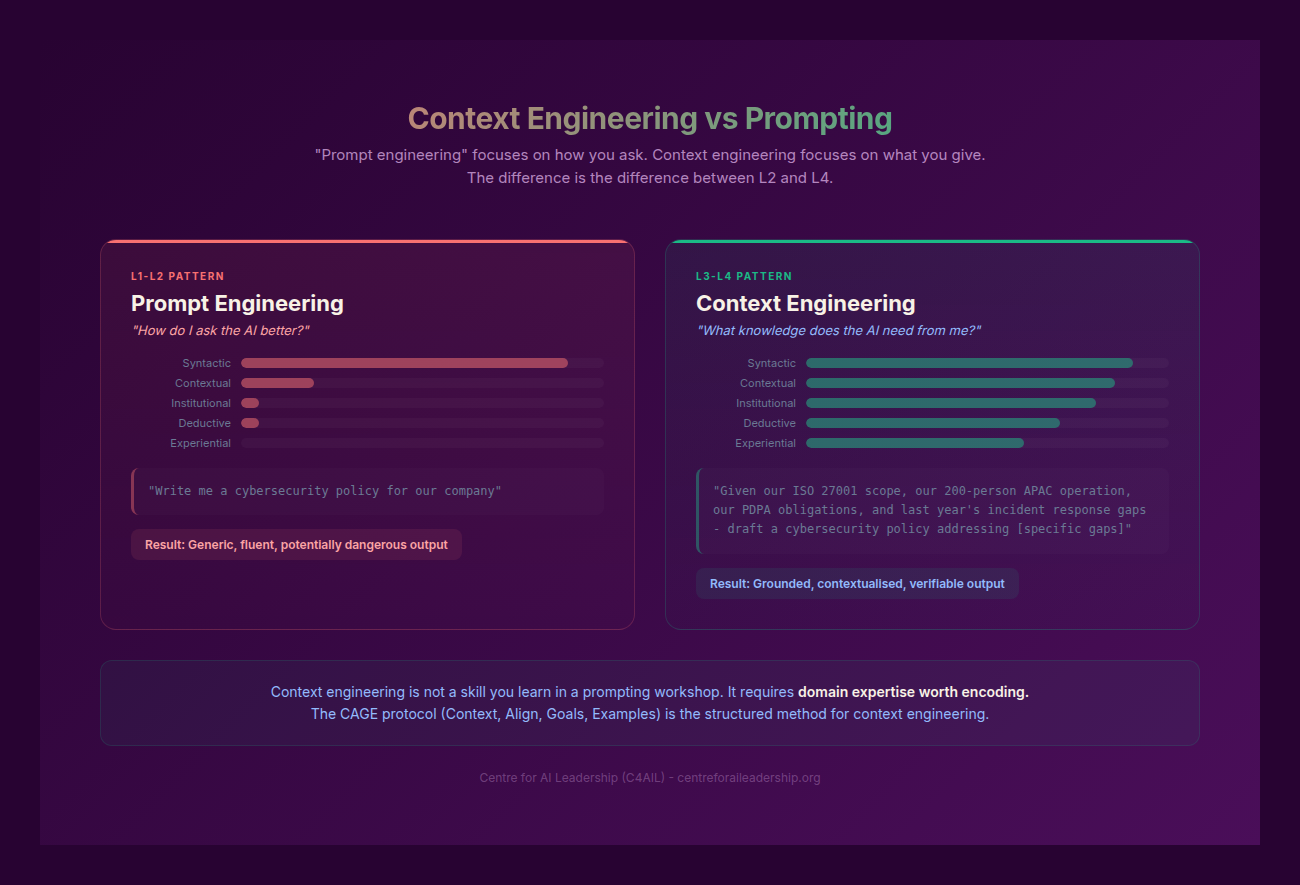
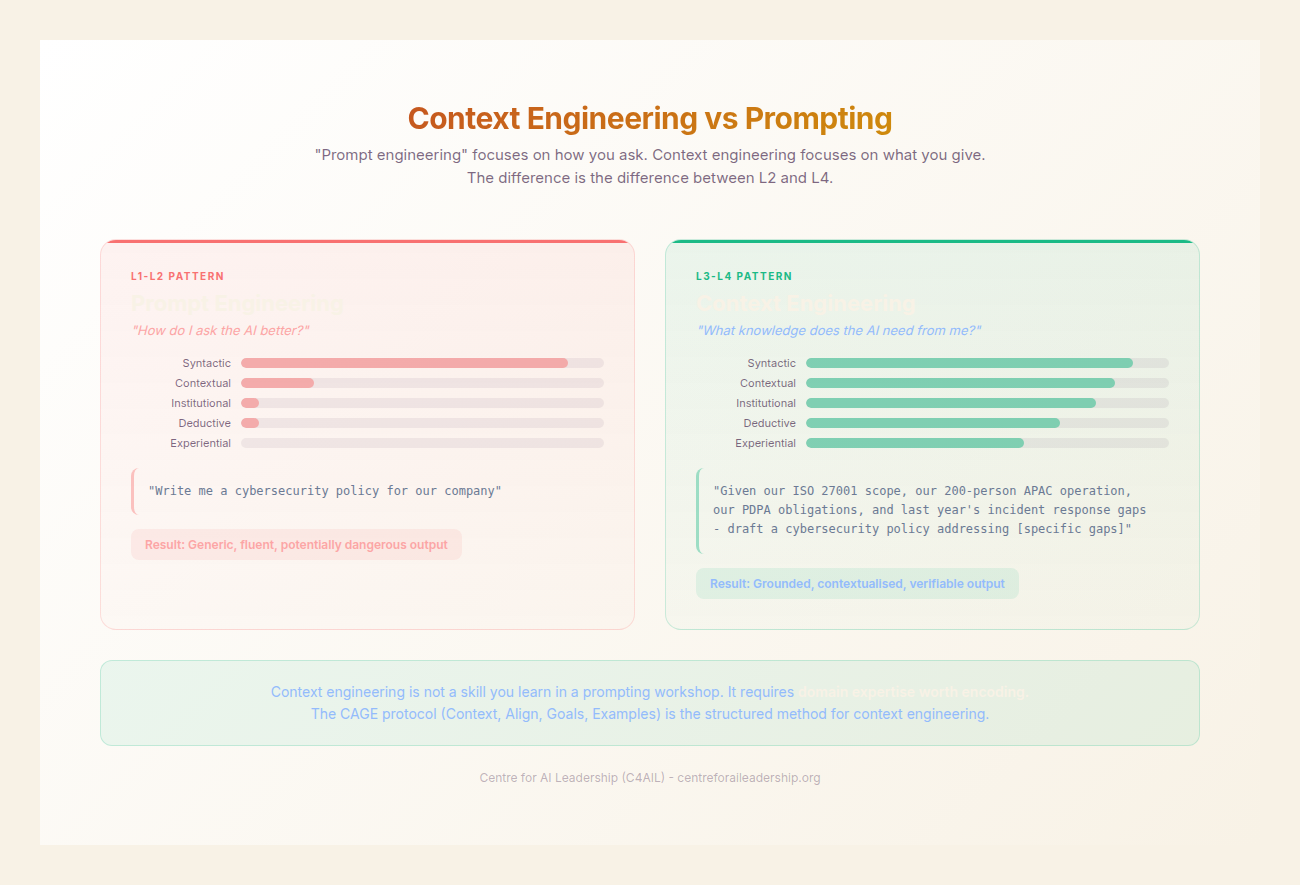
Context injection. Before the AI generates anything, it receives your project’s architectural decisions, coding standards, API contracts, and domain constraints. Not the entire codebase - a curated context that reflects how your team builds software. This is the difference between “write a function that processes payments” and “write a function that processes payments using our PaymentGateway abstraction, following our error handling pattern (never swallow exceptions, always log to structured logger), in the context of our event-sourced architecture where idempotency is non-negotiable.”
Standards alignment. Your linting rules, type conventions, test patterns, and security requirements are not afterthoughts - they are constraints the AI operates within. If your team requires 80% test coverage, the AI’s output includes tests. If you never use raw SQL, the AI uses your ORM. If you have a standard error hierarchy, the AI uses it.
Objective scoping. Each AI interaction has a defined scope and a definition of done. Not “build the user management module” but “implement the password reset flow using our existing AuthService, with rate limiting per the security spec, returning our standard ApiResponse envelope.” Tight scope produces verifiable output.
Reference examples. The AI sees your best code, not the internet’s average. Your most elegant service implementation. Your cleanest test file. Your most thorough error handling. It also sees your anti-patterns - “never do this” examples from past incidents. This calibration is the single highest-leverage input most teams skip.
The Verification Chain
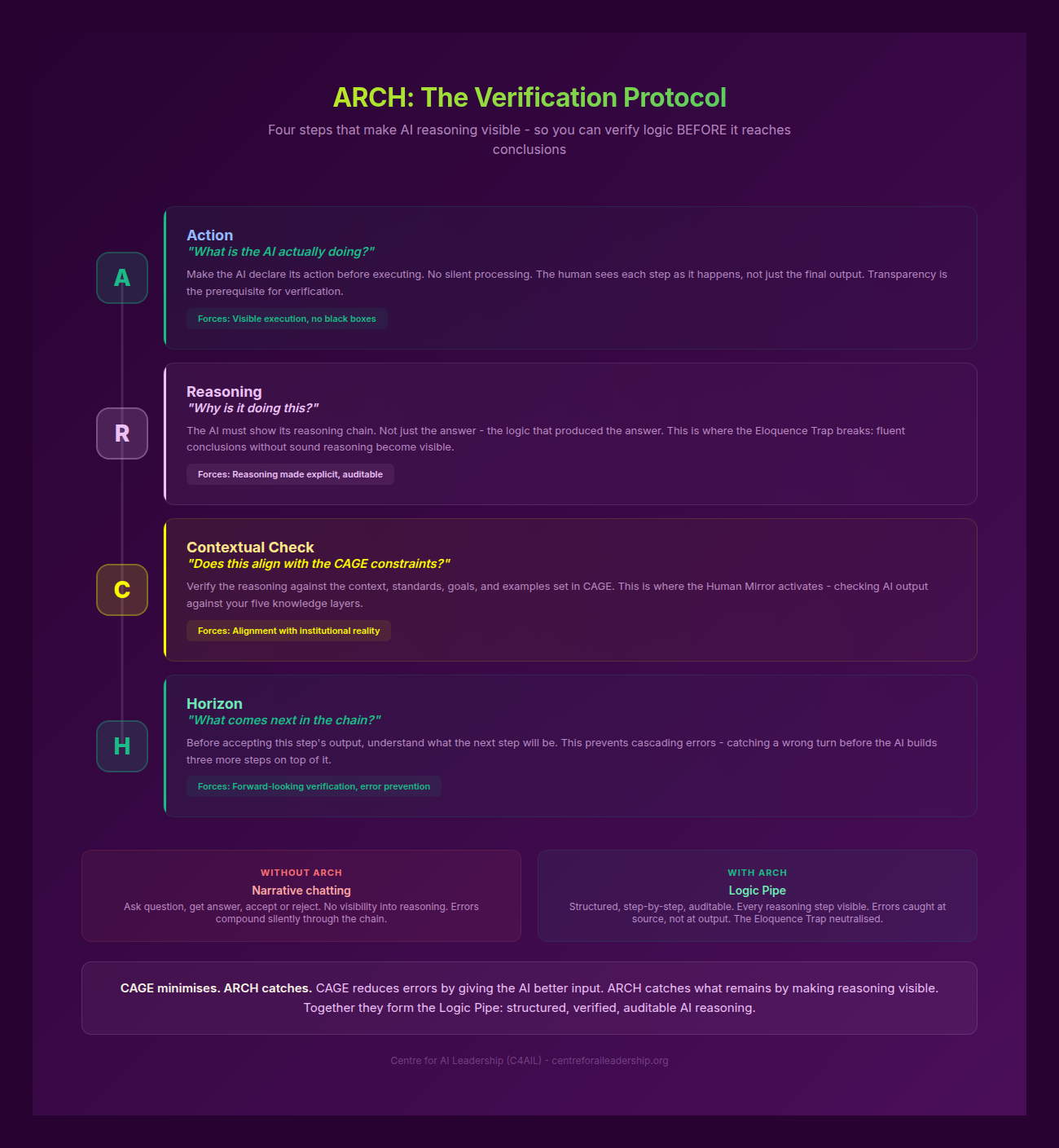
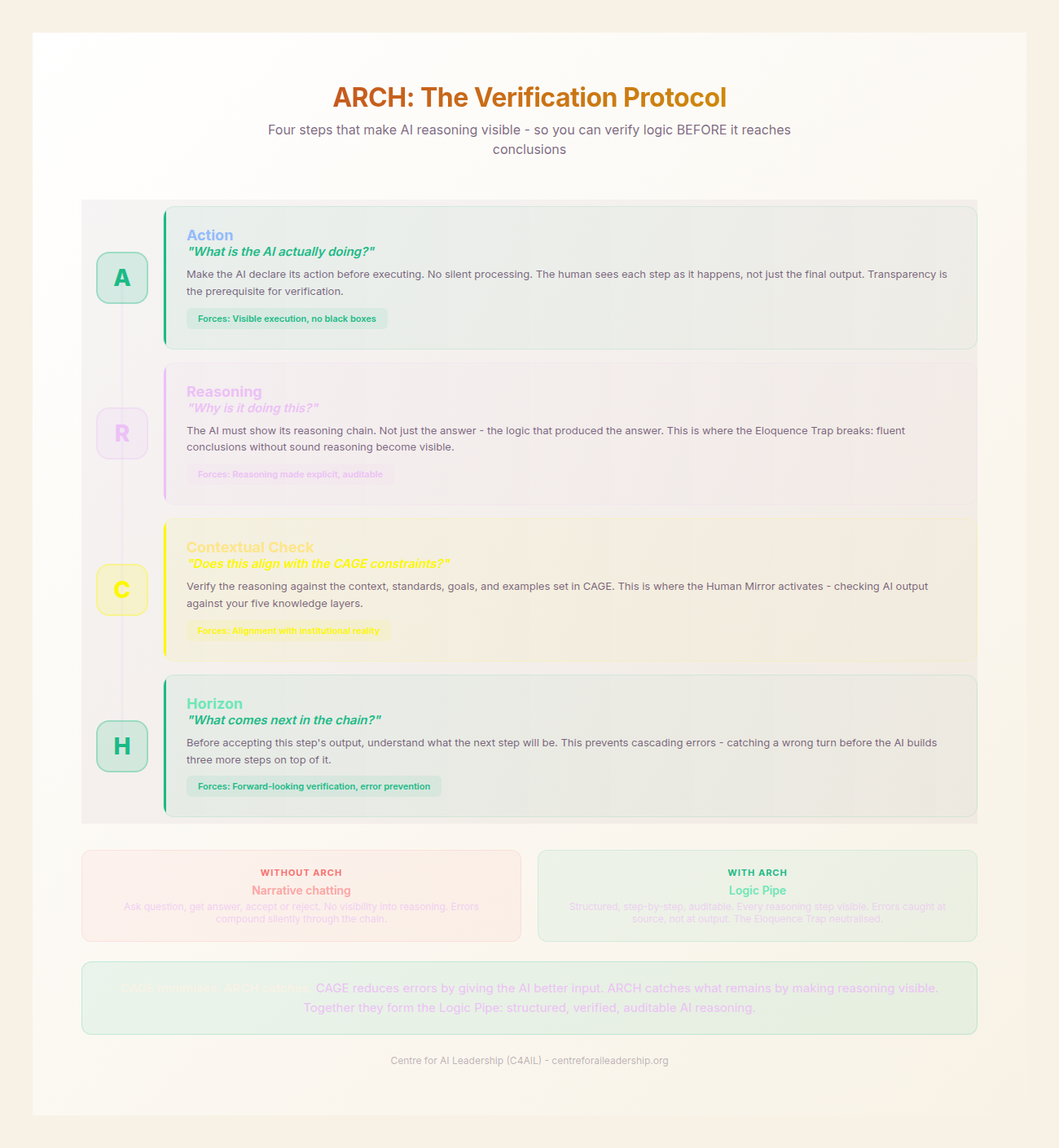
Every Floor needs a built-in verification chain. For software teams, this maps directly to your existing quality infrastructure - but with AI-specific additions:
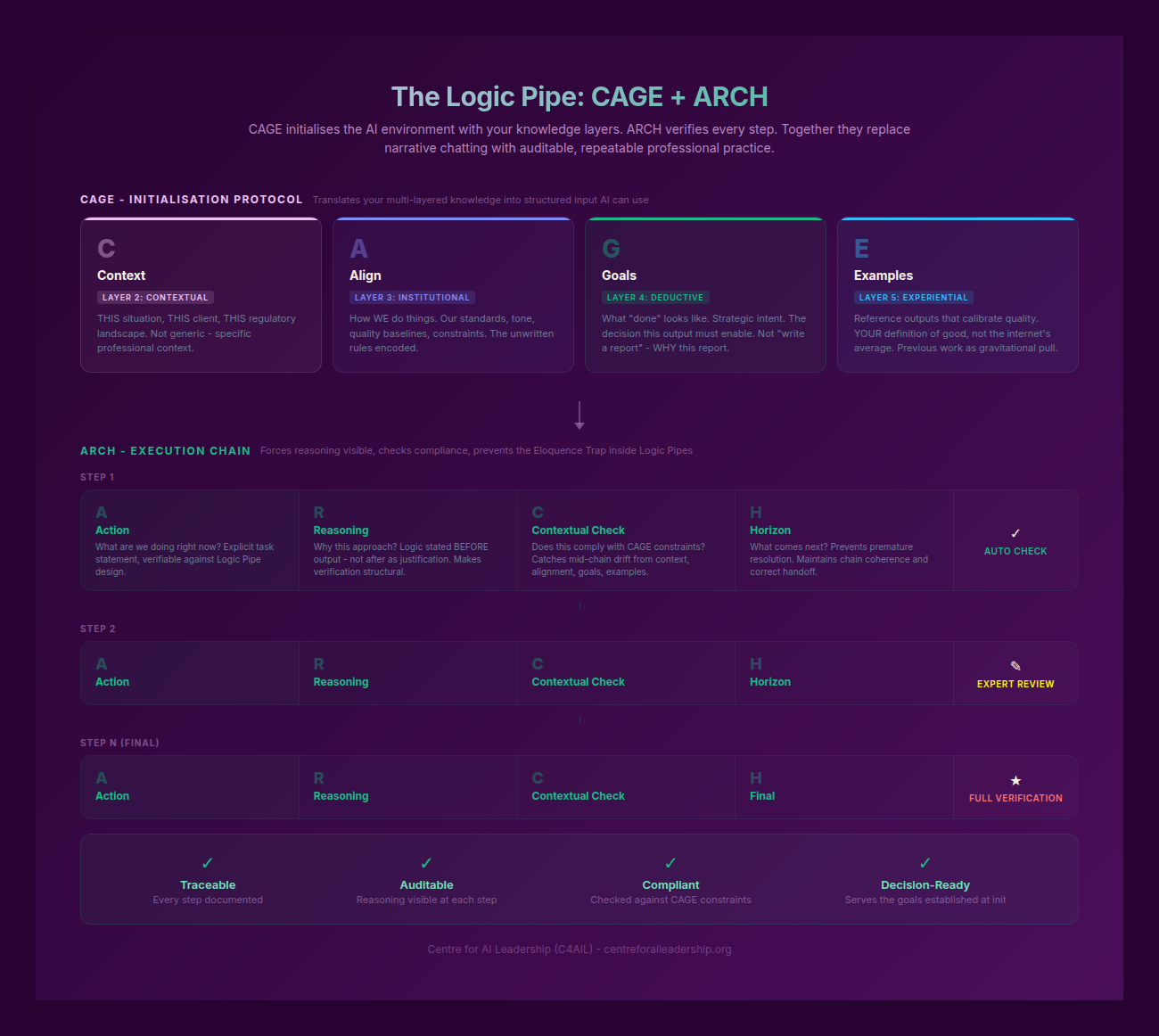
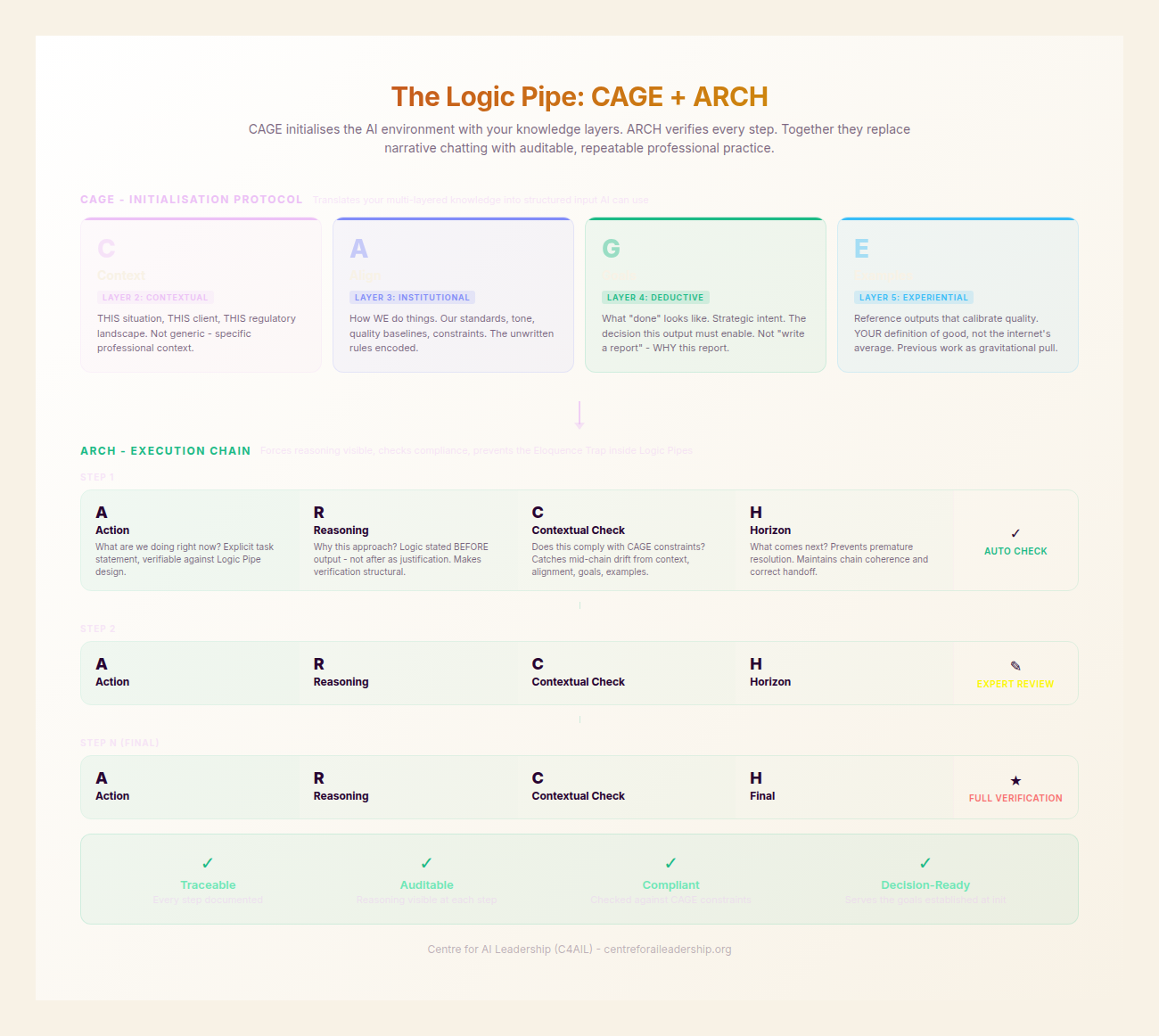
Step 1: Generation with visible reasoning. The AI produces code and explains its decisions. “I chose this pattern because of X constraint. I handled this edge case because of Y requirement. I did not handle Z because it was outside the stated scope.” If the reasoning is wrong, you catch it before reading the code.
Step 2: Automated structural check. Before a human sees the output, automated checks verify: Does it compile? Do the tests pass? Does it conform to your architectural patterns? Does it introduce any known anti-patterns? Does it reference packages that actually exist? This catches the 70% of issues that do not require human judgment.
Step 3: Contextual review. A human reviews what automated checks cannot catch: Does this approach make sense for our domain? Does it handle the business rules correctly? Does it fit with the direction the codebase is heading? This is where domain expertise matters - and it is where you want your senior engineers spending their time, not catching syntax issues.
Step 4: Scope check. Has the AI stayed within the defined scope, or has it helpfully “improved” things that were not asked for? Scope creep in AI-generated code is real and dangerous - the AI refactors a function you did not ask it to touch, introduces a “better” pattern that breaks an assumption three files away, or adds error handling that silently changes behavior.
Building the Ceiling: Developing Your AI Architects
The Floor does not build itself. Someone has to design the context injection, write the reference examples, define the verification chain, and maintain it all as the codebase evolves. These people are your Ceiling - your AI architects.
Who They Are
Your best AI architects are not your most enthusiastic AI users. They are your most experienced engineers who have also developed architectural curiosity about AI systems. The combination matters:
- Domain expertise without AI architecture produces the verification bottlenecka brilliant expert drowning in manual line-by-line review of AI output; domain expertise without AI architecture.See full entry → - a brilliant engineer drowning in review of AI output they must manually check line by line.
- AI enthusiasm without domain expertise produces sophisticated workslopelegant AI pipelines that produce plausible, well-structured output missing the actual business logic.See full entry → - elegant AI pipelines that generate plausible, well-structured code that misses the business logic entirely.
The architect is the engineer who says: “I know that this payment flow has three edge cases that the AI will miss because they come from regulatory requirements that are not in the codebase. Let me encode those into the context template so the AI handles them by default.”
What They Build
Context templates per domain. Not one generic “write code” prompt - specific templates for specific areas of the codebase. The payment processing template is different from the user management template because the domain knowledge is different. Each template encodes the institutional knowledge that makes the AI’s output actually useful: the patterns to follow, the edge cases to handle, the anti-patterns to avoid, the regulatory constraints to respect.
Verification rules per risk level. Not every piece of code needs the same level of review. Your architects design the triage:
- Auto-verified (Queue Aroute AI output by confidence: A auto-approved + logged, B Translator-reviewed, C escalated to Architect/Orchestrator.See full entry →): Boilerplate, CRUD operations, test scaffolding, documentation. AI generates, automated checks verify, no human review needed. This is where you recover the time.
- Expert-reviewed (Queue B): Business logic, integration points, data transformations. AI generates, automated checks run first, then a domain expert reviews. This is where your mid-level engineers develop judgment.
- Architect-owned (Queue C): Security-critical paths, financial calculations, novel architecture, system design. The architect works in tight iteration with AI, maintaining full control. This is where deep expertise cannot be automated.
Living standards. Your context templates and verification rules are not documentation that rots in a wiki. They are living code - version controlled, reviewed in PRs, tested against real output, updated when they fail. When an AI-generated bug reaches production, the post-mortem updates the template that should have prevented it. Each failure makes the Floor smarter.
The Amplifier Pattern: What L3-4 Engineers Actually Do
Between the Floor (L0-2 users operating inside structured systems) and the Ceiling (L5-6 architects designing those systems) sits the most important group: the Amplifiers at Levels 3-4. These are engineers who have moved past accepting AI output and into actively directing it.
One clarification before going further, because it changes how you spot and develop these people. The 0-6 scale is the Build route - the developmental ladder for engineers who build systems. It is one route of several (others operate, assure, or direct), and it is not a universal maturity model. More importantly, the thing that makes an Amplifier an Amplifier - the capacity to translate between what the domain needs and what the AI can do, and to judge what actually matters - is not a rung you climb to and leave behind. It is a trait that overlays every seat. Your best Floor User carries a version of it; your Architects and Orchestrators carry more of it. “Amplifier” names the band where that trait becomes the primary, visible function of the work - not a separate track that some engineers graduate onto while others opt out. You are not looking for people who reached level 3. You are looking for the translation-and-judgment trait wherever it shows up, and giving it room to deepen along each person’s own route.
How Amplifiers Work with AI
They provide their own logic first. An Amplifier does not say “implement the caching layer.” They say: “Here is my design for the caching layer - two-tier with Redis for hot data and Postgres for warm, TTLs driven by the access frequency table, invalidation on write-through. Implement this design, flag anywhere you think the TTL logic might race under concurrent writes, and generate the test fixtures for the three scenarios I have outlined.”
The AI is executing and stress-testing their thinking - not replacing it.
They verify against their own mental model. When the AI returns code, the Amplifier is not reading it cold. They already know what the code should look like because they designed it. They are checking whether the AI’s implementation matches their intent - a fundamentally different cognitive task from trying to understand code someone else wrote. This is why Amplifiers are faster and more accurate than Passengers: they have a reference frame for verification.
They catch what they have seen before. An Amplifier with five years on this codebase knows that the ORM does something unexpected with soft deletes, that the message queue drops messages under specific load patterns, that the third-party API returns inconsistent date formats on Mondays. This is experiential knowledge that the AI does not have. The Amplifier applies it as a filter on every output.
They improve the system, not just the output. When an Amplifier catches a recurring issue - the AI keeps generating code that does not account for timezone handling, say - they do not just fix it. They update the context template so the AI handles it correctly next time. Each fix that improves the template is a permanent improvement to the Floor.
The Amplifier’s Daily Rhythm
Morning: review Queue B items flagged overnight, apply domain knowledge to catch what automated checks missed. Update templates where patterns have changed.
Working sessions: design approach for new features, use AI to implement within the design constraints, verify against mental model, iterate on edge cases.
End of day: review own AI-generated output with fresh eyes. Flag any template gaps discovered during the day.
The Amplifier is not “using AI.” They are directing AI while maintaining their own expertise. The AI handles the Intellectual Labour - the drafting, the syntax, the boilerplate. The Amplifier provides the Accountability Labour - the design, the verification, the judgment that says “this is correct enough to ship.”
Two Ways In: The Senior Who Ports vs The Junior Who Builds
Here is the part most teams get wrong when they try to grow Amplifiers, and it is the single highest-leverage thing in this paper. Amplifier capability rests on substrate - the earned, tacit, peer-calibrated judgment about what good code is, why an approach fails, where the edge cases hide. Substratetacit domain knowledge, accountability experience, mental representations, peer-calibrated judgment; built slowly through consequential practice, transfers across tool eras, cannot be…See full entry → is slow to build and it does not show up in a certificate. But it transfers across tool eras, because it was never about the tool. There are two completely different ways a person arrives at the Amplifier band, and conflating them wastes your strongest asset.
The Novice Pathway (3-5 years). A new engineer has no substrate yet. They are building both layers at once - the judgment and the surface (the AI tooling, the prompting, the workflow). This is the slow track, and it cannot be compressed by curriculum, because substrate only forms through consequential work under supervision: shipping real code, owning the call when it breaks, accumulating the pattern library that lets you smell a race condition before you can name it. Three to five years to genuine Amplifier judgment is real, and no bootcamp shortens it. This is also the track AI most endangers - because the junior work that used to build substrate is exactly what the AI now absorbs, hollowing out the journeyman tier and deferring the failure to the day no one is left who can catch it.
The Adjacency Pathway (9-18 months). A senior engineer with ten or fifteen years on real systems already has the substrate. When AI changes the surface, their judgment does not reset to zero - it ports. The mental model that tells them the ORM does something strange with soft deletes, that this concurrency pattern races under load, that this date handling will break on a Monday - that is the expensive, slow-built layer, and it transfers into the AI-augmented version of the work the moment they pick up the new surface. What they actually need is narrow: the new tooling, the architectural vocabulary to design systems rather than hand-write every function, and a few calibration reps that bridge their existing judgment into the new context. The expert-transfer literature is unambiguous - when the underlying representations transfer, learning the new surface is a matter of months, not years. So a veteran engineer reaches functional Amplifier capability in three to six months, and full architect-level command in nine to eighteen.
The two are not the same track at different speeds. They are different tracks:
| The Junior (Novice) | The Veteran (Adjacency) | |
|---|---|---|
| Starting state | No substrate | Deep substrate, adjacent surface |
| What you are building | Substrate and surface | Surface + reframing only |
| To functional Amplifier | 12-24 months | 3-6 months |
| The real bottleneck | Accountability and judgment, built under stakes | Surface fluency and architectural reframing |
| The failure mode | Trying to compress the timeline | Treating them like a beginner |
The mistake almost everyone makes is to put their senior engineers through generic “AI upskilling” built for beginners - and then wonder why the most experienced people disengage. The problem is not their age or their “digital readiness.” The problem is that the programme is building substrate they already have, and skipping the one thing they need. Your fastest Amplifiers are not your most enthusiastic AI adopters. They are your veterans with the deepest substrate, ported in months - and their judgment is already calibrated to your codebase, not to a generic curriculum’s examples. The mid-career experts already inside your team are the primary source of Amplifier capacity for the next five years. Most teams are writing that asset off.
Anti-Patterns: What Does Not Work
Having seen engineering teams attempt this transition, these are the patterns that consistently fail:
“AI-first” development. Starting with “ask the AI” instead of “think about the problem.” This produces code that compiles and passes tests but does not reflect the actual requirements because nobody formulated the requirements precisely before generating. The AI fills ambiguity with plausible defaults. Plausible defaults are how bugs ship.
Review-only governance. Relying entirely on code review to catch AI errors. This creates the verification bottleneck - seniors buried in review, quality declining as review fatigue sets in, juniors not learning because they never wrote the code they are supposedly responsible for.
Universal Copilot. Giving everyone the same AI tool with the same configuration and assuming outcomes will be good. This is the $40 billion mistake at team scale. Without context injection, standards alignment, and verification chains, you are generating workslop faster.
Banning AI. The opposite extreme. Your developers are using AI whether you support it or not. The question is whether they use it inside a governed system or outside one. Banning pushes usage underground where there is zero verification.
Prompt libraries without architecture. A shared wiki of “good prompts” is not a Floor. Prompts without context injection produce generic output. Prompts without verification produce unverified output. Prompts without standards alignment produce inconsistent output. A prompt library is a start, not a system.
Where to Start on Monday
Week 1: Measure your current state. Before changing anything, measure three things: (1) what percentage of committed code is AI-generated, (2) how long code review takes for AI-generated vs human-written PRs, and (3) how many production incidents trace to AI-generated code. If you do not have this data, that is your first finding.
Week 2-3: Build one Floor. Pick the area of your codebase with the most repetitive work and the most available domain expertise. Build a context template that encodes your team’s knowledge for that area. Add a verification chain. Measure whether AI output quality improves with structured context vs unstructured prompting.
Week 4-6: Identify your Amplifiers. Watch how your team responds to the Floor. The engineers who start asking “what if we added X to the template?” and “the AI keeps missing Y, can we encode that?” - those are your L3-4 Amplifiers. Give them protected time to improve the system.
Month 2-3: Expand and govern. Your Amplifiers build Floors for the next two areas of the codebase. You start tracking first-time-right rates and template effectiveness. Weekly retros focus on template failures, not individual performance. The system gets smarter every week.
Month 4+: The compound cycle begins. Each Floor your Amplifiers build makes the next one faster. Templates become reusable across domains. Verification patterns standardise. New Amplifiers emerge from the engineers who outgrew the Floor. The gap between your team and teams still doing unstructured AI chat widens every sprint.
The Architect’s Choice
You build software for a living. You know that architecture matters more than any individual feature. You know that systems without verification fail. You know that technical debt compounds.
Everything you know about building reliable software applies to building reliable AI-assisted development. The only question is whether you will apply it - or whether you will keep pasting into chat windows and hoping for the best.
The AI is not going away. It is going to get better at generating code. Which means the verification problem is going to get worse. Which means the teams that build architecture around AI now will pull further ahead with every model improvement - while the teams that rely on individual heroics will drown in review debt.
Build the Floor. Develop your Amplifiers. Design the Ceiling. The compound cycle will do the rest.
This paper accompanies the three-part series from the Centre for AI Leadership (C4AIL): “Why Your AI Investment Isn’t Working” (The Diagnosis), “What the 5% Do Differently” (The Framework), and “Monday Morning: Where to Start” (The Playbook).
For the full research framework, see “Orchestrating Intelligence: A Maturity Framework for Realising Human-AI Potential in the Age of Automation” - available from C4AIL on request.
Take the diagnostic: assess.c4ail.org Contact: [email protected] | centreforaileadership.org
Where this sits in the C4AIL canon (2026). This is a popular entry point into the consolidated whitepaper stack. The macro-thesis is The Moat Inversionas AI exhausts the explicit and surface goes free, competitive advantage inverts toward the irreducibly human (judgment, accountability, architectural design); value moves from what you can…See full entry → (Whitepaper 0): for two centuries value flowed to the explicit; AI exhausts it, so the moat inverts to the irreducibly human. The mechanism — substrate vs surface, Epistemic Labourthe value-bearing work of *knowing*: reading what AI output means, catching fluent-but-hollow answers. Delegable (answers to reality); accountability is *owning* (non-delegable, answers to…See full entry →, the Squeezed MiddleAI hollows the journeyman tier where substrate is built (the "barbell": gains at floor and ceiling, squeeze in the middle); no juniors today, no seniors in five years.See full entry →, ConcretisationAI's core economic act: making tacit substrate explicit, proprietary, and scalable. Concretise your own = a moat; depend on generic = erosion.See full entry → — is The Labour Architecture (WP2). The operating model — the Institutional Vaultthe org's codified, executable knowledge store (processes, records, prompts, pipelines) - surface made durable. The three-way line: Holding (frees judgment), Executing codified rules (the…See full entry → and the four seatsDirect (Board), Operate (Manager), Build (Practitioner), Floor (User): one story told from four accountabilities. Plus the Assure / Governance fifth seat - the Brain made into a function…See full entry →, the CAIOthe Translator made institutional: a Direct-seat Orchestrator built on Build substrate, measured by dispensability, who succeeds by manufacturing Translators, not being the bottleneck.See full entry → and the AI Centre of Excellencethe hub-and-spoke unit that scales the CAIO from a person to an institution; three arms = Forge (develop Brains), Governance (govern the Vault), Practice (do the stakes-bearing work).See full entry → — is The Operating Model (WP4). The institution that builds and sustains the capability is the Forge (WP5), the Full Stackthe total infrastructure substrate development requires (educational + community + meaning layers); C4AIL owns "roughly a quarter" (the educational, high-leverage slice).See full entry → (WP6), the Guildhall (WP7), and the Antifragile Institution (WP8). → Read the whitepapers