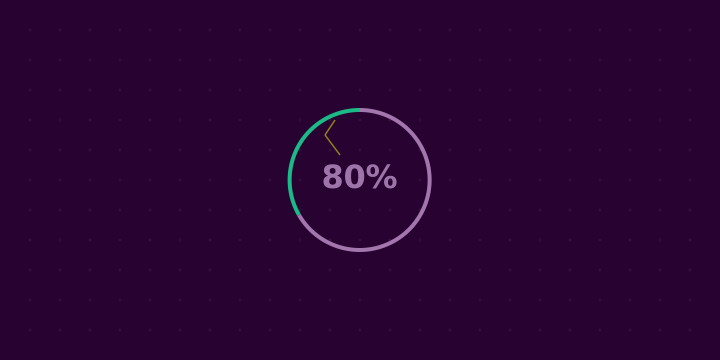
The Anatomy of Failure: Why 80% AI Adoption Delivers 5% ROI
AI tool adoption has reached 80% across the enterprise. Yet measurable ROI remains at just 5%. This paper explains why — and what the alternative looks like.
AI tool adoption has reached 80% across the enterprise. Yet measurable ROI remains at just 5%. US firms spent $40 billion on AI in 2024; 95% saw zero measurable bottom-line impact. Eighty cents of every dollar invested in AI is generating no measurable return.
This is not a technology failure. The technology works. It is a human systems failure — and the evidence from 2025-2026 shows the pattern accelerating, not correcting.
The reckoning has arrived. A METR study in July 2025 found that experienced developers using AI tools took 19% longer to complete tasks — while believing they were 24% faster. The perception-reality gap is measurable: people think AI is helping when it is making them slower. The HBR/BetterUp/Stanford workslop research documented the quality tax at scale: 40% of workers receiving AI-generated content that looks professional but lacks substance, costing over $9 million annually per 10,000-person organisation. MIT found 95% of GenAI pilots failing to achieve revenue acceleration. Gartner placed GenAI in the Trough of Disillusionment. US Census data showed AI adoption declining, not growing.
The organisations that deployed tools without building human capability are the ones stalling. This paper explains why — and what the alternative looks like.
The True Value of AI — and Its Boundary
AI is a genuine force multiplier. This paper does not argue otherwise. A well-directed AI can produce first drafts in seconds, surface patterns across thousands of documents, generate code at a pace no human can match. The value is real. The productivity gains are documented and significant.
But they are gains in one type of work — and there are three. The Bell Curve that once distributed professional competence is dead. AI kills the middle. What replaces it is a Power Law: small differences in how organisations deploy AI produce exponential differences in output.
All professional work falls into three categories, and AI affects each differently. Intellectual Labour is weightless — strategy, synthesis, coding, drafting, research, analysis. AI excels here, operating at the surface layer of language, patterns, and statistical prediction. This is where the genuine value sits, and where the Power Law distribution operates: small differences in how organisations use AI for intellectual work produce exponential differences in output. The 6x-16x productivity gaps documented in 2025 are real — but they measure Intellectual Labour, not the whole picture.
Physical Labour is atom-bound — logistics, manufacturing, skilled trades. AI optimises but does not replace: better routes, predictive maintenance, demand forecasting. Value follows an S-curve — steep initial gains, then plateau at physical constraints. Important, but not where the critical failure lives.
Accountability Labour is presence-bound — ethical oversight, risk ownership, judgment calls, decision-making, empathy, care. This is not just “emotional work.” It includes board-level decisions, crisis management, audit sign-off, medical diagnosis review, threat assessment. It requires contextual, institutional, deductive, and experiential knowledge — the deeper layers that AI does not possess and cannot develop. AI is fundamentally incapable of Accountability Labour. Not “not yet capable.” Fundamentally incapable. The architecture that makes AI powerful at surface-layer pattern matching is the same architecture that makes it unable to take responsibility for a decision, sense when a situation requires human presence, or exercise the judgment that comes from years of practice.
The line between Intellectual and Accountability Labour is not a spectrum. It is a boundary. Organisations that recognise where AI’s Intellectual Labour ends and human Accountability Labour begins — and structure their deployment around that boundary — are the ones the evidence shows succeeding. Organisations that blur the line, deploying AI as if it can do both, produce the three failures below.
Most organisations have not drawn this line. They deploy AI as if it can do both. The 80% adoption / 5% ROI paradox is what happens when you don’t.
When the Line Is Crossed
AI operates on a single layer: syntax — statistically probable sequences of words, fluent, professional, confident. Your people operate on the deeper layers that Accountability Labour demands — contextual knowledge (domain expertise), institutional knowledge (how things actually work here), deductive reasoning (logical verification), and experiential judgment (the pattern recognition that says “this looks right on paper but it will not work”).
These layers are what make professional work trustworthy. Not the words, but the depth behind the words. When organisations deploy AI without structuring how their people engage those deeper layers, three things happen.
The Eloquence Trap
AI’s single-layer fluency is indistinguishable from multi-layered expertise — unless you actively check. We grant what this paper calls Epistemic Credit: unearned trust, because the output looks like it came from someone with the full depth of understanding. It did not. Epistemic Credit is not binary — it operates on a spectrum, proportional to the gap between AI’s apparent depth and the human’s actual depth. The wider the gap, the more dangerous the credit.
A 2025 clinical study made this precise. Physicians — trained clinicians with years of diagnostic expertise and specific AI literacy instruction — received AI-generated advice that was eloquently worded but factually wrong. Their diagnostic accuracy dropped by 14 percentage points. Not because they lacked the knowledge to catch the error. They had it. But they did not engage it. The AI’s surface-level output looked identical to what a knowledgeable colleague would produce, so they deferred to it instead of interrogating it against what they already knew.
This is the Eloquence Trap: not that AI is so convincing it fools everyone, but that professionals will choose to believe AI over their own knowledge unless they actively question it. It is a failure of engagement, not of intelligence. And it happens precisely at the boundary — the professional had the deeper layers (Accountability Labour territory) but let the surface layer (Intellectual Labour output) override them.
The Reliability Trap
In multi-step workflows — the kind organisations are now automating at scale — errors compound multiplicatively. A process with five steps, each 95% accurate, does not produce 95% reliable output. It produces 77%. One in four outcomes is wrong. At ten steps, reliability drops to 60%.
No business would accept this from any other system. You would not sign an SLA for 77% uptime. You would not keep a vending machine that dispenses the wrong product one time in four. Without structured verification at every step — what we call Logic Pipes — AI automation operates below the quality threshold your organisation already enforces for everything else. The Reliability Trap is what happens when you let AI handle multi-step Intellectual Labour without building the Accountability Labour checkpoints that make it trustworthy.
The Dunning-Kruger Peak
When the Eloquence Trap and the Reliability Trap meet at organisational scale, you get the most dangerous pattern of all — because it feels like success. High tool adoption, high confidence, zero verification. Teams report being “10x more productive.” The P&L shows no change. The initiatives are real. The investment is real. The productivity gains are an illusion built on unverified output — and the organisation is accumulating Comprehension Debt at a rate it cannot see and will not understand until something breaks.
This is what the 80/5 paradox looks like from the inside. Everyone believes the AI is working. Nobody is checking whether it actually is. The judgment that says “is this actually trustworthy enough to act on?” — that is Accountability Labour, and it has been quietly abandoned.
When the Stakes Are Human
The consequences of crossing the boundary are not hypothetical. In late 2025, the mental health startup Yara AI shut down a working product with active users and growing traction. The AI could produce empathetic-sounding responses — flawless Intellectual Labour at the surface layer. But it could not take responsibility for a patient in crisis. That is Accountability Labour — presence, judgment, the deeper layers — and the machine cannot do it. Eloquent syntax is not the same as human presence.
The founders exercised sovereignty: they recognised the boundary and acted on it. They shut the company down. This was not a failure of technology. It was a success of leadership — a refusal to let AI cross the line into territory where only humans can operate. Not every organisation will face stakes this high. But the underlying question is the same: does your organisation know where Intellectual Labour ends and Accountability Labour begins — and who owns that boundary?
The Human Anchor
The boundary between Intellectual and Accountability Labour does not maintain itself. The alternative to passive AI consumption is what this paper calls the Human Mirror — the discipline of reflecting AI output against the deeper knowledge that only the professional possesses. It is not a single heroic insight. It is a structured verification that every professional can learn:
- Does this fit my domain context?
- Does this align with how we do things here?
- Does the reasoning hold logically?
- Does this match what I have seen work in practice?
Translation — the ability to engage deeper knowledge layers against AI’s surface output — is the universal skill of the AI era. Not an exclusive capability reserved for technical experts. A discipline that everyone at every level develops. The economics are stark: AI handles 80% of the Intellectual Labour. The human provides 10% niche context and 10% strategic intent — but that 20% IS the value, because it comes from deeper layers AI does not have. Orchestrators make it easier by building it into tools and workflows. But the capability itself is human, universal, and developable.
The paper provides a 0-6 maturity scale that maps where any individual or organisation sits — and maps directly onto the Power Law curve. At L0-2, professionals use AI without engaging their deeper layers — returns are linear, AI is a faster typewriter, and the Eloquence Trap operates most powerfully here. At L3-4 — the Knee of the curve — practitioners shift from using tools to building systems: asking “how do I make this repeatable?” and designing verification for their domain. At L5-6 — the Upturn — the Intelligence Orchestrator emerges — a domain specialist who has developed architectural agency over AI systems. They hold what we call the double-threat: deep vertical expertise in their field, and the horizontal ability to translate that expertise into systems others can use.
One Orchestrator at L5 can oversee the verified output of what previously required an entire department. Not because the machine does the thinking, but because the Orchestrator’s multi-layered knowledge scales through the architecture they built. This is where the economics of AI capability fundamentally change.
But building Orchestrators is necessary, not sufficient. Three Leverage Leaks identify where organisations lose even the value their best people create: no verified systems (Architecture Leak), no data foundations (Infrastructure Leak), and no capability development pipeline (Talent Leak). Most organisations are leaking from all three.
The Framework: ARGS
Sovereignty requires four disciplines working together. We call them ARGS — Agency, Architecture, Governance, Scaling — and they represent a structured path from passive AI consumption to what we call Sovereign Command: the state where the organisation owns its decisions, can defend them, and can scale them without losing control.
Agency is the decision to engage deeper knowledge layers rather than accepting surface output. At the individual level, it is the Human Mirror — checking each output against what you know, or at minimum holding yourself accountable for the end product. At the organisational level, it is a culture that rewards verification over speed. At scale, Agency designs the systems that make this checking structural, but the accountability remains human at every point.
Architecture is the infrastructure that makes AI interaction repeatable, verified, and scalable. Logic Pipes instead of narrative chatting. Clean data foundations. Verified chains of reasoning where each step is traceable and each output can be explained. Architecture is what separates a tool from a system.
Governance is not bureaucratic oversight. It is living governance that creates value. The right governance defines where the limits are and what best practices look like — enabling confident action within clear boundaries. The team that knows where the field ends plays more aggressively. Governance as checkboxes kills speed. Governance as living material — updated when practitioners learn, evolved when the domain shifts — accelerates it.
Scaling is decoupling output from headcount. Investment in tools alone produces linear returns that flatten. Investment in human capability at the Orchestrator level produces exponential returns that compound. One Orchestrator designs systems that serve hundreds. The returns are not from the technology — they are from the humans who make the technology reliable.
ARGS is not a compliance framework. NIST AI RMF and ISO 42001 tell you what boxes to tick. ARGS is a teaching, implementation, and functional framework — it comes with a development programme, an implementation pathway, and people to guide you through it. NIST is the building code. ARGS is the builder, the architect, and the training programme for the people who will live in the building.
The Daily Tools: CAGE and ARCH
Two protocols make the framework operational.
CAGE — Context, Align, Goals, Examples — is the initialisation protocol. It translates the practitioner’s multi-layered knowledge into a structured input the AI can use. Context provides domain knowledge. Align embeds institutional standards. Goals set strategic intent. Examples supply experiential reference points. Hallucination is an architectural feature of probabilistic systems — it will always be present. But you can reduce the risk substantially by giving the AI the knowledge it cannot generate for itself. CAGE minimises hallucination at the source.
ARCH — Action, Reasoning, Contextual Check, Horizon — is the verification chain. It structures the AI’s reasoning BEFORE the conclusion is reached — not after. At each step, the AI must state what it is doing (Action), make its reasoning visible (Reasoning), check that reasoning against the CAGE constraints (Contextual Check), and define what comes next (Horizon) — all before proceeding. The human verifies the logic as it develops, not after a final answer has already been delivered. This is the critical distinction: post-hoc explanation is unreliable — the AI confabulates justifications for conclusions already reached. ARCH builds reasoning into the process itself. Where hallucination persists despite good context — reasoning failures, model limitations — ARCH catches it at the step where it occurs, not after it has compounded through the chain.
CAGE minimises. ARCH catches. The human owns the final verification. Together, they form the Logic Pipe: the structured, verified chain of AI reasoning that replaces narrative chatting with a documented, auditable process.
The Implementation: Floor and Ceiling
Not everyone needs to be an Orchestrator — and that is fine.
Implementation requires a dual-track model — one that maintains the boundary between Intellectual and Accountability Labour across the entire organisation. The Systemic Floor serves the majority of the workforce at L0-2: CAGE and ARCH templates pre-built by Orchestrators, embedded in the business processes people already use, with AI running underneath. The user interacts with their normal workflow. The verification is structural, not personal. The Floor is not dumbed-down AI for passive users. It is responsible design that produces verified output without requiring every individual to become an AI architect. It enables excellence while respecting the choice to do great work and have a life beyond AI mastery.
The Strategic Ceiling is where the organisation’s AI capability is actually built. Domain experts learn to think architecturally — to move from using AI to designing how AI is used by others. The Ceiling produces the Orchestrators who build the Floor. This is where the Power Law investment sits: compound returns as each Orchestrator builds more Floors, surfaces more Ceiling candidates, and expands the scope of verified capability across the organisation.
The compound cycle drives itself. The Ceiling produces Orchestrators. Orchestrators build Floors. Floors surface new Ceiling candidates. Candidates develop into the next generation of Orchestrators. Each cycle expands the scope of what the organisation can do with AI — reliably, verifiably, and at scale.
A tool rollout is not a capability build. The evidence is documented. Organisations that invested in workflow redesign and human capability achieved 25-30% productivity gains. Organisations that simply deployed tools saw 10-15%. The difference is not the technology. The technology is the same. The difference is the humans.
The Choice
The technology is ready. It has been ready. The question was never the technology.
Abdication is the default. It is not a dramatic failure — it is the quiet accumulation of decisions not made. Deploying AI tools without building the capability to command them. Measuring adoption rates instead of verified output quality. Celebrating Year 1 productivity bumps while Year 2’s quality tax accumulates invisibly. When AI output fails, blaming the instrument rather than examining the human system that was supposed to hold the boundary — what this paper calls Artificial Scapegoating.
Sovereignty is deliberate. It requires investment in people, in systems, and in practice. These are human investments. The technology is the same for both paths. The investment in human capability at L3-6 produces Power Law returns: exponential gains from the people who can translate their contextual, institutional, and experiential knowledge into systems that scale. Below Level 3, returns are linear — AI is a faster typewriter. Above it, the curve bends.
Sovereign Command is not a title. It is a practice — daily, iterative, imperfect. The choice to begin that practice is yours.
C4AIL built this framework from practice, not theory. We diagnose where your organisation sits on the 0-6 scale, train your domain experts into Orchestrators, and build the Floor that makes verified AI accessible to everyone else. The compound cycle starts with a single conversation.