Blindfolded by AI: Navigating the Economic Impact of Thoughtless Adoption
AI adoption fails not because the technology is weak, but because companies rush in without strategy, oversight, or workforce readiness. This article explores the true cost of blind AI adoption, from failed projects and job losses to rising inequality and hidden operational risks.
Introduction
Artificial intelligence (AI) is changing many industries by helping businesses improve their services and products. Companies are investing a lot in AI to gain advantages and increase efficiency. However, it is not always easy to use AI successfully. Many organizations face problems such as difficulty fitting AI into their current operations and dealing with data issues. Another challenge is the lack of trained staff who can manage and understand AI technology fully. Many business leaders also make quick decisions to adopt AI without fully knowing its strengths and weaknesses or the effort needed to make it work well. For AI to be truly beneficial, careful planning and strong management are necessary. Companies must think about long-term goals and not just follow popular trends to get good results from AI.
This article examines how AI is often blamed for job losses, but the real cause is blind adoption of AI without proper planning. Companies rush to implement AI, leading to unnecessary layoffs and economic harm. The article argues that thoughtful, strategic use of AI is essential to avoid negative impacts and support sustainable growth.
Why Blind Adoption of AI?
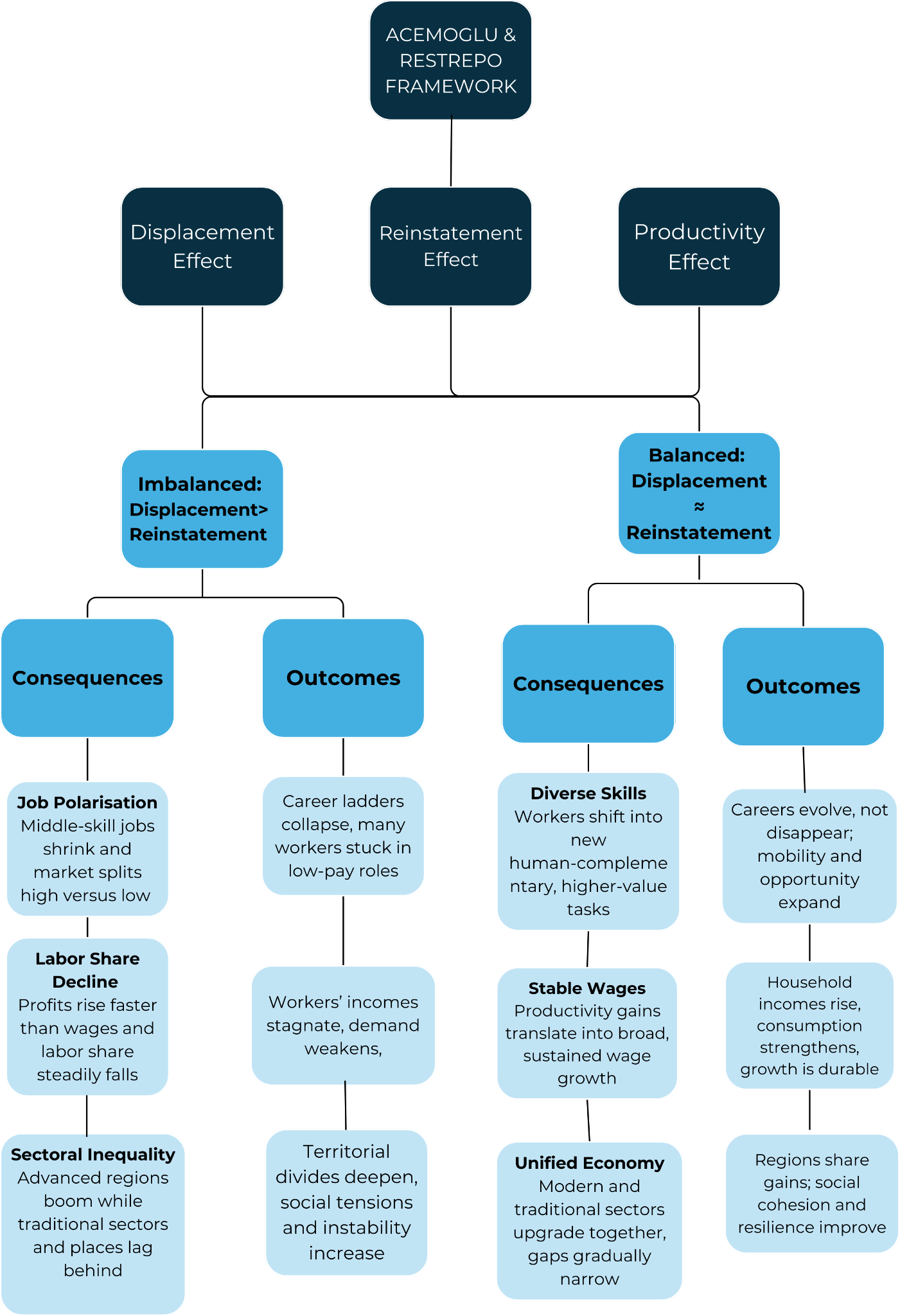
The most-quoted figure here is MIT Project NANDA’s finding that roughly 95 percent of enterprise generative AI pilots showed no measurable profit-and-loss impact. Treat it as directional, not as a measurement: the report calls itself preliminary, rests on 52 interviews and 153 conference survey responses, and has been criticised for a narrow success definition and for withholding its data. The direction is not in dispute: firms are spending heavily and struggling to show a return. This failure is less about AI model quality and more about a “learning gap.” AI tools often do not adapt to specific company workflows or learn contextually, which hinders their effectiveness. Companies tend to invest heavily in marketing and sales automation but neglect critical operational areas that could yield better outcomes.
A term called “workslop” describes low-quality AI work that appears good superficially but lacks depth and requires extra effort to fix. This poor integration causes more downstream problems and reduces productivity. As AI systems increasingly generate and refine their own outputs, the problem extends beyond poor-quality code into recursive validation, where systems iterate on outputs without full visibility into how errors are introduced or resolved. The risk of ‘workslop’ has evolved with the rise of Agentic AI, systems designed to execute multi-step workflows autonomously. While LLMs produced poor text, AI Agents can produce ‘autonomous failures,’ where a system incorrectly executes a financial transaction, deletes critical data, or sends erroneous communications to thousands of clients in seconds. When these agents are deployed without rigorous ‘guardrail’ architectures, the recursive validation problem shifts from a quality issue to a catastrophic operational liability. Large firms frequently spread their AI budgets too thin, resulting in fragmented projects with no clear profit or loss impact. In contrast, smaller startups focusing on targeted problems generally achieve better AI success. Experts advise that companies create clear AI leadership and policies, concentrate spending on high-impact areas like back-office automation, and work with specialized AI vendors instead of building everything internally. This learning gap is now manifesting as a systemic macroeconomic concern, often described as the ‘AI Capex Bubble.’ Financial analysts, including reports from Goldman Sachs, have highlighted a growing divergence between the massive capital expenditure (Capex) on Nvidia chips and data centers and the actual revenue growth seen in the enterprise sector. This suggests that blind adoption is not just a failure of individual projects, but a wider market miscalculation where the cost of the ‘AI entry ticket’ is far exceeding the current productivity gains.
Fear of Missing Out (FOMO) and AI
Many companies adopt AI mainly because of FOMO. They feel pressured to implement AI quickly since their competitors are doing it. This pressure often leads to rushed decisions without fully understanding if their business is ready or if AI suits their needs. Media hype and vendor promotions add to high expectations about AI’s benefits. This creates a rush to adopt AI in hopes of gaining efficiency and profit, even when the actual value might be unclear. As a result, many businesses invest in AI due to competitive pressure and exaggerated claims rather than careful planning.
(Over) Hype around AI use
The rapid adoption of AI by many companies is strongly driven by the hype created by media and vendors. This hype often exaggerates AI’s capabilities and promises significant improvements in productivity and efficiency. As a result, many businesses feel urged to adopt AI quickly, hoping to gain competitive advantages. However, this rush frequently leads to decisions made without fully understanding the risks, costs, or specific needs of their organizations.
For instance, Taco Bell is reviewing its AI drive-through system after a customer accidentally ordered 18,000 cups of water. The incident raised concerns about the technology’s accuracy and reliability. The company said it is testing new ways to improve the system and ensure smoother operations for customers in the future.
Another instance is when McDonald’s decided to remove AI voice ordering from over 100 drive-through locations in the US after many order errors occurred. The company acknowledged the technology was not yet reliable enough for widespread use and is stepping back to improve it.
These decisions highlight the dangers of blind adoption of AI without adequate testing and adjustment in real-world settings. McDonald’s experience shows that while AI can offer benefits, it must be carefully implemented to avoid customer dissatisfaction and operational issues.
To avoid these pitfalls, companies should carefully evaluate AI’s true benefits and challenges before implementation. The hype around AI can mislead decision-makers, so a balanced approach grounded in realistic expectations is essential for success. This phenomenon has triggered a new ‘Productivity Paradox.’ While AI has undeniably increased the volume of output, allowing employees to write more emails and generate more code, it has not proportionally increased the value of that output. This has led to an uncontrollable proliferation of ‘AI slop,’ where the sheer volume of AI-generated noise increases the coordination cost for human managers, who must now spend more time filtering through low-quality AI content to find actionable insights.
Over-Excessive Enthusiasm from Board: Jumping the Gun
Senior executives often rush to adopt AI due to pressure from competitors and board demands. This can lead to hasty decisions without clear strategy or understanding of business needs. Many AI projects fail because they are not aligned with company goals. Additionally, boards often lack sufficient AI knowledge, weakening governance. Experts suggest that successful AI adoption requires leaders to understand AI’s capabilities and limits, set clear objectives, and promote teamwork across departments. With strong leadership and proper planning, companies can transform AI investments into real value instead of merely following trends. In practice, effective AI governance increasingly requires cross-functional oversight, model monitoring, and clear accountability structures to manage risks introduced by semi-autonomous systems.
Task-Based Models and the Hidden Costs of AI Automation
Acemoglu and Restrepo Framework
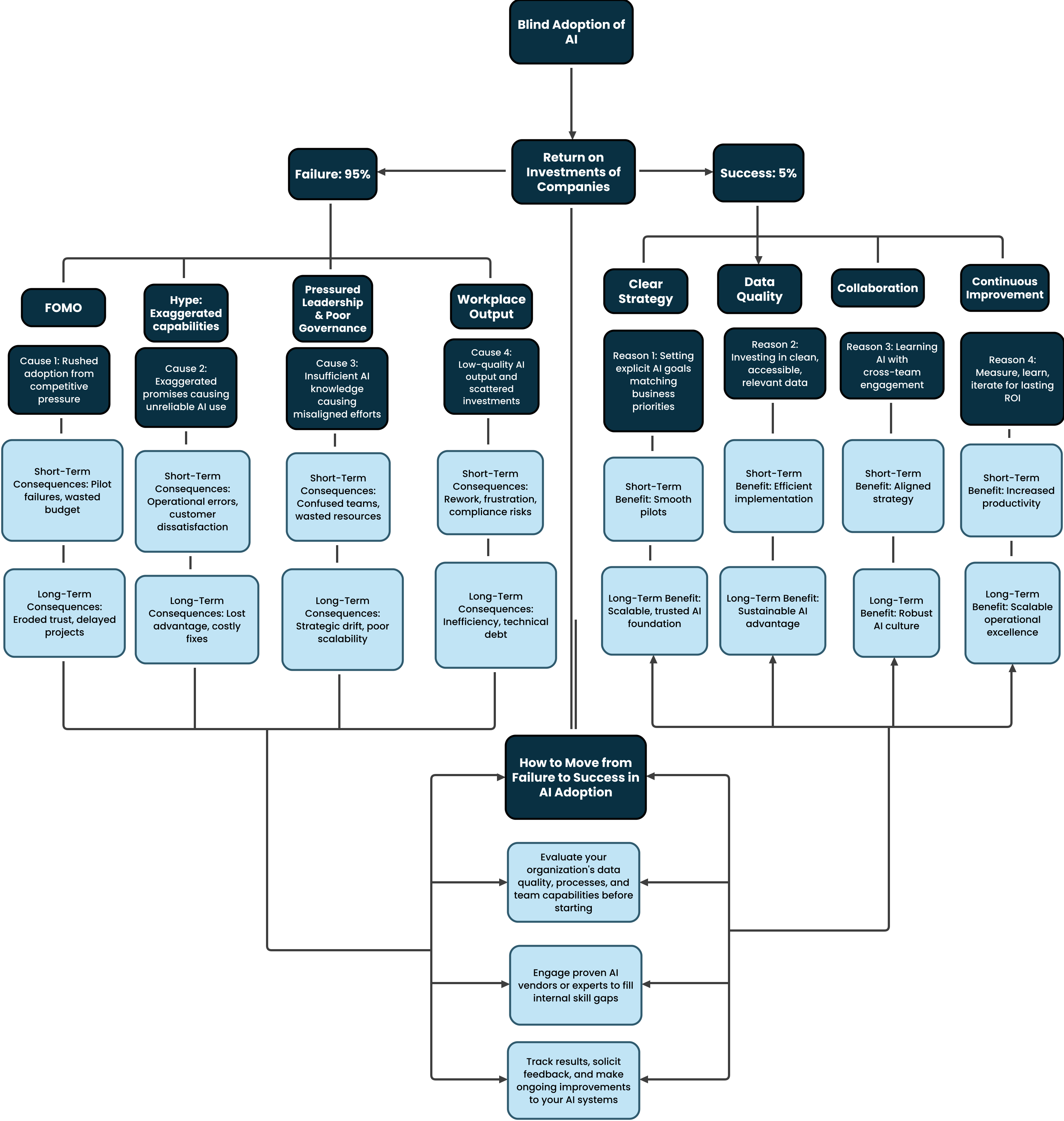
The Acemoglu and Restrepo framework explains how technology affects jobs by dividing work into tasks. Some tasks can be automated, meaning machines take them over, while others require human skills and cannot be automated. When machines do certain tasks, some jobs are lost, but technology also creates new tasks that need people, leading to new job opportunities. This framework helps economists understand how automation changes which jobs exist, how wages shift, and how overall inequality in the economy is affected, by focusing on the balance between tasks done by machines and those done by workers.
There is an increase in short-term job losses because these tasks are the easiest to replace with AI. However, many companies do not invest enough in creating new roles or retraining workers for more complex tasks. As a result, job displacement rises faster than the creation of new opportunities, which can lead to higher unemployment and inequality. The framework highlights that the overall impact on jobs depends on the balance between tasks that are displaced and new tasks that are created through AI. To prevent negative effects, firms should invest in both automation and in helping workers develop new skills and roles that work well alongside automated systems.n
Job Polarization due to Skill Change
Recent studies show that adopting AI tends to favor workers with higher education and skills in science, technology, engineering, and math. This causes fewer jobs for workers without college degrees and lowers their share of employment.
Blindly adopting AI makes this shift happen quickly, leading to sudden job losses in certain regions and industries. Without proper policies in place to protect workers, this can increase unemployment and widen the gap between high and low wages. This process is called skill-biased technological change and contributes to job polarization, where middle-skill jobs decline while high- and low-skill jobs grow. In addition to displacement, roles are being restructured. Workers are increasingly expected to supervise AI systems, interpret outputs, and manage exceptions, shifting skill demand toward oversight and decision-making. Consequently, the labor market is seeing the emergence of the ‘Human-in-the-Loop’ (HITL) mandate. Rather than total displacement, we are seeing a shift where the most valuable employees are no longer those who can generate content, but those who can audit it.
Balanced Investment for Long-Term Productivity
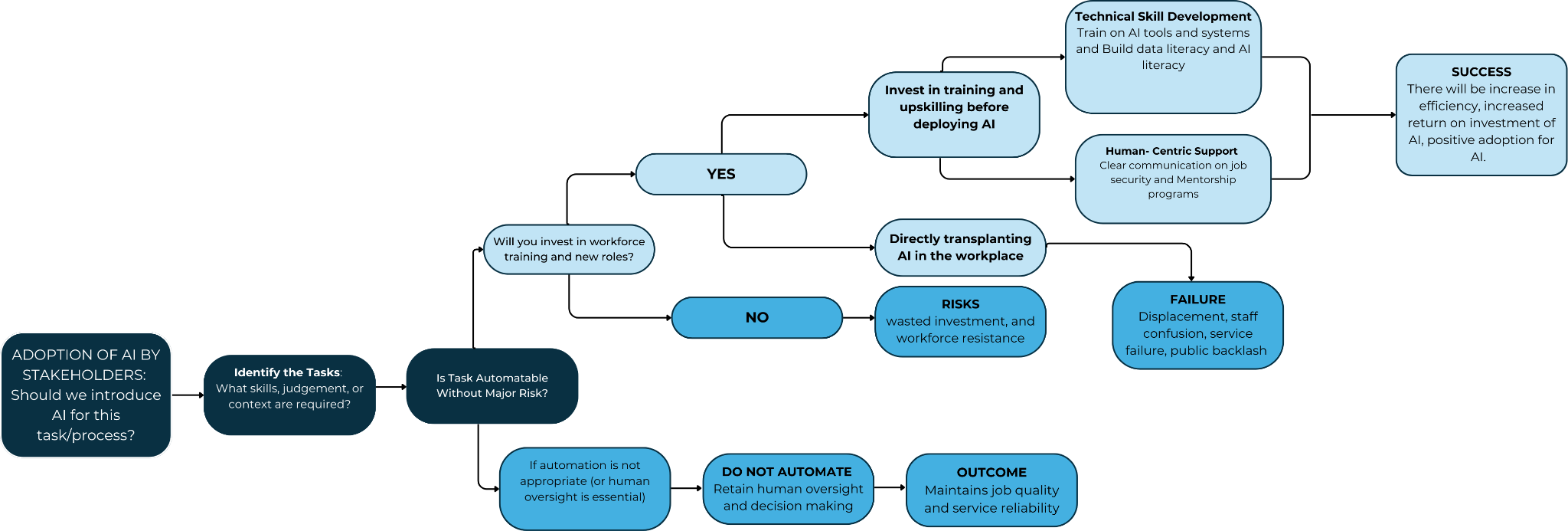
For long-term productivity, firms must invest in both AI technology and their workforce. Focusing only on AI without supporting human capital, such as training and adapting workflows, often leads to projects that fail to deliver real gains.
Research shows that lasting benefits occur when technology investments are matched by efforts to upgrade skills and empower workers. Without this balance, AI can increase costs and disruption without reaching the productivity needed to justify changes. Sustainable growth comes from investing in both AI and people, ensuring productivity gains create real value and new opportunities.
Baumol’s Cost Disease
Baumol’s Cost Disease describes how certain sectors like healthcare and education have slow productivity growth because their work needs human effort that cannot be easily automated. This causes costs to rise as wages increase to keep workers. AI can help by automating some tasks, but it cannot replace all human jobs in these fields. So, blindly adopting AI might reduce some costs but can also make these sectors more expensive overall, needing more funding to keep services effective.
Labor Share of Income Decline
Labor share of income is the part of the economy’s earnings paid to workers. With AI automating many jobs, workers often earn less or lose their jobs, shifting more income to business owners. This reduces the share of income going to labor. Blind AI adoption risks increasing income inequality since owners of AI and machines earn more, while many workers face wage cuts or unemployment, which can hurt overall economic growth by lowering consumer spending.
Dual Economic Theory
Dual Economic Theory explains that economies have two parts: a modern, advanced sector and a traditional, less developed one. AI mostly benefits the modern sector, boosting productivity there. But the traditional sector often remains unchanged or underdeveloped. Blind AI use can increase the gap between these sectors, causing more inequality and social problems if AI benefits are not shared fairly across the whole economy.
Blind AI adoption worsening Return on Investments
AI and (Mis)Governance by Governments
Governments using AI-enabled automation can improve efficiency in public services. For example, AI helps process applications faster, manages resources better, and supports decision-making. Cities like Singapore and Washington, DC, use AI chatbots and smart systems to streamline services and reduce workload.
Poorly managed AI deployments in government can lead to higher operational costs and increased public expenses. Research into AI rollout across NHS hospitals found that the training offered to staff did not adequately address the practical issues the technology introduced, prompting a call for earlier and continuing training on future projects. The technology arrived ahead of the capability to run it, which is the same failure the private sector keeps repeating. Canada offers a sharper case. In March 2026 Immigration, Refugees and Citizenship Canada refused a permanent residence application using a decision letter that cited job duties the applicant had never performed. The department openly acknowledged that generative AI was used in the review. The cost of that failure is not a line item but a procedural one: decisions that have to be re-made, and a process whose reliability is now open to challenge.
These examples suggest that without careful planning and proper objective, failed AI projects can lead to wasted public funds and higher operational expenses.
Financial Losses from Poor AI Decisions: Lessons for Companies
A recent EY survey shows that most companies experience financial losses when deploying AI. These losses arise from risks such as compliance failures, biased outputs, and sustainability setbacks. On average, affected companies lose about $4.4 million, with nearly two-thirds losing more than $1 million. Poor controls and oversight often lead to wasted resources and higher operational costs, highlighting the need for careful planning and governance in AI adoption.
The McDonald’s incident highlights the risks of automated recruitment powered by AI. Poorly secured AI systems exposed the personal data of 64 million job applicants, resulting in significant reputational damage and potential legal costs.
Amazon scrapped an AI recruiting tool after discovering it showed bias against women. The tool downgraded resumes with words like “women’s” and was abandoned due to fairness concerns, highlighting the risks of biased AI in hiring processes.
Beyond software and labor, blind adoption now faces a physical constraint: the Energy Bottleneck. The economic cost of powering massive AI clusters has begun to impact corporate balance sheets, with energy prices rising as power grids struggle to meet demand. Companies that adopted AI without considering the long-term cost of compute and electricity are discovering that their ‘efficiency gains’ are being erased by skyrocketing operational utility costs and the need for expensive cooling infrastructure.
Conclusion
Firms must ensure that AI investments are guided by thorough cost–benefit analyses, considering integration, training, and governance, not just license fees. Pilots should use clear metrics and include human-in-the-loop safeguards to avoid inefficiencies and “workslop.” Workflows must be redesigned to prevent duplication and maximize value. Bonuses and incentives should be linked to actual productivity or quality improvements, not merely to AI spending.
This approach helps firms achieve sustainable returns, minimize wasted resources, and ensure that AI adoption delivers real benefits, supporting long-term growth and efficiency.
About the Author
Ethan Seow is a Centre for AI Leadership Co-Founder and Cybersecurity Expert. He’s ISACA Singapore’s 2023 Infosec Leader, ISC2 2023 APAC Rising Star Professional in Cybersecurity, TEDx and Black Hat Asia speaker, educator, culture hacker and entrepreneur with over 13 years in entrepreneurship, training and education.