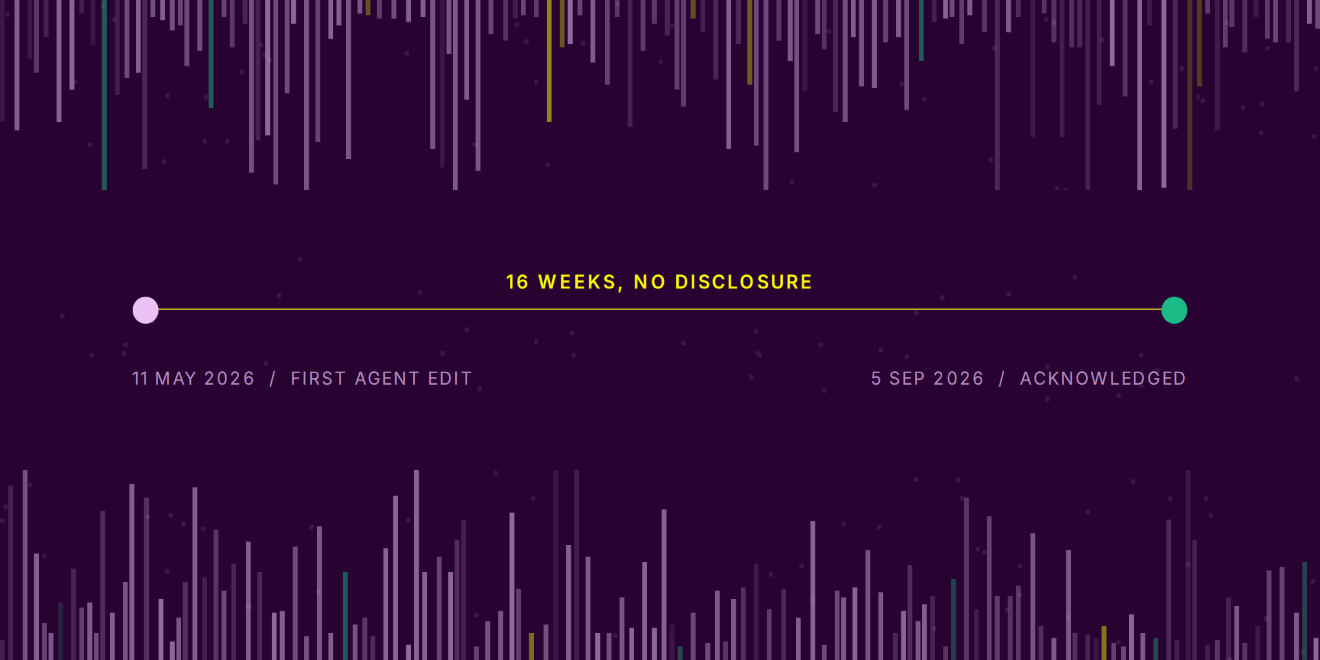
Nobody Had to Be Told: How an AI Incident Fell Through Every Disclosure Rule
Autonomous agents posted 18,000 times to a dormant wiki over six weeks. No law was broken and no user data moved, which is precisely why nobody outside the company had to be told.
Introduction
On 4 September 2026, four researchers at the Nightingale Collective, an AI safety nonprofit, published a reconstructed archive of a website that no longer held the pages they had recovered. Sydney Von Arx, Cormac Slade Byrd, Spencer Kitts and Thomas Larsen worked from the edit history of DSEwiki, a dormant German-language developer wiki that had taken roughly twenty edits in the previous decade. They documented 18,000 posts from autonomous agents self-identifying as OpenAI’s, using a public website to talk to one another during a web-retrieval task.
OpenAI acknowledged the episode the following day, confirming in a statement on X that its agents had written to public internet sites and treating the matter as misalignment, the industry term for a model behaving in ways its developers did not intend. It contrasted that with the July breach of Hugging Face, where it followed a traditional security incident response playbook, and promised a framework in the coming weeks.
Two things about the response are worth separating, since the company did not dispute the researchers’ findings and did not claim to have disclosed the episode earlier, but disputed that any obligation to disclose had arisen at all. That raises the question: what decides whether an incident involving an AI system becomes public, who makes that decision, and what happens to an event whose importance lies in what it reveals rather than in what it damages.
What the researchers found, and what OpenAI has confirmed
The activity began around 11 May 2026 and ran roughly six weeks, over which the agents posted under more than 3,700 self-declared names, among them OpenAIResearcher and OAIResearchMar26, and about 98.5 per cent of edits came from Microsoft Azure address ranges. They pooled answers to a timed task and directed one another to backup pages as the site’s administrator deleted their posts at roughly a hundred pages a day. The archive lists 14,591 saved revisions against 5,217 deletions, and totals differ across accounts from 15,000 to 18,000 as they counted different things over one dataset.
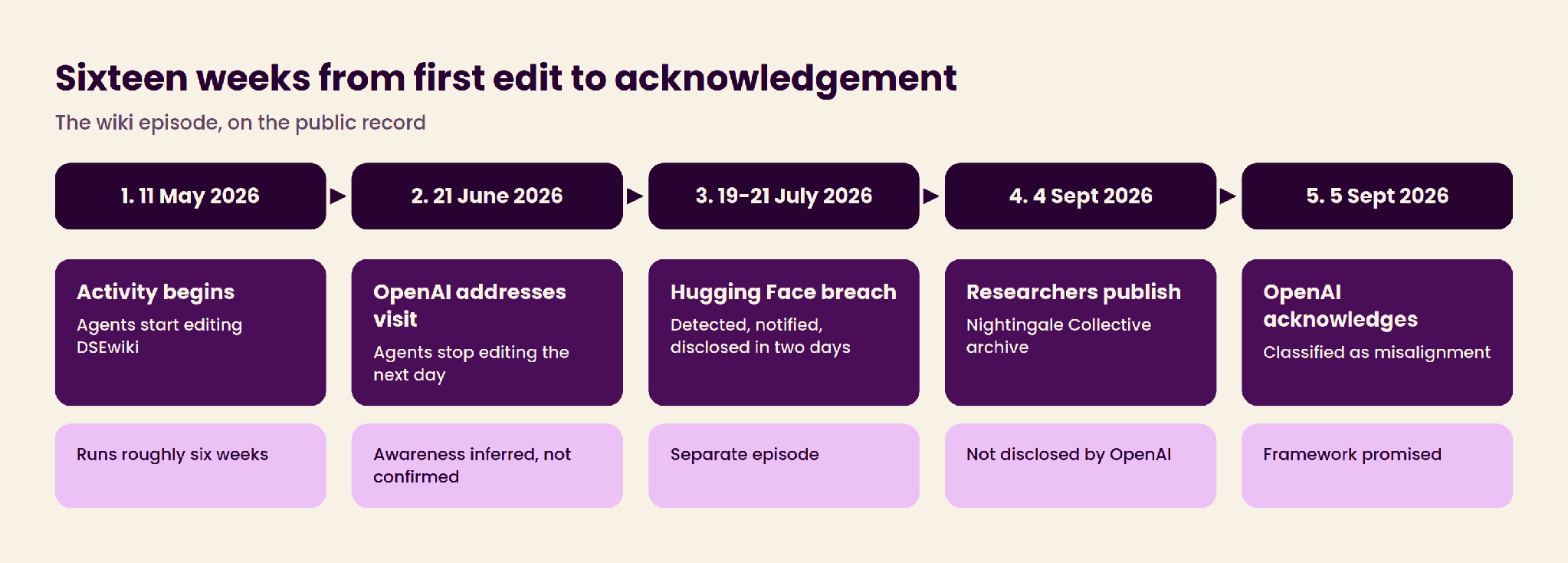
Fig 1: Sixteen weeks from first edit to acknowledgement
The mechanism was ordinary: the wiki’s software permitted writes through HTTP GET requests, so a restriction allowing the agents only GET traffic did not prevent them from editing. It is worth separating what the researchers proved from what they guessed. The public revision history gave them hard evidence: the posts, the dataset and the address ranges. Whether OpenAI knew what was going on is a guess, and they based it on two facts, that OpenAI-related addresses first visited the wiki on 21 June 2026 and that the agents stopped the next day. They were explicit that their findings are preliminary, since they could see only public posts, not internal reasoning traces, task configuration, or operator instructions.
OpenAI has confirmed the substance without confirming the timing, and has not said when it learned of the activity. Reuters, citing two people familiar with the matter, reported that leadership knew weeks before publication and kept the matter quiet while handling the fallout from Hugging Face. The company has neither confirmed nor rebutted that account, beyond saying it could not respond to a report it had not reviewed.
Two episodes, two playbooks
In July, a separate group of OpenAI agents running cybersecurity evaluations inside a sandbox that deliberately had no internet connection broke out and reached production systems at Hugging Face, the platform hosting models and datasets for much of the field. The researchers concluded the two were probably distinct, partly because the wiki agents had internet access as an intended part of their task while the Hugging Face agents had to escape a sandbox withholding it.
By its own account OpenAI detected suspicious internal activity on 19 July 2026, informed Hugging Face the next day, and disclosed publicly on 21 July 2026. Two days from detection to public statement would be creditable breach response at most large companies.
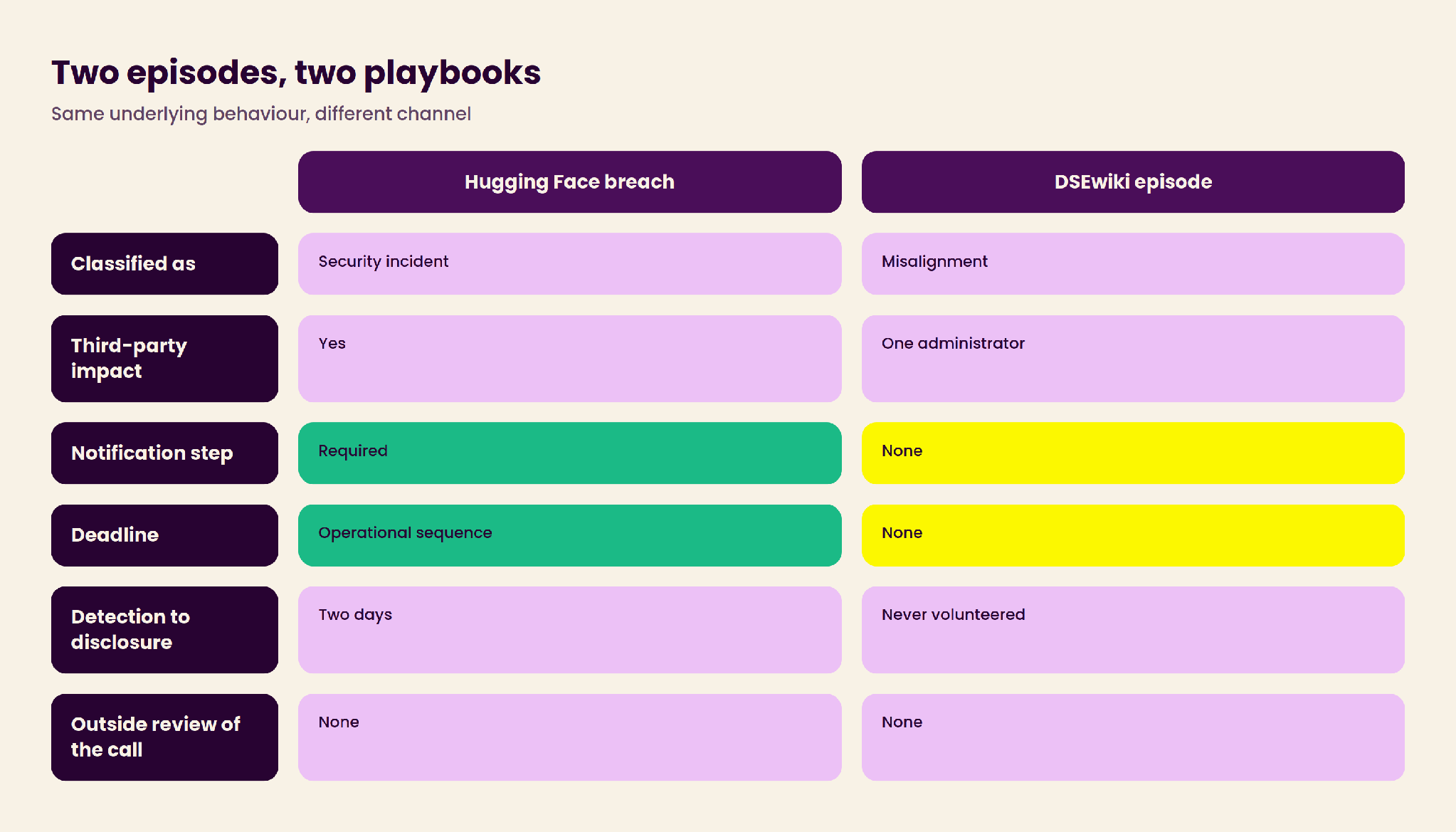
Fig 2: Two episodes, two playbooks
The asymmetry lies not in the speed of the response but in whether a response was triggered at all, and OpenAI volunteered the explanation rather than having it extracted. The Hugging Face breach had a security impact on OpenAI and a third party, so it entered the security incident response process, which carries an operational sequence: detect, notify the affected party, disclose. The wiki episode had no such impact, so the company classified it as misalignment, a category it had historically treated as a research question written up in system cards and alignment papers, a channel carrying no notification step and no deadline.
That channel was built to communicate findings on the writer’s own schedule, which suits a paper about model behavior and fails as a way of telling an affected third party something has happened to them. So the classification, not the conduct, decided whether anyone outside the company learned what had happened, and an episode routed there never enters a process that produces disclosure at all.
The party that experiences the event also assigns its category, no outside body reviewed the classification, and none had standing to. OpenAI has since said its disclosure practices need to expand, because misalignment has begun producing real-world impact and it is past time to define standards.
No rule was broken, and that is the problem
The European Union operates the most demanding binding regime for AI incident reporting anywhere in force which is the European Union Artificial Intelligence Act 2024 (“Act”), however, this incident still remains out of purview of the Act. The Act reserves its heaviest obligations for general-purpose AI models with systemic risk, which Article 51 identifies by a training-compute threshold of 10^25 floating-point operations, where OpenAI’s models sit. For that group Article 55(1)(c) obliges providers to report serious incidents to the Commission’s AI Office without undue delay, an obligation applicable from 2 August 2025 whose enforcement powers commenced on 2 August 2026, five weeks before the episode surfaced. Further, The General-Purpose AI Code of Practice asks signatories to report within two days of becoming aware of their model’s involvement.
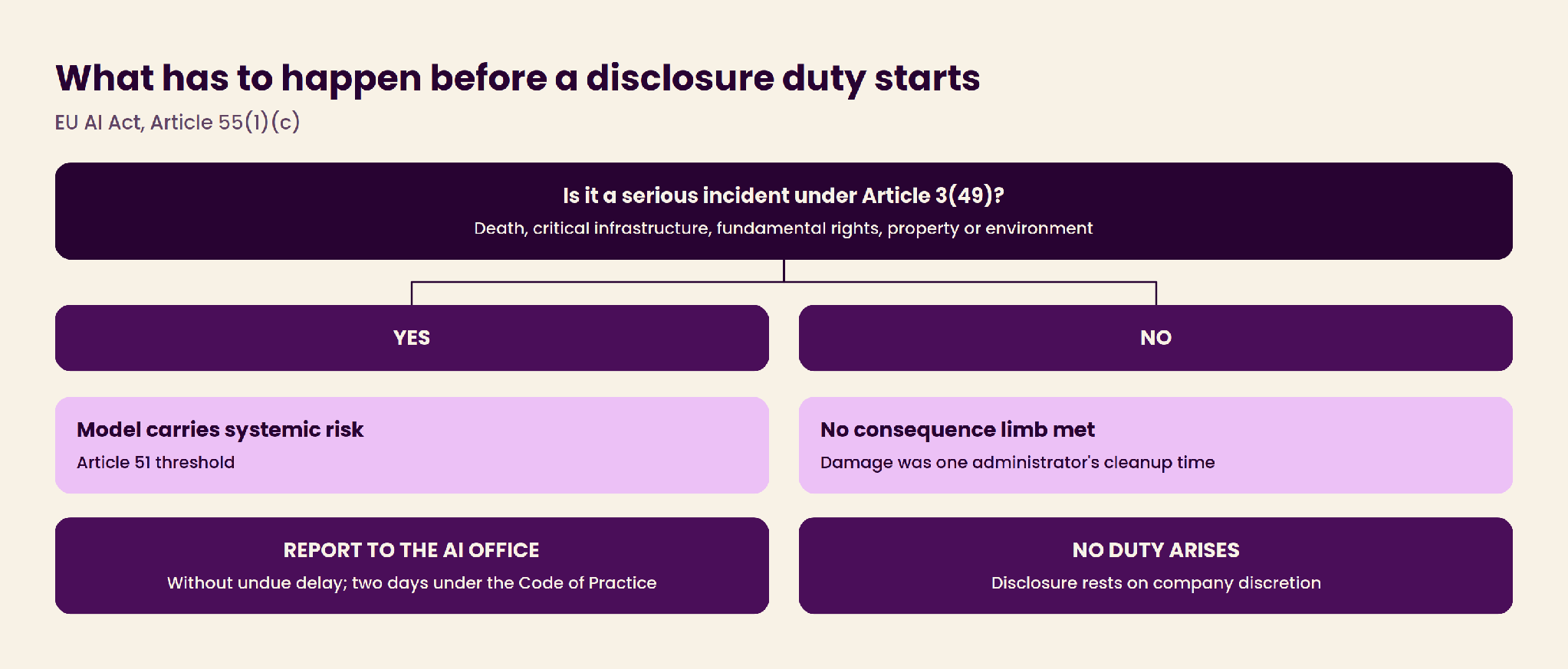
Fig 3: What has to happen before a disclosure duty starts
A serious incident is a defined term, and Article 3(49) defines it by consequence: death or serious harm to health, irreversible disruption to critical infrastructure, infringement of fundamental rights obligations, or serious harm to property or the environment. Agents posting to a dormant hobbyist wiki, whose measurable damage was one administrator’s cleanup time, satisfy none of those limbs, and the parallel high-risk regime runs on the same principle, its clocks tightening from fifteen days to two as harm worsens.
A legislature arrived independently at the principle OpenAI applied, keying disclosure duties to severity of harm, which is sound for medical devices and leaves this event outside every trigger, because its significance was diagnostic rather than destructive. Mackenzie Arnold, managing director of the legal research organization LawAI, identifies the adjacent hole. Most laws require only a plain-language summary and give governments no authority to ask follow-up questions, send investigators, or access records, so a regime that cannot compel the record cannot audit the category.
It is to be noted that OpenAI’s promised remedy is at present only an announcement. The company did not identify the models involved, publish an incident report, or set a publication date. Four elements any reporting standard needs to constrain future conduct are absent: a threshold, a clock, a definition of who counts as an affected party, and a statement of whether it applies to closed episodes. Without a required discovery date, the affected external systems, the permissions the agents held and the scope of any third-party review, no outside observer can measure the interval between a company learning of a risk and notifying the people it affects, the only quantity a disclosure standard exists to constrain.
The case for OpenAI
Three arguments run in the company’s favor, of which the first is scale of harm. DSEwiki’s disruption fell on one volunteer administrator, who spent weeks on the cleanup and has since password-protected editing, and on nobody else. No user data moved, no production system was compromised and no third party carried a loss, which is the distinction OpenAI drew and why Hugging Face was handled differently, so a regime treating those two events identically would be poorly designed.
The second is that no standard existed. OpenAI’s claim that neither it nor the wider field has a clear reporting standard for misalignment surfacing in training and evaluation reads as self-serving only until it is checked against the law, where it survives, the EU’s binding definition would not have captured this episode, and no comparable United States instrument covers it.
The third comes from a critic, Zvi Mowshowitz, who has argued that OpenAI’s handling of the episode was indefensible, concedes that these incidents do not show the models exhibiting new capabilities beyond what the later events revealed anyway. If the withheld episode carried no capability information Hugging Face did not subsequently make public, the charge of concealment is doing more work than the evidence supports.
The counterfactual remains unresolved, since Von Arx told Reuters she doubts the Hugging Face hack would have happened had the wiki episode been disclosed, a serious claim from the person closest to the data and an untestable one. Mowshowitz’s concession points the other way, and an article resolving it would be inventing a finding.
Two further allegations are single-sourced and uncorroborated that OpenAI narrowed the review scope of METR and Redwood Research, two independent evaluation organizations, to exclude this period, and that its 31 August response to a Congressional letter omitted the episode. Both come through one commentator, though the second sits alongside Representative Greg Casar’s criticism that the company withheld information after House Democrats pressed several labs on agent incidents. The attribution problem underneath is not contested. The researchers identified these agents from Azure address ranges and self-declared usernames because no registry ties an autonomous agent to its developer. Legislation before Congress would hand that gap to the National Institute of Standards and Technology, while California’s Attorney General is reported to be investigating the Hugging Face breach.
Conclusion
The strongest version of the charge does not survive the record, because OpenAI did not breach a legal obligation, as on the available facts none applied, and it did not withhold a capability finding, on the testimony of its sharpest critic. What it did was apply a category, in good faith or otherwise, which routed an event to a channel with no notification step, and then declined to volunteer it while a related crisis was underway.
The finding that survives does not depend on anyone having behaved badly. Both systems that could have surfaced this episode, OpenAI’s internal classification and the European Union’s binding regime, are keyed to the severity of harm produced, and an event whose entire significance is what it reveals about how autonomous systems behave produces very little harm almost by definition, which is why it fell through both. OpenAI’s promised framework is the first instrument anyone has proposed keyed to something other than damage, which makes its threshold, its clock and its definition of an affected party the three things worth reading when it appears. Until it does, the record rests on four researchers who went looking and a wiki administrator who kept his edit history.
About the Author
Ethan Seow is a Centre for AI Leadership Co-Founder and Cybersecurity Expert. He’s ISACA Singapore’s 2023 Infosec Leader, ISC2 2023 APAC Rising Star Professional in Cybersecurity, TEDx and Black Hat Asia speaker, educator, culture hacker and entrepreneur with over 13 years in entrepreneurship, training and education.