The GenAI Paradox, Part 5: Trust, Governance, and What Comes Next
The trust deficit is widening. Regulation is accelerating. And the winners of the next decade won't be the ones with the best models — they'll be the ones who governed the transition without breaking the human systems underneath.
This is Part 5 of a five-part series. Read Part 1: The Great Divide | Part 2: Boardroom Hope vs Operational Reality | Part 3: The Invisible Workforce Crisis | Part 4: Shadow AI and the Singapore Model
Responsible AI and the Trust Deficit
This series has traced a single fault line across four parts: the 5% and the 95% are buying categorically different things. The 95% bought the surface of AI — the fluent output the technology made universally cheap. The 5% invested in the substrate that surface runs on — the organisation’s codified knowledge of how it actually works, and the human judgment accountable for what the system does. The trust deficit is the same fault line seen from the security side. As AI permeates the enterprise, the gap between risk recognition and action is not a compliance footnote — it is the place where the inversion either holds or breaks.
The Implementation Gap
While companies acknowledge Responsible AI risks, there is a persistent gap in taking meaningful action. Standardised Responsible AI evaluations are rare among industrial developers, even as AI-related incidents rise. The gap has a name. Fluent output earns unearned trust — what we call granting it epistemic credit: because the answer reads well, it is waved through without the verification it never earned. The cure is the opposite labour: the human work of knowing — reading what the output means, supplying the missing context, judging whether it is sound. That labour is exactly what the implementation gap leaves undone, and it does not automate away. It is the scarce thing, not the abundant one.
Trust Erosion. Public trust in AI companies is declining, with fewer people believing their data is safe. Concerns regarding fairness, bias, and misinformation are widespread. The MIT Project NANDA report found that trust in AI providers has decreased year-over-year, even as adoption has increased — a divergence that cannot be sustained indefinitely.
There is a deeper reason this matters, and it reframes the whole risk conversation. The same human capacity that makes substrate valuable is also the thing that defends the enterprise. AI is not only the tool you wield to build a moat; it is the weapon adversaries wield against you — phishing drafted in minutes, deepfake voice and video, prompt-injection against your own agents. The verification capacity that catches a fluent-but-wrong AI output is the same capacity that catches the AI-crafted phish; the accountability that cannot be delegated is what owns the breach when it comes. The human remainder is the moat, the shield, and the defence at once. An AI-armed adversary does not weaken the case for human judgment — it makes that judgment matter more.
Regulatory Pressure
Governments are stepping in to fill the void. The EU AI Act — the world’s first comprehensive binding AI law — has set a benchmark that is influencing corporate compliance globally, even where legislative convergence has not followed. South Korea’s AI Basic Act (January 2026) mirrors its risk-based approach. In the US, federal AI-related regulations more than doubled in 2024, rising from 25 to 59, according to the Stanford HAI AI Index.
Compliance is becoming a competitive advantage. Vendors that can guarantee data residency and explainability are winning market share, particularly in regulated industries and in markets like Singapore where the government has made AI governance a national priority.
Future Outlook: 2026 and Beyond
As 2025 concludes, the sentiment among leadership is shifting from “magic” to “mechanics.” The focus for 2026 is on engineering rigour, proven ROI, and workflow reconstruction.
The “Put Up or Shut Up” Era
Predictions from IMD, Forrester, and SAS converge on a reckoning for AI budgets. Initiatives that cannot demonstrate tangible P&L impact will be defunded. The GenAI Divide will widen, with laggards retreating to basic productivity tools while winners double down on custom, agentic workflows.
The Orchestration Challenge
Forrester’s 2026 predictions describe the CIO role evolving into a “Chief Orchestration Officer” — responsible for governing AI agents, rescuing failed AI projects, and ensuring interoperability across an increasingly fragmented vendor ecosystem. Success will depend on the ability to orchestrate complex multi-agent systems, manage “agent sprawl,” and ensure interoperability via emerging standards like the Model Context Protocol (MCP).
This is the right instinct pointing at the wrong org chart. The role the market is reaching for is not a renamed CIO; it is a Chief AI Officer — the institutional translator accountable for the whole system: that the codified knowledge is built right, that the humans who govern it are developed, and that the line between the two is held. And the role only gets harder, not easier, as agents take over the doing. The reason is a systems fact the agent-sprawl narrative keeps missing: chain ten autonomous steps, each succeeding 85% of the time, and the end-to-end success rate falls below 20%. That is not a model-quality problem; it is an architecture problem. So when the machine does the doing, the scarce human work moves upward — architecting which agent runs with which tools and guardrails, verifying compounding output that is now autonomous and confidently wrong, and owning what an autonomous system did in your name. The orchestration challenge is not a tooling gap. It is the moat relocating up the stack to the people who can govern autonomy and answer for it.
The Human-Centric Pivot
Following high-profile automation failures — Klarna’s reversal being the most prominent — 2026 is likely to see what SAS has termed a “Human-in-the-Loop Renaissance.” The narrative is shifting from “replacement” to “augmentation,” with a premium placed on employees who can manage, audit, and govern AI agents. The value of these professionals lies not in competing with AI on speed but in providing the judgement, context, and accountability that autonomous systems cannot.
It is worth being precise about which humans, because “human-in-the-loop” is too loose to organise a workforce around. The accountable role splits along one axis — what a person is answerable for — into four routes that are peers, not a hierarchy: those who build the AI capability, those who operate it inside a function, those who assure it against risk and regulation, and those who direct its strategy and set the autonomy line. The “0-to-6” mastery scale that gets quoted everywhere is the builder’s route only; managers, governance specialists, and leaders ride their own routes on the minimum viable literacy their accountability demands. What unites all four is a single test — Decision Survivability: can you defend this decision after it fails, in front of the people you answer to? An employee who can survive that question is performing the irreplaceable work. One who merely forwarded the model’s confident answer cannot, and the loop has quietly closed on no one.
This is also the honest answer to the “junior freeze” Part 3 named. The middle tier of every profession was where mastery was built — the supervised rung where juniors did the work badly, under watch, until they could do it well. AI lets organisations skip that rung because the output looks finished without it. Skipping it looks efficient and breaks expert renewal a few years downstream, when there is no one left who climbed the ladder. The squeezed middle is not a casualty of AI to be mourned; it is the rung that has to be deliberately rebuilt.
Conclusion
The state of AI in 2025 is defined by a painful but necessary maturation. The initial euphoria has collided with the hard realities of enterprise integration, data governance, and human psychology.
For leadership, the path forward requires a fundamental strategic pivot:
-
Abandon “Wrappers.” Stop investing in generic tools that offer no competitive moat. The wrapper is the surface AI made free; it cannot be a moat for anyone because everyone can buy the same one. Invest instead in the Institutional Vault — your own codified knowledge of how the business actually operates, the asset rivals cannot crack. The Vault holds what is precious, and it runs the rules you have codified; it never judges the calls you have not. It can decide. It must never judge. That line is the whole difference between an asset and a liability.
-
Bridge the Divide. Acknowledge the GenAI Divide and cross it by focusing on learning systems that improve over time — not static chatbots that impress in demos and disappoint in production. A living Vault compounds; a static wrapper rots.
-
Heal the Workforce. Address the invisible burnout of middle management and the “junior freeze” by rebuilding the supervised middle rung that mastery is forged on — not by redesigning org charts, but by defining, route by route, what humans are accountable for: who builds, who operates, who assures, who directs.
-
Govern the Shadows. Treat Shadow AI not as a compliance violation but as a signal of unmet needs. Enable secure usage rather than relying on failed bans — bringing it into the light is itself a Vault-building act, surfacing the real workflows your codified knowledge should capture.
Stand far enough back and these four pivots are one move. For two centuries, economic value flowed to whatever could be made explicit, codified, and scaled, and the human was valued only as a scarce input to that machine. Generative AI drives that logic to its limit and exhausts it: when the explicit is universally cheap, the only scarcity left is the irreducibly human — the judgment, the accountability, the embodied knowledge that does not codify. The moat inverts. The 95% are still investing on the wrong side of that inversion, in the surface the technology just made free. The 5% — knowingly or not — are investing on the right side: the Vault, and the human Brain that governs it.
But the inversion is not self-sustaining. The same cheap codification that lets you finally build the Vault also tempts you to stop developing the people, because why pay to grow capability that walks out the door? That is the trap. A codified institution with no one left who can tell when it has drifted from reality is not a moat — it is corporate amnesia at scale. The human remainder is a frontier that opens as fast as it is worked, which means it has to be worked: forged, deliberately, by people doing consequential work under supervision. The guild once fused educating its apprentices with preserving its craft into a single act. The market is about to pull those apart at the exact moment AI makes it possible. The work of the next decade is to fuse them back — to build the Vault and the Brains that govern it, and never let the Vault decide what only a human can answer for.
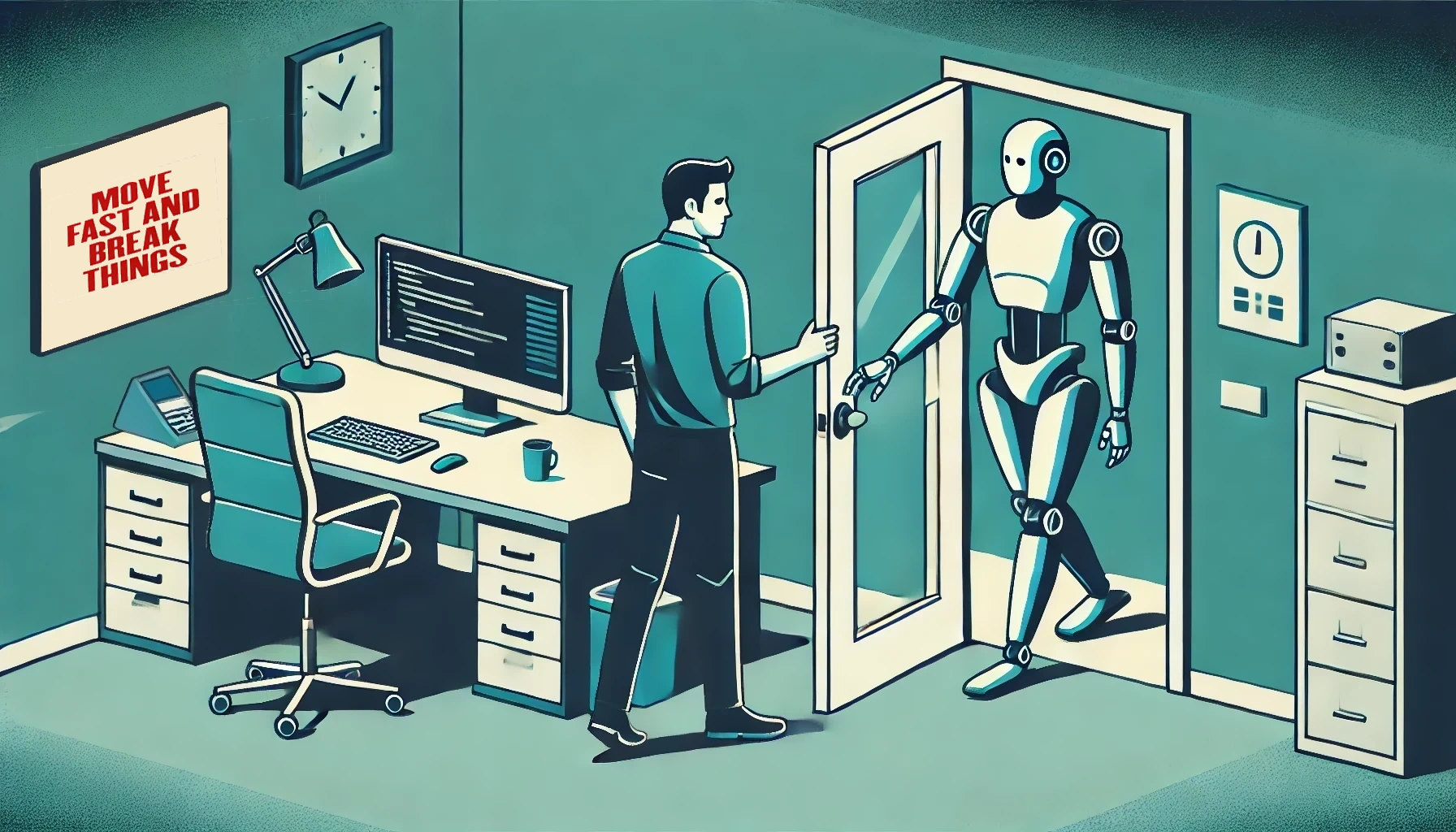
2025 was the year the “magic” faded, replaced by the complex, messy work of building a truly intelligence-driven enterprise. The winners of the next decade will be those who can navigate this transition without breaking the human systems that underpin their success.
That is the work Sovereign Command was written for.
About the Author
Ethan Seow is a Centre for AI Leadership Co-Founder and Cybersecurity Expert. He is ISACA Singapore’s 2023 Infosec Leader, ISC2 2023 APAC Rising Star Professional in Cybersecurity, TEDx and Black Hat Asia speaker, educator, culture hacker and entrepreneur with over 13 years in entrepreneurship, training and education.
This concludes the five-part GenAI Paradox series. Start from Part 1: The Great Divide.